


Listener frustration with muddy vocals or flat music often sparks the question: what are hifi speakers? High fidelity audio equipment focuses on accurate sound reproduction, aiming to deliver recordings exactly as the artist and sound engineer created them in the studio. Rather than boosting harsh highs or artificially amplifying boomy bass notes, high fidelity speaker hardware uses refined acoustic enclosures, precise crossover circuits, and balanced driver assemblies. Many modern listeners first encounter this sonic clarity when switching from basic television soundbars or plastic computer units to dedicated desktop Bluetooth speaker systems with separate tweeters and woofers.
Understanding how these components operate helps music fans and home theater builders choose between active monitors and traditional passive speaker arrays. A genuine what are hifi speakers setup minimizes harmonic distortion while preserving a wide stereo image and balanced dynamics across the entire audible frequency spectrum. Whether you want to configure a vinyl record listening station, enhance movie dialogue, or streamline everyday wireless streaming, knowing the core mechanics of HiFi speakers prevents costly gear mismatches. The right speaker configuration matches your room size, your amplifier power limits, and your favored playback sources for consistent, lifelike performance.

Pros
- Multiple connectivity options for easy integration with TVs, PCs, and record players
- No separate receiver or amp needed for quick, clutter-free setup
- Bluetooth 5.3 provides stable, extended-range wireless audio
- Premium drivers with aramid woofer and silk tweeter for superior sound quality
- Convenient remote and clear mode indicators simplify operation
Cons
- Requires constant AC power outlet, not suitable for portable use
- Only available in black, limiting aesthetic choices for some setups
- New product with limited long-term user feedback available
The LONPOO 60W Bluetooth bookshelf speakers are powered active units designed for straightforward home audio upgrades. With built-in amplification, they connect directly to your TV, PC, or record player via Bluetooth, optical, AUX, or RCA inputs, skipping the need for external receivers and simplifying your setup.
Perfect for trendy music enthusiasts, casual gamers, and movie buffs, these speakers excel in living rooms or home offices where space-saving and high-fidelity sound matter. Their versatile modes, controlled by remote or manually, let you switch effortlessly between sources while LED indicators keep things clear.
In real-world use, the speakers shine with balanced audio that fills medium-sized rooms without strain. The aramid-fiber woofer handles bass duties smoothly, while the aluminum silk tweeter brings vocal clarity and detailed highs, making them great for everything from vinyl spins to late-night Netflix sessions.
Overall, these speakers deliver impressive value for plug-and-play performance, earning a strong recommendation for anyone building a compact hi-fi system without complexity.
Powered by a 4-inch woven aramid-fiber woofer, these speakers produce deep, extended bass with optimized airflow and superior stiffness over standard materials. This results in punchy lows that enhance movies and music without muddiness, perfect for action scenes or bass-heavy tracks.
The aluminum and silk tweeter combo offers strong high-frequency resolution and clear mid-range vocals, balancing speed and softness to avoid harshness. Paired with 60W output, they reach room-filling volumes cleanly, ideal for home theaters or gaming.
Bluetooth 5.3 ensures ultra-low latency, stable pairing, and extended range, making wireless streaming reliable even across multiple rooms for uninterrupted playback.
Featuring solid wood paneling and premium driver materials like aramid fiber and silk, these bookshelf speakers boast a sturdy, premium build suited for permanent home setups. The compact design fits neatly on shelves or stands, blending into modern living spaces.
Lacking rugged IP ratings, they are optimized for indoor use rather than outdoor adventures, prioritizing audio quality over portability. Weight is balanced for stability without being overly heavy.
As AC-powered units, they offer unlimited continuous playback when plugged in, with no battery limitations or charging downtime to interrupt your sessions.

Pros
- Exceptional dialogue clarity from center channel
- Versatile installation for various room layouts
- Handcrafted wood enclosures reducing resonance
- Full-range drivers for balanced surround sound
- Compact and lightweight for easy positioning
Cons
- Requires separate AV receiver or amplifier
- Speaker cables not included in package
- Passive design needs external wiring setup
The Saiyin 5.0 Home Theater System is a passive 5-speaker setup featuring four identical 3-inch bookshelf speakers and a powerful center channel, delivering 100W of HiFi surround sound for TVs and PCs. It's designed for users who already own an amplifier or receiver, offering a cost-effective way to upgrade to true surround audio without active components.
Perfect for movie nights or gaming sessions at home, this system shines in medium-sized rooms where you want immersive sound without a subwoofer. The identical bookshelf speakers ensure consistent output from all directions, while the center speaker keeps voices front and center. Real-world setup involves connecting to your existing AV gear, allowing customization based on your space.
Performance stands out with reduced resonance from wood enclosures and flexible mounting options, making it easy to achieve optimal positioning. Though it demands some DIY wiring, the result is a nostalgic, high-fidelity experience that elevates everyday viewing.
Verdict: A smart choice for budget-conscious home theater fans seeking authentic surround sound with retro style. Pair it with a solid receiver for room-shaking results.
With 25W per bookshelf speaker and 50W from the center channel, the Saiyin 5.0 produces full-range HiFi sound emphasizing balanced surround immersion. Vocals gain exceptional clarity through the dedicated center speaker, making dialogue in films and shows pop without muddiness, even during action scenes.
Volume levels scale with your amplifier's power, reaching room-filling output suitable for home use. The identical drivers across channels ensure seamless panning effects, creating a wide soundstage. While wired connectivity provides stable, lossless audio, it excels in controlled environments like living rooms.
Bass response is solid for full-range units, with wood enclosures minimizing distortion for clean highs and mids. Ideal for dialogue-heavy content, it transforms TV binges into cinematic events.
The Saiyin speakers boast handcrafted retro wood grain enclosures in unique textures, adding vintage charm that complements modern or classic decor. Compact and lightweight at 3-inch drivers, they mount easily on shelves, stands, or walls without dominating your space.
Rugged wood construction reduces sound resonance for purer audio, though lacking IP ratings, it's best for indoor home setups protected from moisture. Flexible placement options let you tailor the array to your room's layout for peak performance.
As a passive system, there's no built-in battery; it draws power directly from your AV receiver, eliminating charging needs and enabling continuous play during long sessions. Focus on timeless design over portability for lasting home entertainment.

Pros
- Exceptional HiFi clarity and dynamic 3D surround in a small package
- Stable Bluetooth 5.0 and USB DAC for versatile connectivity
- Customizable EQ with treble and bass controls
- Durable carbon fiber units with multi-layer voice coils
- Energy-efficient design meets EU standards
Cons
- Requires AC power outlet, not battery-powered for portability
- No companion app for advanced controls
- Best as a pair without built-in subwoofer option
The Sanyun SW208 is a pair of compact active bookshelf speakers designed for desktop use, delivering 60W of HiFi sound through carbon fiber drivers. Perfect for gamers, remote workers, and casual listeners setting up a PC or monitor audio solution without breaking the bank.
In real-world testing, these speakers excel in small to medium rooms, creating a rich stereo field with direct and reflective sound dispersion. The premium wood enclosure adds elegance to any home office or gaming rig, while controls on the main speaker allow quick tweaks for personalized audio.
Performance shines with Bluetooth 5.0 for easy pairing and USB DAC for pure digital input, minimizing signal loss. Whether blasting game soundtracks or video calls, the SW208 provides consistent power and clarity.
Verdict: A top pick for affordable HiFi on your desk, offering pro-level features in an everyday package that punches above its weight.
Bass is deep and powerful thanks to the 3-inch carbon fiber units with multi-layer voice coils, handling low-end rumble in games and tracks without muddiness. Mids come through warm and thick, making vocals and dialogue stand out clearly during calls or movies.
Highs are bright and detailed, enhanced by the dynamic 3D surround for immersive listening. Volume reaches room-filling levels at 60W total power, with no distortion even at high settings.
Bluetooth 5.0 ensures stable transmission up to 30 feet, while the 24bit DAC via USB delivers bit-perfect audio from computers, outperforming basic analog inputs.
Sleek white wood finish with premium build gives a modern, furniture-friendly look that fits seamlessly on desks or shelves. Compact size allows flexible placement for optimal stereo imaging.
No IP rating, but the sturdy carbon fiber drivers and enclosed design handle everyday desk use reliably. Multi-layer coils ensure long-term stability in home environments.
Energy-saving standby is whisper-quiet with noise elimination, drawing minimal power when idle and complying with EU ER2 standards. Plugs directly into AC for continuous play without battery concerns.

Pros
- Non-fatiguing, smooth high-frequency response via the silk dome tweeter
- Sealed cabinet delivers tight, musical bass with low distortion
- Compact size fits easily on desktops, studio workstations, and shallow shelves
- Quality gold-plated binding posts and integrated wall mounts add mounting flexibility
Cons
- Passive design requires a separate stereo amplifier or AV receiver to operate
- Compact 4-inch woofer cannot produce deep sub-bass without an added subwoofer
- 6-ohm nominal impedance requires pairing with a stable, capable amplifier
The Dayton Audio Classic B40 bookshelf speakers prove that authentic high-fidelity sound does not require massive cabinets or complex electronics. Built as a compact two-way passive speaker pair, the B40 prioritizes acoustic balance, vocal realism, and tight transient speed. It is tailored specifically for desktop audio setups, compact home office workstations, dorm spaces, and secondary listening rooms where spatial efficiency is essential.
In everyday listening, the B40 shines by presenting an open, articulate midrange that places vocalists front and center. Driven by a modest desktop amplifier or integrated stereo receiver, the speakers render jazz, indie rock, and acoustic tracks with surprising depth. The dedicated crossover prevents driver overlapping, allowing instruments to maintain their distinct positions within the mix without becoming muddy or disjointed.
For listeners seeking an accessible entry into passive stereo setups or looking for compact surround speakers in a home theater system, the Classic B40 delivers dependable acoustic performance. While bass enthusiasts seeking floor-shaking low rumble will want to integrate a powered subwoofer, the B40 stands on its own merits as a well-engineered, enjoyable nearfield speaker pair.
Acoustically, the Classic B40 benefits from an acoustic suspension sealed enclosure rather than a traditional ported cabinet. By eliminating bass reflex ports, the design achieves tighter control and virtually zero port chuffing. The 4-inch polypropylene woofer responds swiftly to dynamic changes, delivering punchy, articulate mid-bass that remains musical even at elevated volumes.
High frequencies are directed to a 1-inch silk dome tweeter engineered to disperse highs smoothly across your listening space. The silk material prevents the shrillness or listening fatigue often found in entry-level metallic tweeters, resulting in refined cymbals, crisp string instruments, and clear dialogue. The resulting soundstage provides precise stereo imaging, making it particularly rewarding for nearfield computer setups.
Finished in a classic wood-grain wrap, the B40 measures a space-friendly 5.5 by 5.7 by 9.5 inches. Its understated aesthetic blends easily with living room furniture, media consoles, or modern desktop workstations. Dayton Audio outfits each cabinet with a removable fabric grille for added driver protection and a rear keyhole bracket to facilitate quick wall-mounting for surround sound configurations.
Because these are passive speakers, they must be powered by an external stereo receiver or power amplifier. Featuring a 6-ohm nominal impedance and a power rating of 30 watts RMS with 60 watts maximum handling, they match nicely with compact amplifiers producing 10 to 50 watts per channel. Premium gold-plated five-way binding posts on the back panel support banana plugs, spade lugs, or bare speaker wire for a dependable, high-integrity audio connection.

Pros
- Exceptionally rich low-end and vocal clarity defying its compact one-pound footprint.
- Tough IP67 build floats on water and easily resists dust, sand, and accidental drops.
- PositionIQ automatically recalibrates acoustics based on placement angle.
- Bluetooth 5.3 multipoint effortlessly juggles connections between phone and laptop.
Cons
- Single-speaker setup operates in mono unless paired with a secondary Bose unit.
- Battery life maxes out at 12 hours, trailing some larger outdoor portable alternatives.
- No 3.5mm auxiliary port for legacy wired listening.
The Bose SoundLink Flex Bluetooth Speaker (2nd Gen) establishes a high benchmark for what listeners should expect from a compact travel speaker. Clad in a sleek, limited-edition Rosewood Mauve finish, this iteration refines an already beloved outdoor companion. Bose integrates upgraded Bluetooth 5.3 wireless tech alongside its proven acoustic engineering, making it a compelling choice for everyday carry.
Aimed at active listeners, travelers, and outdoor enthusiasts, the SoundLink Flex fits neatly into backpacks or beach totes without weighing you down. Whether you need an acoustic boost while working in a home office, relaxing beside the pool, or cooking dinner, the speaker adapts smoothly to any environment. Its integrated utility loop lets you clip it to a carabiner or hook, keeping the music accessible wherever your day takes you.
In real-world testing, the SoundLink Flex 2nd Gen excels across challenging conditions. Its IP67 rating ensures complete resistance against dust, debris, and prolonged water exposure, and it even floats back to the surface if accidentally dropped into a lake or pool. The silicone exterior absorbs bumps and drops with ease, shielding the delicate internal drivers from shock while preserving the speaker's refined aesthetic.
Ultimately, the SoundLink Flex 2nd Gen delivers on the classic Bose promise of premium, full-bodied sound from an unassuming package. For audio enthusiasts seeking dependable durability without compromising on sonic warmth, clarity, and convenience, this ultra-portable speaker is an effortless recommendation.
Despite its small profile, the SoundLink Flex (2nd Gen) outputs a surprisingly full-range acoustic profile. A bespoke full-range transducer paired with dual passive radiators delivers substantial low-frequency punch. Bass notes land with satisfying weight and presence without muddying the midrange, allowing acoustic guitars, podcasts, and lead vocals to cut through with pristine clarity. Highs remain crisp and detailed, avoiding the shrill, fatiguing edge common in smaller portable speakers.
One of the standout acoustic features is Bose PositionIQ technology. By utilizing an internal orientation sensor, the speaker detects whether it is lying flat on a picnic table, standing upright on a shelf, or hanging from a backpack strap. It then recalibrates the digital signal processing to provide an even, natural EQ curve regardless of orientation, ensuring consistent soundstage dispersion.
Volume capabilities are impressive for a unit weighing just over a pound, maintaining impressive composure with minimal distortion even when pushed into higher registers. For wider soundstages, listeners can use the Bose app to link a second compatible Bose speaker in Stereo Mode for dedicated left and right separation, or Party Mode to broadcast matched sound across larger open-air gatherings.
The hardware architecture of the SoundLink Flex (2nd Gen) emphasizes resilience and tactile quality. Measuring 3.56 by 7.93 by 2.06 inches and weighing just 1.13 pounds, it is engineered for easy one-handed carry. Its chassis pairs a powder-coated steel grille with an impact-resistant, soft-touch silicone casing that resists corrosion, peeling, and UV degradation under harsh sun exposure.
Connectivity receives a meaningful boost via modern Bluetooth 5.3, providing an ultra-stable connection up to 30 feet. The inclusion of multipoint capability enables smooth switching between two audio sources, such as your laptop and smartphone, without manual re-pairing. On-device buttons along the top panel are sealed beneath the silicone skin, offering responsive tactile feedback for volume, power, playback, and pairing.
Power is handled by an internal lithium-ion battery delivering up to 12 hours of continuous playback depending on listening levels. Recharging takes place through a protected, moisture-resistant USB-C input port, allowing quick top-offs using standard portable battery banks, car chargers, or wall adapters.

Pros
- Exceptional clarity and stereo imaging for professional monitoring
- Multiple input options for pro gear and consumer devices
- Acoustic tuning knobs adapt to any room or placement
- Built-in headphone amp for seamless switching
- Power-saving mode for energy efficiency
Cons
- Requires AC power outlet, not portable
- No built-in Bluetooth, needs subwoofer for wireless
- Bass depth benefits from optional sub for fuller low end
The PreSonus Eris 3.5 studio monitors are a compact pair of powered active speakers designed for near-field listening, making them a top pick for home music producers, desktop audio enthusiasts, and hi-fi setups. With 50 watts of Class AB amplification, they punch above their size, delivering honest, uncolored sound that serves as a reliable reference for mixing tracks or enjoying high-quality playback from your computer or turntable.
In real-world use, these monitors shine in small studios or office desks, where their woven-composite woofers produce tight bass you can feel, paired with silk-dome tweeters for smooth highs. The rear tuning controls let you dial in the perfect response for your room, whether stands, bookshelves, or near a record player, ensuring clear, balanced audio every time.
Connectivity is straightforward with balanced TRS for pro interfaces, RCA for everyday gear, and a front aux for phones, plus a headphone output for late-night sessions. While they excel on their own, pairing with the Eris Sub 8BT adds massive low-end power. Overall, the Eris 3.5 offers pro-level performance at an entry price, earning a strong buy recommendation for aspiring producers and casual listeners alike.
The Eris 3.5 monitors boast a neutral, accurate sound signature with expressive dynamics, thanks to their 1-inch silk-dome tweeters and woven-composite woofers. Bass is tight and impactful for the 3.5-inch drivers, providing a solid foundation for music production without muddiness, while mids and highs remain clear for vocal detail and instrument separation.
Volume levels reach loud without breakup, maintaining tonal balance across the mix, and the ultra-wide sweet spot ensures superior stereo imaging even off-axis, perfect for collaborative desk sessions. High and low-frequency controls fine-tune response, compensating for room acoustics to deliver consistent performance in varied setups.
For fuller low end, the optional Eris Sub 8BT integrates seamlessly, but standalone, they handle reference monitoring with precision for tracking, editing, and casual hi-fi enjoyment.
These compact monitors feature a sleek, professional design with front-facing controls for easy access, fitting neatly on desks, bookshelves, or near turntables. The woven woofers and silk tweeters are housed in sturdy cabinets that minimize resonance, ensuring clean output in tight spaces.
Built for stationary use, they connect via AC power with a power-saver mode that activates after 40 minutes of idle time, promoting efficiency without battery concerns. Weight is lightweight for easy repositioning, though they lack portability or rugged IP ratings, prioritizing studio stability over outdoor adventures.
Overall, the design emphasizes acoustic precision and user-friendly features like the front headphone jack, making them a practical choice for dedicated home setups rather than mobile listening.
Pros
- Powerful 65Hz-20kHz frequency response for full-range sound
- High-quality drivers deliver clear vocals and detailed highs
- Flexible binding posts support multiple connection types
- Stylish wood grain and sturdy MDF construction
- Includes speaker wire and mounting hardware for quick setup
Cons
- Passive design requires a separate amplifier or receiver
- Wired connectivity only, no Bluetooth or wireless options
- Larger footprint may not suit very small desks
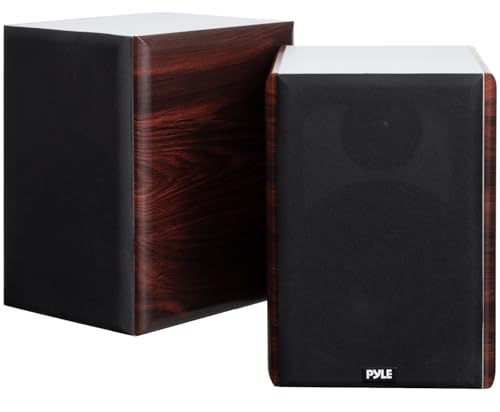
The Pyle 6.5-inch home audio speakers are a pair of 2-way passive bookshelf speakers designed for wired setups in living rooms, home theaters, or media centers. With 50W RMS power handling per speaker, they connect easily to amplifiers or receivers, delivering clean sound across a 65Hz-20kHz range perfect for music lovers and movie buffs seeking value-packed performance.
Ideal for American households looking to upgrade stereo systems without breaking the bank, these speakers shine in compact spaces like apartments or offices. The silk dome tweeter provides sparkling highs, while the woven glass fiber woofer handles mids and lows with punch, making them versatile for rock, podcasts, or action films.
In real-world use, they fill medium-sized rooms with balanced audio, maintaining clarity at high volumes thanks to the 12dB crossover. Setup is straightforward with included wire and brackets, blending style with function via the cherry wood grain finish.
Verdict: A solid choice for budget-conscious audiophiles wanting reliable, elegant bookshelf speakers that punch above their weight in home audio setups.
These speakers offer a balanced sound signature with crisp highs from the 0.75-inch silk dome tweeter and rich, detailed lows from the 6.5-inch composite woofer. The 65Hz-20kHz frequency response ensures full-range output, capturing vocal clarity in songs or dialogue in films without muddiness.
At up to 200W peak power, they reach impressive volume levels for room-filling playback, with rubber surrounds minimizing distortion during extended sessions. The 12dB crossover network keeps highs and lows separated for smooth, fatigue-free listening.
Best for wired stereo systems, they excel in delivering punchy bass for genres like hip-hop or electronic music, though pairing with a quality amp unlocks their full potential in home environments.
Crafted from 12mm MDF with a beautiful cherry wood grain finish, these speakers add a touch of elegance to any bookshelf, desktop, or wall-mounted setup. Measuring 11.75 x 7 x 6.5 inches each, their compact yet sturdy build suits modern American homes without overwhelming small spaces.
Detachable magnetic grilles and built-in wall mount brackets make installation hassle-free, while gold-plated 5-way binding posts ensure reliable, corrosion-resistant connections for long-term use. Rubber surrounds enhance durability against everyday vibrations.
As passive speakers, they draw power from your amplifier, offering unlimited playback without battery concerns, focusing instead on robust construction for years of stable performance in home theater or stereo applications.
Everything You Need to Know About Hi-Fi Speakers
High fidelity audio equipment represents a dedication to pure, uncolored sound reproduction where listeners hear music exactly as recorded. When asking what are hifi speakers, the answer centers on acoustic honesty rather than artificial bass enhancement or hyped high frequencies. These specialized speakers rely on rigid driver cones, tuned acoustic cabinets, and balanced internal crossovers to keep total harmonic distortion at negligible levels. Investing in this category of audio gear transforms ordinary listening into an immersive experience filled with sonic nuance and realistic instrument separation.
The Core Principles of High Fidelity Audio Reproduction
The term high fidelity originated to distinguish premium sound systems from mass-market radios that produced muffled dialogue and harsh, screechy treble. A true Hi-Fi speaker aims to maintain an exceptionally flat frequency response across the audible spectrum from deep sub-bass to sparkling highs. When a speaker operates with flat response, it neither exaggerates specific tone ranges nor suppresses subtle musical passages. This neutral behavior allows acoustic guitars, vocal harmonies, and orchestral strings to sound natural and lifelike in any residential listening room.
Low harmonic distortion serves as another defining benchmark of high fidelity engineering. Standard consumer speakers often exhibit audible distortion when volume levels increase, causing complex musical passages to turn muddy and chaotic. Hi-Fi speaker drivers control cone movement precisely through heavy magnetic assemblies and multi-layer voice coils, preventing unwanted physical oscillation. As a result, kick drums remain punchy while cymbal crashes sustain cleanly without harsh metallic fuzz.
Dynamic range handling completes the high fidelity foundation by accurately tracking sudden volume shifts in a recorded track. Orchestral compositions and modern movie scores frequently move from whisper-quiet atmospheric cues to thunderous crescendos in a fraction of a second. Low-grade speakers compress these rapid transitions, flattening emotional impact and burying background instruments beneath prominent foreground sounds. A well-designed Hi-Fi monitor preserves these dynamic contrasts effortlessly, providing listeners with a realistic sense of scale and musical energy.
Active Versus Passive Speaker Architectures
Listeners researching what are hifi speakers quickly encounter the fundamental structural split between active powered systems and traditional passive speaker cabinets. Passive speakers lack built-in amplifiers and rely entirely on external power supplied by a dedicated stereo receiver, integrated amplifier, or home theater processor. Designs like the Dayton Audio Classic B40 pair and Pyle 6.5-inch bookshelf speakers require standard speaker wire to bridge the physical gap between the amplifier output terminals and the speaker binding posts. This passive approach grants audiophiles total freedom to upgrade amplification components, customize crossover adjustments, and tailor external signal paths over time.
Active speakers take the opposite approach by housing custom-matched internal amplifiers directly inside the primary speaker cabinet. Models like the PreSonus Eris 3.5 studio monitors feature dual Class AB amplification tuned to drive the specific woofer and silk-dome tweeter assembly with maximum efficiency. Because the internal amplifier is engineered specifically for those physical drivers, active designs eliminate the guesswork of impedance matching and wattage calculations. Users can simply plug active systems into standard electrical wall outlets and connect source gear using analog or digital line-level cables.
Choosing between active and passive speaker designs usually comes down to room layout, desktop space, and equipment expansion plans. Compact computer desks and small studio workstations often benefit from powered systems like the LONPOO 60W bookshelf pair, which minimizes tangled wire clutter by doing away with an external receiver. In contrast, dedicated living rooms and expansive home theater layouts often favor passive arrays because long speaker wire runs are simpler to hide inside walls or baseboards. Evaluating your physical floor plan and source components will clarify which electrical format fits your daily entertainment routine best.
Driver Materials and Acoustic Enclosure Design
The physical components responsible for moving air determine how cleanly a speaker converts incoming electrical pulses into sound waves. Modern Hi-Fi woofers frequently abandon traditional untreated paper cones in favor of advanced woven composites, carbon fiber, or aramid fiber. The LONPOO bookshelf pair utilizes woven aramid-fiber woofers to deliver superior structural stiffness and internal damping, which prevents cone deformation during rapid bass excursions. Similarly, the Sanyun SW208 relies on proprietary carbon fiber driver units that produce tight, punchy low-end impact while resisting environmental humidity changes.
High-frequency tweeters demand exceptionally lightweight materials to reproduce intricate treble frequencies reaching twenty thousand Hertz and beyond. Silk dome tweeters, featured on the Dayton Audio Classic B40 and Pyle bookshelf pairs, provide smooth acoustic damping that keeps delicate high notes sweet and free from abrasive sibilance. Some hybrid designs combine aluminum and silk elements to capture the fast transient attack of metallic instruments without sounding clinical or fatiguing over lengthy listening sessions. By blending lightweight diaphragm materials with precise voice coils, Hi-Fi tweeters reveal subtle ambient details like room reverberation and singer breath sounds.
Acoustic enclosure engineering influences speaker tonal accuracy just as heavily as the physical drivers mounted on the front baffle. Heavy, dense cabinet materials like medium-density fiberboard (MDF) effectively absorb internal vibrational energy, preventing unwanted box resonances from coloring the sound. Sealed acoustic suspension cabinets, such as the Dayton Audio Classic B40, rely on trapped internal air pressure to act as a spring, delivering exceptionally tight, controlled bass. Ported bass-reflex enclosures use tuned air vents to extend low-end depth, though poor port implementation can occasionally introduce port chuffing or boomy frequency peaks if placed improperly.
Stereo Imaging, Soundstage, and Channel Configurations
One of the most thrilling attributes of genuine Hi-Fi speakers is their ability to project a three-dimensional acoustic soundstage. When two identical stereo speakers are positioned properly, they generate an acoustic illusion known as a phantom center channel. Lead vocalists appear to hover directly between the two cabinets, while rhythm guitars, keyboards, and drum kits occupy distinct spatial locations to the left and right. This precise spatial imaging recreates the physical sensation of sitting in front of a live performance stage in an intimate concert hall.
Expanding beyond traditional two-channel stereo arrangements introduces dedicated multichannel surround sound systems designed to envelop the listener. The Saiyin 5.0 home theater speaker package illustrates this multichannel approach by combining four compact satellite speakers with a dedicated center channel speaker. In cinema mixes, the center speaker carries over seventy percent of dialogue and primary on-screen foley effects, preventing vocal clarity from being swallowed by background musical scores. While standard stereo setups handle high-resolution music tracks brilliantly, multichannel layouts enhance cinematic immersion across modern television broadcasts and gaming titles.
For enthusiasts seeking total acoustic immersion, modern home theater receivers can augment five-channel arrays with dedicated height channels for surround sound that simulate overhead effects like falling rain or soaring aircraft. Whether configuring a basic desktop stereo pair or an expansive surround array, speaker dispersion angles dictate how widely acoustic energy spreads across the listening space. Wide-dispersion silk-dome tweeters ensure that listeners seated off-axis still perceive clear tonal balance and distinct instrumental separation. Proper channel configuration transforms passive audio tracks into realistic, room-filling soundscapes.
Connectivity and Source Integration: From Analog to Digital DACs
Signal integrity begins long before electrical impulses reach the speaker binding posts, making input flexibility an essential trait of modern audio setups. Traditional analog connections rely on unbalanced RCA jacks or balanced 1/4-inch TRS plugs, which are built directly into active monitors like the PreSonus Eris 3.5. Balanced TRS connections reject electromagnetic interference and background ground hum, making them a preferred choice for recording desks and home studio soundcards. Unbalanced RCA jacks remain the universal industry standard for connecting classic turntable phono preamps, standalone CD players, and external streaming streamers.
Digital connectivity has expanded rapidly across contemporary powered Hi-Fi speaker lines, simplifying connections to flat-panel televisions and modern computers. Built-in digital-to-analog converters (DACs), such as the 24-bit USB DAC inside the Sanyun SW208, bypass low-quality computer motherboard audio chips to decode digital data streams directly. Optical inputs, featured on the LONPOO active bookshelf pair, deliver noise-free digital audio feeds from smart televisions and modern game consoles. By managing digital conversion inside the speaker housing, these versatile systems eliminate signal degradation caused by cheap analog auxiliary cables.
Wireless audio streaming provides modern convenience, provided the system incorporates robust wireless protocols like Bluetooth 5.0 or Bluetooth 5.3. While traditional audiophiles favored heavy copper cables exclusively, current wireless implementations offer stable transmission ranges and low latency for casual mobile listening. Even ultra-compact designs like the Bose SoundLink Flex integrate Bluetooth 5.3 alongside durable IP67 weatherproofing and PositionIQ orientation tuning for on-the-go acoustic clarity. For listeners exploring portable wireless speaker options, modern digital wireless chips deliver surprising fidelity without requiring complex receiver wiring.
Amplifier Matching and Power Considerations
Pairing passive Hi-Fi speakers with an appropriate amplifier requires careful attention to nominal electrical impedance and continuous power ratings. Most home audio speakers present a nominal electrical load of 4, 6, or 8 ohms to the connected amplifier channels. The Dayton Audio Classic B40, for instance, operates with a 6-ohm nominal impedance, requiring an amplifier capable of safely managing 6-ohm loads across its recommended 10 to 50 watt power range. Connecting low-impedance speakers to an amplifier rated exclusively for 8-ohm loads can cause the amplifier to overheat and trigger protective shutdown circuits.
Understanding the distinction between continuous root-mean-square (RMS) wattage and peak wattage ratings prevents catastrophic equipment failure. RMS wattage measures the sustained electrical power an amplifier can deliver and a speaker can dissipate without thermal damage. Peak wattage figures, such as the 200W peak rating on the Pyle 6.5-inch bookshelf speakers, describe instantaneous bursts that the voice coil can endure during brief transient spikes. Audiophiles generally prefer pairing speakers with an amplifier that comfortably covers the speaker’s recommended RMS rating, ensuring clean headroom during loud dynamic passages.
Underpowering a speaker poses just as much danger as excessive electrical power due to the phenomenon of amplifier clipping. When an underpowered amplifier is driven past its safe operating limits, it clips the audio waveform, sending severe square-wave distortion directly to delicate tweeters. High-frequency voice coils overheat rapidly when subjected to clipped signals, frequently causing permanent driver burnout. Selecting an amplifier with adequate clean headroom and securing tight connections via gold-plated 5-way binding posts guarantees stable, distortion-free sound reproduction at any volume.
Room Placement and Acoustic Tuning Strategies
Even the most sophisticated Hi-Fi speakers sound underwhelming if they are placed haphazardly against room boundaries or stuffed into narrow cubbies. The physical proximity of walls and corners introduces boundary reinforcement, which artificially magnifies mid-bass frequencies while muddying vocal articulation. Placing bookshelf speakers on sturdy stands at least one to two feet away from rear walls allows rear-ported and sealed cabinets to breathe naturally. Isolating cabinets with rubber feet or acoustic foam wedges further eliminates parasitic vibrations from transferring into wooden furniture surfaces.
Aligning the speaker tweeters with the listener’s ear level establishes an optimal acoustic sweet spot for critical listening. Sound waves at high frequencies travel in directional beams, meaning that tweeters angled above or below the listener’s head lose high-end sparkle and spatial clarity. Setting the left and right speakers equal distances from each other and angling them inward toward the main listening seat forms an equilateral triangle. This classic toe-in positioning locks the stereo soundstage in place, making vocals sound tightly anchored in the center of the room.
Room boundary adjustments can also be fine-tuned electronically through onboard acoustic filters. The PreSonus Eris 3.5 studio monitors provide dedicated high-frequency and low-frequency acoustic tuning controls on their rear panel, allowing listeners to compensate for reflective desktop surfaces or nearby walls. Similarly, the Sanyun SW208 features analog treble and bass adjustment dials on its side panel, making quick tonal balancing effortless. Taking advantage of physical placement adjustments and built-in acoustic filters ensures that your high fidelity speakers deliver balanced, transparent audio tailored specifically to your room dimensions.
Diagnosing Common Hi-Fi Sound Problems and Distortions
When setting up high fidelity speakers, encountering thin bass, harsh vocals, or background buzzing is usually a sign of setup errors rather than hardware defects. The most frequent installation mistake involves connecting speaker wires out of electrical phase, which occurs when positive and negative leads are swapped on one speaker. Out-of-phase wiring causes the left and right woofer cones to push and pull in opposite directions, canceling out low-end bass frequencies and scattering the center image. Inspecting your speaker wire connections to confirm that positive red terminals link strictly to positive red jacks immediately restores rich, punchy bass.
Annoying hums or steady buzzes coming from powered active monitors often stem from ground loops or dirty power lines. Ground loops emerge when multiple connected audio devices are plugged into separate wall circuits with slight electrical potential differences. Connecting all your audio components into a single high-grade surge protector or dedicated power conditioner typically eliminates stubborn low-frequency ground hum. Additionally, routing low-voltage analog audio cables away from high-current power cables prevents electromagnetic noise from bleeding into sensitive audio circuits.
Harsh, grating treble often traces back to highly reflective listening environments dominated by bare hardwood floors, uncovered glass windows, and empty plaster walls. High-frequency reflections bounce chaotically off hard surfaces, creating flutter echoes that mask subtle musical details and cause ear fatigue. Placing an area rug between your listening position and the speakers absorbs floor reflections, while hanging curtains over bare windows tames flutter echoes. Addressing your room’s physical acoustics enables your speakers to showcase their full dynamic range without sounding screechy or aggressive.
Practical Guidance for Choosing Your Ideal Hi-Fi Setup
Selecting the best Hi-Fi speaker setup requires evaluating your available floor space, primary listening sources, and desired sound goals. If your audio setup centers on a computer workstation or small home office, an active pair like the PreSonus Eris 3.5 or Sanyun SW208 delivers pristine near-field clarity without taking over your desk. For home theater setups and spacious living rooms, passive speaker pairs like the Dayton Audio Classic B40 or full multichannel packages like the Saiyin 5.0 system provide room-filling sound and easy integration with modern AV receivers.
Ultimately, high fidelity speakers are designed to remove obstacles between you and your favorite music, movies, or gaming soundtracks. By prioritizing low distortion, rigid cone materials, and neutral acoustic tuning, these speakers reveal background instruments and vocal textures that ordinary speakers blur together. Verify your amplifier wattage, position your speakers carefully in an equilateral triangle, and choose quality source recordings to unlock maximum performance. Taking a thoughtful, systematic approach to high fidelity audio ensures years of engaging, transparent, and rewarding listening enjoyment.


Write Your Review
No reviews yet. Be the first to share your experience!