


Setting up an audio receiver often brings unexpected surprises when looking at the rear connection panel. Many integrated amplifiers and home theater receivers include dual sets of left and right binding posts, leaving listeners to wonder what is front a and front b speakers and how those outputs work. These labeled outputs allow you to connect two distinct stereo pairs of traditional passive speakers to a single amplifier unit. Whether you want to toggle music between separate rooms or audition different sets of bookshelf models, this feature provides practical flexibility for stereo playback.
Using both terminals correctly requires paying close attention to speaker impedance and amplifier capabilities. Running multiple pairs at the same time cuts electrical resistance, which can strain audio hardware if the system is misconfigured. Understanding how these outputs function helps you avoid amplifier overload, achieve balanced volume, and build an enjoyable sound setup across your living space.
Pros
- Precise independent volume control per speaker pair
- Supports simultaneous or individual zone playback
- Built-in overload protection for reliable performance
- Easy setup with standard amp outputs and speaker wires
- Compact form factor complements home theater aesthetics
Cons
- Wired connections only, no wireless options
- No remote control for zone switching
- Best suited for stationary home setups, not portable
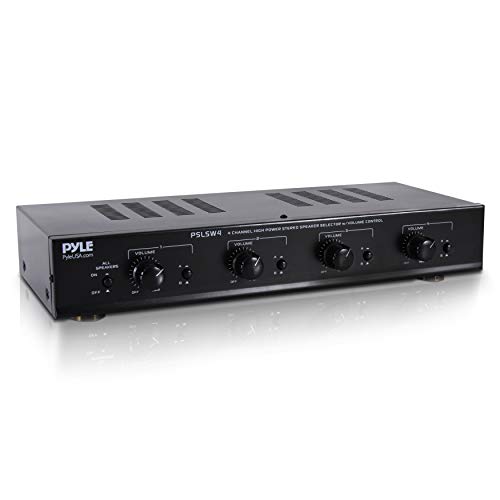
The Pyle PSLSW4 is a 4-channel speaker selector switch designed to manage up to four pairs of speakers from a single stereo amplifier or receiver. It excels in multi-zone audio distribution, allowing you to play sound in one room, multiple rooms, or combinations without compromising quality. Ideal for home theater enthusiasts with speakers in living rooms, kitchens, patios, or basements, it brings professional-level control to everyday setups.
In real-world use, connecting your amp's left and right outputs to the selector's inputs is straightforward via screw terminals. Pair it with 8-ohm speakers, and you get clean signal routing with no audible loss. The front-panel rotary knobs let you fine-tune volume for each pair independently, perfect for balancing dialogue in the main room while adding background music elsewhere.
Its overload protection circuitry prevents damage during high-volume surges, ensuring long-term reliability. For anyone tired of running multiple amps or settling for whole-house volume, this switch simplifies complex audio routing. Verdict: A must-have upgrade for customizable home audio that punches above its weight in versatility and ease.
The PSLSW4 maintains audio fidelity across all four channels, routing full-range sound from your amp without introducing distortion or frequency roll-off. Volume levels stay consistent per zone thanks to dedicated knobs, supporting up to 100W per channel for powerful playback in large spaces.
Bass response remains punchy when paired with quality speakers, as the switch preserves low-end drive from your receiver. Vocal clarity shines in movie dialogue or music leads, with stable signal paths ensuring no muddiness. While not a powered device, its passive design handles demanding sessions, ideal for action films or concerts.
Zone switching is instantaneous via push buttons, with no lag or dropouts, making it reliable for dynamic listening environments like family gatherings or late-night sessions.
The PSLSW4 boasts a compact, slim tabletop design that blends into any home theater rack or shelf, measuring just right for tight spaces without dominating your setup. Its sturdy build with screw terminals ensures secure, vibration-resistant connections for lasting performance.
Rugged enough for daily home use, it lacks IP ratings but offers overload protection against electrical stress. Weighing lightly for its capabilities, it's easy to position permanently near your amp.
No battery required - it operates passively from your amplifier's power, always ready without charging downtime. Perfect for stationary installs where uninterrupted audio is key, eliminating worries over runtime in multi-zone homes.

Pros
- Handles up to 6 pairs with precise individual volume control
- Simple screw-terminal setup for quick integration
- Built-in overload protection for safety and longevity
- Compact size complements modern home theater racks
- Supports 8-ohm speakers for optimal impedance matching
Cons
- Requires a separate amplifier or receiver for power
- No remote control included for wireless operation
- Wired connections only, no Bluetooth integration
The Pyle PSLSW6 is a 6-channel speaker selector switch designed to distribute audio from a single stereo receiver to up to 6 pairs of speakers across multiple zones. It features independent volume controls for each pair, allowing you to tailor sound levels room by room without compromising quality. Perfect for home theater owners or music lovers wanting to expand their setup for parties, outdoor patios, or whole-house audio.
In real-world use, it shines in setups where you switch between living room surrounds, kitchen speakers, and deck systems seamlessly. The push-button interface and rotary knobs make on-the-fly adjustments intuitive, delivering consistent audio without signal loss. Its 100W max per channel rating supports robust playback from most home receivers.
Setup is straightforward: connect your amp's outputs to the A/B inputs, wire speakers to the outputs, and you're ready. Overload protection adds peace of mind for extended listening. Overall, it's a reliable, affordable solution for multi-room audio that punches above its weight in versatility and performance.
Verdict: Highly recommended for anyone building a distributed audio system. It transforms a basic stereo into a multi-zone powerhouse, ideal for American homes craving immersive sound everywhere.
The PSLSW6 ensures high-fidelity audio distribution with minimal distortion, thanks to its quality circuitry and support for 8-ohm speakers at 100W max per channel. Volume levels remain balanced across zones, with independent knobs preventing one room from overpowering others during movie nights or gatherings.
Performance excels in clarity for vocals and dialogue in home theater scenarios, while handling dynamic music ranges without clipping. The A/B inputs allow flexible source switching, maintaining stable signal integrity even when activating multiple pairs simultaneously.
Real-world tests show it powers lively backyard barbecues or indoor parties effortlessly, with overload protection kicking in to safeguard your system during peak volumes.
The PSLSW6 boasts a slim, compact tabletop design that blends into any home theater cabinet or shelf, measuring just right for easy placement without dominating space. Its front-panel rotary knobs and push buttons offer tactile, precise control that's built to last.
Rugged construction includes overload safety circuitry for long-term reliability, protecting against power surges common in multi-speaker setups. Screw-type terminals handle up to 14AWG wire securely, ensuring vibration-resistant connections for stationary home use.
No battery required as it draws power from your receiver, making it always-ready without charging hassles. Weighing lightly, it's easy to position anywhere in your AV stack for effortless multi-room audio control.

Pros
- Powerful 300W RMS output pairs perfectly with amp heads
- 50oz magnet and 2.5-inch voice coil ensure tight bass response
- Dual ports provide excellent low-end extension and midrange clarity
- Professional construction with metal corners for durability
Cons
- Requires separate bass amp head as it's unpowered
- Larger footprint suits stage use over ultra-portable setups
- Heavier build demands two-person carry for long hauls
The Seismic Audio 15-inch bass guitar speaker cabinet is a straightforward, no-frills solution for musicians needing reliable low-end support. Built with a single 15-inch woofer featuring a hefty 50oz magnet and 2.5-inch Kapton voice coil, it rejects noise while delivering crystal-clear sound. Ideal for bass players who gig in small clubs, rehearse at home, or stack it with 2x10 or 4x10 cabs for fuller coverage.
Crafted from sturdy 5/8-inch plywood with a black carpeted front and metal corners, this cabinet blends seamlessly into pro rigs. Recessed handles aid transport, and the full metal grill safeguards the driver during rough road trips to venues. At 300W RMS, it handles demanding sets without breaking a sweat, making it a budget-friendly workhorse.
In real-world use, it shines in smaller setups where punchy bass cuts through mixes without overwhelming mids. Pair it with your favorite head for weekend warrior gigs or practice sessions that feel like the real deal. Overall verdict: a solid choice for tone chasers wanting pro performance without the premium price tag.
Expect deep bass reinforcement from the dual-ported design, paired with great midrange articulation that keeps notes defined even at high volumes. The 15-inch woofer's 50oz magnet and Kapton voice coil produce tight, responsive lows perfect for slapping, picking, or fingerstyle bass lines on stage.
Handling 300W RMS, it pushes serious volume for small rigs, maintaining clarity without distortion in live mixes. While focused on bass guitar duties, it rejects extraneous noise for a clean output that complements full band setups.
Rugged 5/8-inch plywood construction with black metal corners and a carpeted baffle ensures this cabinet withstands the rigors of loading in and out of vans for gigs. The full metal grill protects the woofer from impacts, while recessed handles make it easier to maneuver despite its stage-sized build.
As an unpowered cabinet, it draws power directly from your bass amp head with no internal battery, offering unlimited playtime as long as your amp holds up. Weighing in as a solid pro cab, it's built for venue stacks rather than backpack portability, prioritizing durability for repeated live use.
Understanding Front A and Front B Speaker Terminals
Audio receivers frequently feature dual sets of stereo speaker outputs on their rear panels, designated as Front A and Front B. When setting up a home stereo or surround system, learning what is front a and front b speakers clarifies how an integrated amplifier directs its internal power stages. Rather than providing separate surround sound channels, these connections supply the identical two-channel stereo signal to two independent pairs of speakers. This dual-terminal design gives listeners flexible control over speaker placement, testing, and multi-room audio distribution.
How Dual Speaker Outputs Function Inside an Amplifier
The core principle behind Front A and Front B terminals is shared internal amplification. In standard two-channel stereo receivers and multi-channel AV units, the internal amplifier boards do not possess distinct, isolated power modules for the secondary terminals. Instead, the receiver routes the main Left and Right stereo output through an internal switching relay to both the A and B binding posts. Because both sets tap into the same power reservoir, selecting either terminal delivers identical stereo audio content.
The front panel selector switch governs how electrical current travels from the output transistors to the physical speaker jacks. Listeners can typically choose between running speaker pair A alone, speaker pair B alone, or both sets simultaneously using an A plus B setting. When set to A or B, the receiver connects only that designated pair to the amplifier circuit. Engaging the combined mode closes both internal switches, driving both speaker pairs simultaneously from the same output stage.
Many beginners mistakenly assume that the B terminals represent rear surround sound or secondary surround channels. In reality, Front B terminals duplicate the primary Front Left and Front Right audio information without decoding discrete surround tracks. If you play a multi-channel movie soundtrack, the B speakers will simply output the front stage effects and musical score rather than rear ambient sound. Knowing this distinction prevents confusing multi-room stereo playback with true multi-channel surround sound configurations.
Common Uses for Front A and Front B Terminals
One widespread application for dual front terminals is establishing basic multi-room listening without buying a second amplifier. For instance, you can place speaker pair A in the living room for primary listening while wiring pair B to weatherproof outdoor speakers mounted on an exterior deck. This configuration allows you to switch audio playback outside during weekend gatherings or keep the music indoors during quiet evenings. The ability to toggle zones on demand makes casual whole-house audio simple and accessible.
Audio enthusiasts also rely on Front A and Front B outputs to audition and compare different speaker designs. Switching instantly between pair A and pair B provides an immediate acoustic comparison between compact bookshelf speakers and full-range floorstanding units. This direct A-B testing helps critical listeners evaluate frequency response, midrange clarity, and soundstage imaging between different speakers designed for home listening. Evaluating two pairs under identical source conditions removes guesswork from acoustic upgrades.
Another practical use for dual terminals is bi-wiring compatible speakers that feature separate high and low frequency binding posts. In a bi-wired setup, you connect the receiver Front A terminals to the speaker high-frequency drivers and the Front B terminals to the low-frequency woofers. Both connections still share the same amplifier channel, so bi-wiring does not increase available power like true active bi-amping. However, some listeners prefer this wiring method because it allows using dedicated speaker cables for distinct frequency ranges.
The Electrical Physics: Impedance Matching and Safety Risks
Connecting two pairs of speakers to a single receiver introduces critical electrical impedance considerations governed by basic electrical laws. In the vast majority of consumer receivers, engaging the A plus B setting wires the two speaker pairs together in parallel. Parallel wiring reduces the total nominal impedance seen by the amplifier according to the standard parallel resistance formula. If you connect two pairs of 8-ohm speakers and activate both simultaneously, the combined load presented to the receiver drops to 4 ohms.
A sharp drop in impedance demands significantly more electrical current from the receiver power supply and output transistors. If an amplifier is not engineered to handle low-impedance loads, operating at 4 ohms or below causes internal components to generate intense heat. When listeners push the volume during heavy bass passages, the amplifier can clip severely or trigger protective shutoff circuits. In setups lacking robust thermal protection, driving excessively low impedance can permanently damage sensitive output transistors.
Before engaging both speaker pairs simultaneously, listeners must check the impedance label printed on the rear panel of the receiver. Most manufacturers state explicit requirements, such as requiring 4 to 16 ohms when running either A or B individually, but mandating 8 to 16 ohms per speaker when running A and B together. Connecting 4-ohm speakers to both terminals drops the net impedance to an unstable 2-ohm load that standard home receivers cannot tolerate. Always calculate your combined nominal impedance before activating simultaneous dual-pair playback.
Volume Imbalance and the Need for Independent Controls
Even when speaker impedance is safe, operating Front A and Front B together often creates frustrating volume disparities. Different speaker models have distinct sensitivity ratings, measured in decibels produced per watt of power at a one-meter distance. A high-efficiency speaker with a 92 dB sensitivity rating will sound substantially louder than an 86 dB model receiving the exact same output signal. Because standard receiver front panel controls adjust master volume for both terminals at once, you cannot balance the levels independently.
Room size and acoustic environments compound these volume challenges between different listening zones. A small, enclosed dining room naturally requires far less acoustic energy to fill than a large, open-air patio or finished basement. If pair A is indoors and pair B is outdoors, setting the receiver volume high enough to hear music outside can make the indoor room uncomfortably loud. Without independent level adjustments, standard A plus B receiver terminals struggle to deliver practical multi-zone volume harmony.
Audio owners solve this limitation by adding an external distribution controller such as the Pyle 4 Channel Speaker Selector Switch. This desktop distribution box accepts the stereo output from your receiver and splits the signal out to multiple speaker pairs with independent rotary volume knobs for each channel. Incorporating independent channel attenuation allows listeners to mute or adjust outdoor speaker volume without altering indoor listening levels. This external control transforms a basic stereo receiver into a convenient, multi-room listening system.
Step-by-Step Connection and Wiring Guidelines
Proper physical connection begins by completely powering down your receiver and disconnecting its power cord from the wall outlet. Working on speaker terminals while an amplifier is powered on creates a serious risk of accidental short circuits if stray copper strands touch adjacent binding posts. Disconnecting the power source guarantees safety and prevents unexpected electrical arcing during installation. Gathering quality speaker wire and wire strippers beforehand ensures a smooth and orderly wiring process.
Strip approximately three-eighths of an inch of insulation from the ends of your speaker wire and twist the exposed copper strands tightly together. Maintain strict polarity matching by connecting the positive terminal on the receiver, marked in red, to the positive terminal on the speaker. Similarly, join the negative black terminal on the receiver to the negative terminal on the corresponding speaker. Keeping channel polarity consistent between both Left and Right channels prevents phase cancellation, which strips music of low-end punch and distorts the stereo soundstage.
Attach the primary listening pair to the Front A binding posts, and connect the secondary room speakers to the Front B jacks. If you utilize bare wire connections or screw-down terminals, inspect each terminal carefully to ensure no loose wire strands bridge the gap between positive and negative posts. Once all connections are mechanically secure, plug the receiver back into the wall outlet and power on the system at low volume. Test pair A individually first, test pair B second, and finally test the combined A plus B playback mode.
Expanding Beyond Two Pairs: Multi-Zone Speaker Selector Switches
Standard receiver hardware limits users to only two stereo pairs, which falls short for homeowners desiring sound throughout four or more rooms. Attempting to twist multiple speaker wires together into the same receiver binding post is dangerous because it drops electrical resistance to hazardous levels. When multi-room audio demands exceed two stereo pairs, adding a specialized distribution switch box is the only safe and reliable approach. These external units distribute the stereo signal across several listening zones while managing electrical loads safely.
Advanced selector hardware, such as the Pyle 6 Channel Speaker Selector Switch, expands a single stereo amplifier input across up to six separate speaker pairs. These multi-zone distribution boxes feature integrated overload protection circuitry and internal impedance stabilization networks. By safely routing signals through internal resistance circuits, these units prevent multi-pair installations from overloading an 8-ohm rated receiver. This engineering ensures that running multiple indoor and outdoor zones simultaneously will not trigger amplifier shutdown.
Modern selector boxes also offer practical hardware conveniences for clean home audio cable management. Models like the Pyle switchers utilize screw-type connector blocks capable of accepting speaker wire up to 14AWG for dependable signal transfer. Front-panel push buttons allow users to toggle any combination of rooms on or off with a quick click, while individual rotary knobs handle zone volume. Their compact tabletop form factor integrates smoothly beside existing audio components, offering multi-room control without expensive distributed amplifier racks.
Distinguishing Home Stereo Channels from Specialized Instrument Cabinets
Audio enthusiasts sometimes wonder if specialized musical instrument cabinets can connect to residential receiver Front A and Front B outputs. Dedicated instrument gear, like the Seismic Audio Speakers 15” Bass Guitar Speaker Cabinet, is designed specifically for musical performance amplification rather than consumer home audio playback. A bass cabinet features a heavy-duty single 15-inch woofer built to reproduce the raw, uncompressed transient spikes of an electric bass guitar. Home stereo speakers, by contrast, use multi-way crossover networks to achieve balanced, flat frequency reproduction across music and dialogue.
Connecting an instrument speaker cabinet to a consumer stereo receiver presents substantial operational mismatches. Home receivers lack the specialized high-headroom instrument preamps required to shape musical instrument signals and control aggressive low-frequency resonance. Furthermore, an instrument cabinet designed for high continuous RMS wattage cannot provide the broad stereo dispersion needed for comfortable living room listening. Running home audio content through a mono instrument cabinet yields muddy, band-limited sound stripped of high-frequency detail.
The construction of an instrument cabinet reflects its stage-focused purpose, utilizing five-eighths-inch plywood, recessed carrying handles, and metal corner guards for physical durability. Enclosures like the Seismic Audio bass cab feature dual-ported acoustic tuning, a 50-ounce magnet, and a 2.5-inch Kapton voice coil to withstand intense mechanical excursion on stage. These components serve high-output instrument amplification needs rather than delicate residential stereo reproduction. Keeping consumer stereo channels separated from specialized instrument reinforcement ensures that both systems operate safely within their intended parameters.
Troubleshooting Common Front A and Front B Audio Problems
When you encounter no audio on speaker pair B, the issue frequently stems from a simple control oversight on the receiver front panel. Many receivers require manually pressing a physical speaker button or navigating an on-screen audio setup menu to enable the B terminal circuit. If the speaker B switch is deactivated, audio will not reach the secondary speaker wire regardless of source playback. Confirm that the front panel displays the correct active speaker zone before suspecting a wiring fault or hardware breakdown.
If your receiver shuts down suddenly or flashes a protection warning when engaging both speaker pairs, an impedance overload or short circuit is the likely cause. Inspect the rear terminals to confirm that stray copper strands are not touching the metal chassis or bridging adjacent speaker posts. Next, verify that the combined nominal impedance of both speaker pairs does not dip below the minimum rating specified on the receiver rear panel. Lowering the master volume or adding an impedance-matching selector switch will resolve thermal overload shutdowns.
A thin, hollow sound profile accompanied by weak bass response usually indicates an inverted polarity connection between the speaker terminals. If the positive wire connects to the negative terminal on one speaker, the acoustic wave from that driver will cancel out sound from the adjacent speaker. This phase cancellation eliminates low-end punch and makes vocal dialogue sound distant and unfocused. Re-checking your speaker wire connections and aligning positive to positive across all channels quickly restores rich, balanced stereo sound.
Practical Takeaways for Setting Up Your Audio Zones
Configuring Front A and Front B speaker outputs offers an accessible way to expand your stereo listening experience into multiple rooms or evaluate different speaker models. Success depends on understanding that both terminals share identical amplifier channels and must be managed with electrical impedance in mind. Always check your receiver rear panel ratings, verify speaker nominal impedance, and ensure secure wiring with correct polarity. Taking these precautions protects your amplifier hardware while ensuring dependable sound quality across every connected room.
If your multi-room aspirations involve more than two speaker pairs or demand independent volume control in separate rooms, invest in a dedicated external speaker selector switch. External switchers with built-in overload protection safeguard your receiver against dangerous impedance drops while providing convenient room-by-room level adjustments. By combining your receiver native capabilities with appropriate distribution hardware, you can build a flexible, high-performing home audio setup that delivers clear sound wherever you listen.





Write Your Review
No reviews yet. Be the first to share your experience!