


Vaulted ceilings add drama, light, and architectural beauty to a living room, but they can quickly create complications when planning an immersive surround sound system. Home theater enthusiasts often wonder whether will atmos speakers work with vaulted ceilings when attempting to bring true overhead audio into high, angular rooms. Achieving authentic three-dimensional sound requires precise directionality, which means sound waves must arrive at your ears from distinct spatial angles rather than scattering chaotically across steep drywall planes. If you are building a modern entertainment space, selecting speakers designed for immersive audio can transform your movie experience, provided your room acoustics and physical speaker positions work together effectively.
The short answer is yes, but the method you choose makes all the difference in whether you experience genuine overhead realism or muddled audio clutter. Upward-firing Atmos modules that attempt to bounce acoustic signals off a sloped ceiling rarely succeed, but direct physical height channels can deliver extraordinary results. By utilizing pivoting architectural drivers, aimable tweeters, or carefully angled height mounts, you can overcome steep slopes and direct spatial cues right to your primary seating area. Understanding the critical differences in driver dispersion, ceiling reflection physics, and receiver configuration ensures your audio investment delivers the high-impact realism you expect.

Pros
- Pivoting silk dome tweeter allows precise soundstage imaging toward primary seating positions
- Moisture-resistant design holds up exceptionally well in high-humidity areas like master bathrooms and covered porches
- Straightforward DIY installation with included cutout templates and rotating mounting dogs
- Flawless aesthetic integration with paintable grilles that virtually disappear into the ceiling
Cons
- Passive design requires an external amplifier or AV receiver with adequate power delivery
- Compact 6.5-inch driver lacks deep sub-bass impact, making a dedicated subwoofer essential for action movies
- Permanent drywall cutout required, making relocation or repositioning difficult after installation
The Polk Audio RC60i pair is engineered for listeners who want expansive, dynamic sound without giving up precious floor space or wall real estate to bulky speaker cabinets. Designed as a stealth architectural solution, these speakers slip cleanly into overhead ceilings, making them a prime candidate for whole-home background audio, high-fidelity zone listening, and Dolby Atmos elevation channels in modern surround sound setups.
In everyday use, the RC60i showcases the classic Polk signature: smooth, musical, and thoroughly engaging across diverse genres. Whether serving as ambient sound sources during a dinner party or channeling overhead effects in high-octane movie sequences, the speakers create a unified soundfield that avoids harshness or shrillness. The broad dispersion ensures that you do not need to stand in a rigid sweet spot to appreciate rich tone and clarity.
A standout attribute of the RC60i is its resilience. Polk crafted these speakers with moisture-resistant components, stainless steel hardware, and durable surrounds, opening up installations in humid environments that would ruin conventional speakers. From steam-filled master bathrooms and laundry areas to covered exterior lanais, the RC60i maintains structural integrity and acoustic consistency where ordinary speakers fail.
Ultimately, the Polk Audio RC60i provides an accessible and refined pathway into architectural audio. While they cannot replace dedicated floorstanding towers for bottom-octave slam, they deliver exceptional midrange presence, airy highs, and unbeatable visual discretion. For custom audio projects on a practical budget, this pair remains one of the smartest architectural investments available.
Acoustically, the Polk Audio RC60i punches well above its understated profile thanks to its tuned two-way configuration. The 0.75-inch silk dome tweeter offers crisp, sweet highs that reveal micro-details in acoustic guitar plucks and cinematic sound effects without introducing listening fatigue. Because the tweeter sits on a swivel mount, you can angle the high-frequency beam up to 15 degrees toward your main listening area, overcoming traditional ceiling-speaker placement challenges.
The midrange and upper bass frequencies are anchored by a 6.5-inch Dynamic Balance polymer composite cone. This driver is calibrated using laser imaging to identify and eliminate unwanted resonant frequencies before production. The result is pure, natural vocal reproduction that keeps spoken movie dialogue intelligible and vocals centered, preventing the muddy or hollow sound often associated with budget in-ceiling speakers.
While the RC60i produces satisfying mid-bass punch down to approximately 40 Hz, it behaves naturally as an infinite baffle speaker inside your ceiling cavity. For low-frequency rumble in home theater applications, pairing these speakers with a dedicated powered subwoofer is highly recommended. When crossed over around 80 Hz, the RC60i handles demanding dynamics effortlessly, filling medium to large rooms with clear, distortion-free sound.
The hardware architecture of the Polk Audio RC60i emphasizes durability, ease of setup, and visual discretion. Measuring roughly 10.8 inches across with an installed depth of just 3.3 inches, these speakers fit comfortably into standard ceiling joists without interfering with overhead plumbing or wiring. The frame utilizes high-grade, moisture-resistant materials and a durable rubber surround that resists humidity and environmental decay.
Installation is streamlined through Polk's patented rotating cam system. After tracing and cutting the ceiling drywall using the included template, you slide the speaker into the opening and tighten the front screws. This swings the dog-ear clamps into place, sandwiching the drywall firmly to stop mechanical rattles. The metal grilles come standard in a neutral matte white finish, but they are fully paintable to match your exact ceiling color scheme.
As passive speakers, the RC60i units require connection to an amplifier, multi-room distribution unit, or AV receiver. They feature gold-plated spring-loaded push terminals that accept bare speaker wire up to 14-gauge with secure contact. With an 8-ohm nominal impedance and a recommended power range of 20 to 100 watts per channel, the RC60i integrates easily with virtually any standard audio receiver on the market.

Pros
- Exceptional clarity and dynamics from premium titanium tweeter
- Pivoting woofer allows targeted sound dispersion
- Attenuation switches for easy room-matching
- Robust build quality for long-term reliability
- Seamless in-ceiling integration hides speakers cleanly
Cons
- Requires professional installation for best results
- Passive design needs a compatible AV receiver or amp
- Single speaker purchase means buying multiples for full setups
The Klipsch CDT-5800-C II is a premium in-ceiling speaker designed for audiophiles building high-end home theater or whole-home audio systems. Featuring a 1-inch titanium tweeter mated to a Tractrix horn and an 8-inch pivoting Cerametallic woofer, it brings Klipsch's signature dynamic sound to any room without visible speakers cluttering your decor.
Ideal for surround channels in home theaters or ambient music in kitchens and living rooms, it excels in spaces where discretion meets performance. The Controlled Dispersion Technology (CDT) allows the tweeter to pivot independently, optimizing high-frequency coverage even off-axis.
In real-world use, it handles everything from explosive action scenes to nuanced vocals with authority, thanks to horn-loading that boosts efficiency. Treble and midbass attenuation switches provide customization for room acoustics.
Verdict: A top choice for serious listeners wanting powerful, precise audio from the ceiling. Pair it with a quality AV receiver for stunning results that elevate everyday listening.
Bass from the 8-inch Cerametallic woofer is deep and controlled, pivoting up to 15 degrees for focused low-end delivery right to your ears. It punches through in movies and anchors music rhythms without boominess.
Vocal clarity shines via the titanium tweeter's silky highs and the horn-loaded design, which extends response for detailed mids. Volume levels scale effortlessly with your amp, maintaining composure at reference levels.
Controlled Dispersion Technology ensures stable performance across wide listening areas, with attenuation switches refining treble brightness and midbass weight to match furnishings or preferences.
Sleek white paintable grille blends invisibly into ceilings, with a low-profile bezel for flush mounting. The rugged Cerametallic woofer and titanium tweeter stand up to years of daily use in home environments.
Weighing in at a manageable size for installers, it fits standard joist spacing and includes a template for precise cutouts. No battery needed as a passive speaker; it draws power efficiently from your AV receiver.
Build prioritizes durability with magnetic grille attachment and weather-resistant materials suited for indoor humidity, ensuring reliable performance without frequent maintenance.

Pros
- Breeze-to-install mounting system saves time and hassle
- High sensitivity ensures powerful performance with any AV receiver
- Smooth, clear highs over wide coverage area
- Moisture-resistant build thrives in humid environments
Cons
- Requires precise ceiling cutouts for professional fit
- Wired connection needs compatible amplifier, no built-in wireless
- Best paired with receiver for full potential in larger spaces
The Klipsch R-1650-C in-ceiling speakers come as a convenient 4-pack, designed for seamless integration into home or commercial spaces. Featuring a 6.5-inch polymer-cone woofer paired with a 1-inch polymer-dome tweeter, they deliver dynamic acoustics that punch above their affordable price point. Ideal for American homeowners upgrading to surround sound systems or adding music to kitchens, bathrooms, and beyond.
Installation is a standout, with a user-friendly mounting system that pivots for easy alignment and a paintable aluminum grille that blends into any decor while offering rust protection in damp areas. Whether you're building a home theater or enhancing multi-room audio, these speakers provide reliable performance without complexity.
In real-world use, expect vibrant sound that fills rooms evenly, making movie nights or casual listening more engaging. The high sensitivity means they pair well with standard receivers for impressive volume and clarity. Overall verdict: a smart buy for durable, high-value ceiling audio that elevates everyday living spaces.
At the heart of the R-1650-C is a robust 6.5-inch woofer with a large motor structure, delivering solid bass depth and midrange punch suitable for music and movies in home setups. The coaxially mounted 1-inch tweeter ensures smooth, detailed highs distributed over a wide area, creating an immersive soundstage without hot spots.
High sensitivity allows these speakers to reach impressive volume levels with modest amplification, maintaining clarity even during action scenes or upbeat tracks. Perfect for distributed audio systems where consistent performance across rooms is key, they handle vocals with natural timbre and instruments with lively dynamics.
Sleek and compact at 9.5 inches in diameter, the R-1650-C fits neatly into ceilings with an 8.3-inch cutout, making it versatile for standard residential installs. The paintable aluminum grille not only resists rust in moisture-heavy zones like bathrooms and kitchens but also allows customization to match your interior.
Built for longevity, the polymer cone and dome components offer durability in everyday home use, with no battery concerns as passive speakers that draw power from your AV system. The rugged design withstands humid environments like saunas, ensuring reliable performance year after year.
Pros
- Balanced sound reproduction with excellent depth and detail
- Rubber seal prevents moisture ingress for humid environments
- Simple, fast installation in three steps
- Aimable tweeter directs high frequencies precisely
- Discreet design with paintable grilles
Cons
- Requires ceiling cutout for installation
- Best paired with an existing amplifier or receiver
- Limited to covered outdoor use, not fully exposed weather
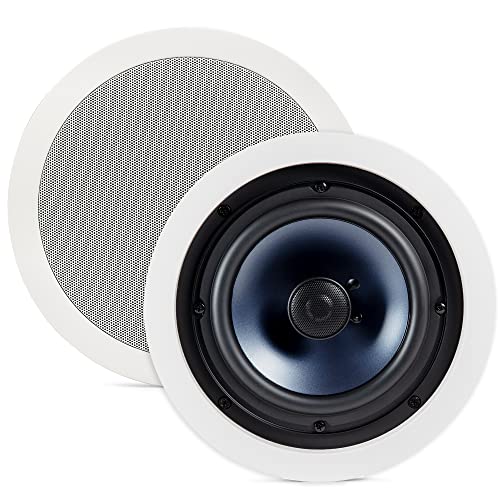
The Polk Audio RC80i is a pair of premium 2-way in-ceiling speakers featuring 8-inch round drivers, designed for seamless integration into home audio systems. With a moisture-resistant rubber seal, they thrive in damp locations such as bathrooms, kitchens, and covered porches, making them perfect for American homeowners wanting high-quality sound without visible speakers.
These speakers deliver excellent audio reproduction thanks to the Dynamic Balance woofer and 1-inch aimable tweeter, providing balanced, lifelike sound for music and movies. Installation is straightforward in three steps, with paintable grilles that disappear into your decor. Polk Audio's 50-year legacy ensures reliability and innovation.
In real-world use, the RC80i elevates everyday listening in humid spaces, offering full-bodied sound that rivals traditional bookshelf speakers. While they require an amp, their versatility and durability make them a smart upgrade. Verdict: Highly recommended for discreet, weather-resistant home audio enhancement.
The RC80i shines with its 8-inch woofer delivering full-bodied bass and midrange, complemented by a 1-inch aimable tweeter for crisp highs and detailed vocals. This setup creates a balanced sound signature ideal for everything from podcasts in the kitchen to movie nights on the porch.
Volume levels fill rooms evenly without distortion, and the mineral-filled polymer cone enhances damping for natural reproduction. Bluetooth connectivity allows wireless streaming, with stable performance when added to home systems. Expect reliable range in typical indoor setups.
Built for durability, the RC80i features a robust rubber seal that prevents moisture leaks, making it rugged for humid indoor/outdoor use like showers or patios. The 8-inch round design with paintable aluminum grilles ensures a sleek, invisible look that matches any decor.
Weighing in at a manageable size for ceiling mounts, these speakers prioritize easy handling during install. As wired in-ceiling models, they draw power from your home audio system, eliminating battery concerns for continuous playback without recharging interruptions.

Pros
- Exceptional power handling up to 140W for distortion-free loud playback
- Wide frequency extension to 28kHz for sparkling treble detail
- Robust 8-inch driver provides solid low-end response in ceilings
- Low 4.3-inch depth fits most standard installations
Cons
- Requires external amplifier or receiver as passive speakers
- Professional installation needed for precise ceiling cutouts
- Lacks wireless connectivity options
The Yamaha NS-IC800 is a pair of high-performance 2-way in-ceiling speakers designed for seamless integration into home audio systems. With an 8-inch woofer and dome tweeter, they handle up to 140W of power, making them perfect for home theater enthusiasts or whole-home audio setups where discreet placement matters.
These speakers shine in real-world use for surround sound channels or ambient music distribution, providing balanced audio that punches above its in-wall category. Homeowners upgrading from basic systems will appreciate the clarity and dynamics without visible clutter.
Performance stands out with controlled bass from the large woofer and extended highs, though they demand a quality amp to unlock full potential. Overall, the NS-IC800 earns high marks for value in custom installs, delivering pro-level sound for immersive listening.
Verdict: A top pick for audiophiles seeking powerful, hidden speakers that elevate any room's acoustics.
The NS-IC800's 2-way design with a 3.5kHz crossover ensures smooth transitions, yielding clear midrange for vocals and instruments alongside punchy bass from the 8-inch woofer. Highs extend to 28kHz via the dome tweeter, adding airiness to cymbals and strings without harshness.
Soundstage feels expansive for in-ceiling units, ideal for creating a cohesive surround bubble in home theaters. At 50W nominal power, it maintains composure up to reference volumes, with 140W max handling headroom for dynamic peaks in action movies or rock tracks.
Acoustic engineering focuses on even dispersion, minimizing hot spots for uniform listening across rooms.
Built for flush-mount installs, the NS-IC800 features a slim 4.3-inch depth and 10.9-inch outer diameter, fitting most drop ceilings with minimal protrusion. The white paintable grille ensures a seamless look in modern homes.
As passive 8-ohm speakers, they connect via standard speaker wire to AV receivers or amps, supporting 50W nominal and 140W max input. No onboard inputs like HDMI or Bluetooth; power comes from external amplification.
Durable construction handles residential rigors, with the woofer and tweeter optimized for vertical firing patterns to enhance ceiling dispersion.

Pros
- Robust bass and natural sound signature from quality woofer-tweeter combo
- Super simple installation with built-in tabs for quick setups
- Elegant paintable design blends invisibly into any room
- Pivoting tweeter optimizes sound direction for better coverage
- Durable build lasts for years in indoor or covered outdoor spots
Cons
- Requires external amplifier or receiver for power
- Limited to covered outdoor use, not fully weatherproof
- 3-inch mounting depth may need thinner ceilings for flush fit
The Micca M-6C is a 2-way in-ceiling speaker designed for seamless integration into home audio systems. Featuring a 6.5-inch poly woofer and 1-inch pivoting silk dome tweeter, it delivers balanced sound perfect for multi-room music or explosive home theater effects. Homeowners upgrading from basic speakers will love its ability to fill living rooms, kitchens, or patios without visible clutter.
In real-world use, these speakers shine in whole-house setups, providing robust bass down to 50Hz that anchors movies and playlists. The 6dB crossover ensures smooth transitions for clear vocals and instruments, making casual listening or parties equally enjoyable. Easy mounting tabs make it a weekend project for DIY enthusiasts.
Versatile for bedrooms to covered outdoor areas, the M-6C prioritizes performance and subtlety. Its 87dB sensitivity means efficient power use with standard amps. Overall verdict: a smart pick for clean, powerful audio that elevates everyday living without dominating your space.
Expect robust bass from the high-excursion 6.5-inch woofer, reaching 50Hz for deep impact in home theater explosions or bass-heavy tracks. The pivoting 1-inch silk dome tweeter delivers crisp highs up to 20kHz, with excellent vocal clarity that stands out in music or dialogue.
A precise 6dB crossover blends woofer and tweeter seamlessly in the upper mids, creating a spacious soundstage. At 80W power handling and 87dB sensitivity, it pushes high volumes cleanly across rooms without muddiness. Ideal for whole-house systems where consistent performance matters.
Engineered for natural engagement, it handles everything from background tunes to intense sessions, outperforming basic ceiling cans in depth and detail.
The modern rimmed grille protrudes minimally at 9 inches outer diameter, blending into ceilings with a clean white finish thats fully paintable to match walls. At just 3 inches deep with a 7.6-inch cutout, it fits standard installs effortlessly for a virtually invisible look.
Built tough with durable materials for indoor rooms or covered porches, it withstands family use year after year. No battery needed as a passive speaker, it draws endless power from your amp for non-stop playback without recharges.
Compact and lightweight design prioritizes space-saving elegance, making it rugged enough for kitchens or bathrooms while keeping setups simple and reliable.
Pros
- Robust bass and natural sound signature for engaging listening
- Simple installation on drywall or wood with secure mounting tabs
- Elegant, low-profile design that's paintable to match walls
- Wide 40Hz-20kHz response covers full audio spectrum
- Versatile for indoor rooms and covered patios
Cons
- Requires an external amplifier or receiver for power
- Involves cutting a 9.4-inch ceiling hole for installation
- Best for covered outdoor use, not fully exposed to weather
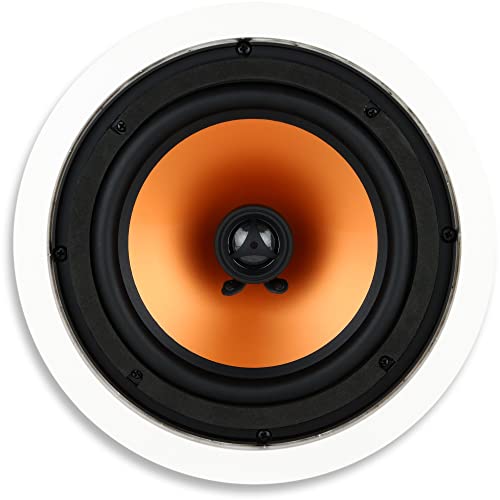
The Micca M-8C is a 2-way in-ceiling speaker designed for seamless integration into home audio systems, featuring an 8-inch poly woofer and a 1-inch pivoting silk dome tweeter. It's perfect for homeowners building whole-house audio or enhancing home theaters without visible speakers cluttering the space.
In real-world use, it shines in multi-room setups like living rooms, kitchens, bedrooms, and bathrooms, delivering smooth, natural sound with punchy bass that fills spaces effortlessly. The 6dB crossover ensures seamless transitions for clear vocals and detailed highs, making movies and music come alive.
Installation is straightforward with built-in tabs that grip drywall securely, and the paintable grille makes it disappear into ceilings. While it needs an AV receiver, its 90dB sensitivity and 100W power handling provide reliable performance for daily enjoyment.
Verdict: A top pick for clean, powerful ceiling audio that elevates everyday listening and entertainment without compromise.
The M-8C's 8-inch high-excursion woofer plunges to 40Hz for deep, robust bass that anchors music and movie effects, while the pivoting silk dome tweeter delivers crisp, airy highs up to 20kHz. The precise 6dB crossover blends them smoothly, ensuring vocal clarity and a wide soundstage even off-axis.
With 90dB sensitivity and 100W power handling, it reaches high volumes without distortion, ideal for dynamic home theater scenes or background music across rooms. Paired with a quality amp, it maintains stability and coherence for hours of fatigue-free listening.
Users appreciate its natural signature for everything from podcasts to rock concerts, outperforming basic ceiling speakers in bass depth and detail.
The M-8C's modern rimmed grille protrudes just minimally at 10.7 inches diameter, blending unobtrusively into ceilings. Paint it to match your walls for a virtually invisible look that saves floor and shelf space in any room.
Built tough with durable materials, it handles family rooms, kitchens, bathrooms, and covered porches reliably over years. At 3.5 inches mounting depth, it fits standard joists easily without bulk.
No battery means endless playback powered by your AV system, with 100W handling for all-day sessions. Its 8-ohm impedance pairs perfectly with most receivers for efficient, heat-free operation.
Understanding Dolby Atmos Performance on Sloped and Vaulted Ceilings
Dolby Atmos relies on precise spatial metadata to place sounds at distinct coordinates within a three-dimensional room. When listeners ask whether will atmos speakers work with vaulted ceilings, the fundamental answer comes down to speaker type and driver orientation. While standard upward-firing modules struggle in vaulted rooms, physical height channels installed directly into the ceiling drywall deliver excellent audio precision. Understanding how sound waves behave on an angled boundary ensures your drivers direct spatial audio to your seats rather than firing aimlessly down a slope.
The Acoustic Problem With Upward-Firing Bounce Modules
Upward-firing Dolby Atmos modules rely on specular reflection to simulate overhead audio. In a room with a flat drywall ceiling between eight and fourteen feet high, an upward-firing speaker shoots sound toward the ceiling so it bounces cleanly downward into the listening area. This acoustic bounce creates the illusion that sounds originate from directly above your head. The entire technology assumes that the ceiling surface is parallel to the floor below.
Vaulted, cathedral, and sloped ceilings break this physical assumption completely because of the law of reflection. When sound waves strike an inclined plane, the angle of reflection equals the angle of incidence relative to the surface normal. Because the ceiling slopes upward, sound bounces away from the primary seating position into opposite walls, hallways, or adjacent rooms. The resulting audio at the listening position becomes diffuse and weak, completely collapsing the overhead soundstage.
Ceiling textures also present an acoustic challenge in rooms with high architectural peaks. Many vaulted spaces feature exposed wood beams, tongue-and-groove planking, or acoustic textures that scatter or absorb high-frequency energy. Upward-firing speakers require a smooth, reflective surface to redirect high frequencies without significant attenuation. For these reasons, relying on reflected sound in an angular room almost always leads to disappointing results.
Direct In-Ceiling Speakers as the Architectural Solution
Installing physical in-ceiling speakers bypasses the need for acoustic reflection by delivering direct sound paths. When you mount a speaker directly inside ceiling drywall, audio travels straight from the driver cone to the listener without bouncing off intermediate surfaces. This direct path maintains the crisp transient response and phase coherence required for pinpoint spatial placement. Even in a room with dramatic ceiling pitch, direct speakers preserve the immersive realism intended by modern multichannel soundtracks.
Direct ceiling speakers also provide substantially greater dynamic headroom compared to compact upward-firing add-on modules. Architectural models typically house larger driver diaphragms that reproduce a broader frequency spectrum. A capable in-ceiling speaker handles midbass transitions smoothly down to eighty hertz, allowing your subwoofer to blend seamlessly with the overhead channels. This extended response prevents height effects from sounding thin or disconnected from the lower surround channels.
Flush-mounted ceiling speakers maintain the clean lines of a grand vaulted living space. Models with paintable aluminum grilles, such as the Klipsch R-1650-C, blend directly into drywall surfaces without drawing unwanted visual attention. Bulky speakers perched atop front towers can look cluttered, whereas in-ceiling drivers preserve the architectural volume of high ceilings while providing genuine spatial performance.
The Critical Role of Aimable Tweeters and Pivoting Drivers
Ceiling pitch presents a distinct physical challenge for conventional in-ceiling speakers. If an architectural speaker has fixed drivers that fire perpendicular to the frame, installing it on a sloped ceiling means the sound cone projects down-slope rather than toward the main couch. High frequencies are naturally directional, meaning a listener seated off-axis will experience treble roll-off and muffled sound effects. To solve this problem, you need architectural speakers designed with pivoting or aimable components.
Advanced designs incorporate swiveling tweeters that you can physically orient toward your primary listening position after securing the frame. The Polk Audio RC60i features a swiveling 0.75-inch silk dome tweeter, while the larger Polk Audio RC80i includes a 1-inch aimable tweeter alongside its 8-inch Dynamic Balance woofer. Similarly, the Micca M-6C and Micca M-8C integrate pivoting 1-inch silk dome tweeters that provide broad high-frequency steering. Aiming the tweeter allows you to compensate for ceiling pitch up to approximately fifteen or twenty degrees.
For steeper cathedral pitches, models with fully pivoting woofer assemblies provide an even greater acoustic advantage. The Klipsch CDT-5800-C II utilizes Controlled Dispersion Technology, featuring an 8-inch pivoting Cerametallic woofer paired with a 1-inch titanium compression driver mounted in a pivoting horn. This design allows you to steer both midrange and high frequencies directly toward your ears. Klipsch also equips this model with treble and midbass attenuation switches, giving you physical control to tame harsh reflections caused by nearby drywall angles.
Calculating Ceiling Pitch and Coverage Angles
Before cutting holes into your ceiling, determine the exact slope and coverage pattern required for your room. Roof pitch is commonly expressed as a ratio of vertical rise to horizontal run, such as a 4/12 or 6/12 pitch, corresponding to roughly nineteen and twenty-six degrees of tilt. A steeper slope shifts the acoustic center of your speaker further away from the central seating area. Calculating this angle helps you decide whether a standard aimable tweeter is sufficient or if a fully articulating woofer system is necessary.
Dispersion patterns vary considerably among architectural speaker designs. Most standard dome tweeters produce a usable dispersion cone of roughly thirty to forty-five degrees off-axis before noticeable high-frequency drop-off occurs. If your ceiling pitch exceeds thirty degrees, a fixed woofer might fire its midrange energy into an empty wall, leaving only the aimable tweeter pointing at your seat. In such setups, choosing speakers with wide dispersion characteristics ensures that midrange tracks and atmospheric cues remain balanced.
Speaker placement relative to the seating position also shifts based on ceiling height. In a standard eight-foot room, height channels sit relatively close to the seating perimeter to maintain proper Dolby elevation angles. In a vaulted room reaching fourteen or sixteen feet, sound travels further before reaching your ears. Spacing the left and right height channels slightly closer together on the ceiling helps prevent the overhead stage from feeling diffuse or disconnected.
Alternative Height Placements for Challenging Vaulted Architecture
Some vaulted living spaces feature structural barriers that prevent in-ceiling installation altogether. Solid timber tongue-and-groove decking, concrete rafters, spray foam insulation, or absence of attic access can make running wire through the ceiling impossible. When cutting into the ceiling is not a viable option, front and rear height speakers mounted high on vertical walls serve as an excellent alternative. These speakers are installed right where the vertical wall meets the sloped ceiling and angled down toward the seating area.
Height-channel wall mounting allows you to use surface-mount brackets that offer wide-ranging tilt and swivel adjustments. You can aim the speaker cabinet precisely at the listening position regardless of how steep the adjacent ceiling slope might be. Many audio enthusiasts combine these wall-mounted channels with traditional passive speakers in their primary surround layout to maintain a consistent tonal signature across all channels. Modern AV receivers readily recognize Front Height and Rear Height channel assignments in their configuration menus.
Another creative solution for extreme ceiling heights involves suspended pendant speakers. In cathedral rooms with peaks exceeding eighteen feet, dropping pendant enclosures on aircraft cable brings the acoustic drivers down to a uniform ten-foot elevation plane. This approach eliminates the challenges of steep slope angles while establishing an ideal height ratio relative to the floor speakers. While pendant speakers require careful aesthetic planning, they offer remarkable acoustic performance in cavernous spaces.
Receiver Configuration, Calibration, and Delay Matching
Physical installation is only half the battle; configuring your audio video receiver properly is critical for vaulted ceilings. Modern receivers provide distinct speaker layout settings, allowing you to designate height channels as Top Front, Top Middle, Top Rear, or Front Height. If your speakers are physically mounted on the ceiling slope, setting them as Top channels tells the processor to apply appropriate elevation panning algorithms. Choosing the wrong speaker type in the setup menu can result in incorrect acoustic filtering and unnatural spatial panning.
Asymmetrical vaulted ceilings, where one side of the room is higher than the other, introduce timing differences between channels. An automated room calibration system, such as Audyssey MultEQ, Dirac Live, or Yamaha YPAO, measures acoustic impulses to calculate speaker distances and output levels. If your left height speaker is twelve feet away on a lower slope and the right height speaker is sixteen feet away near the ridge, the processor delays the left channel by milliseconds so both sound waves strike your ears simultaneously.
Crossover management also deserves careful attention during setup. Even large architectural models like the 8-inch Yamaha NS-IC800 or Polk Audio RC80i benefit from a dedicated subwoofer crossover, typically set between sixty and eighty hertz. Directing low bass away from the ceiling prevents drywall rattle and maximizes the power handling of your height speakers. Yamaha NS-IC800 speakers handle up to 140 watts maximum with a 50-watt nominal rating, providing ample dynamic capability when relieved of deep bass reproduction.
Practical Mounting and Structural Considerations for Sloped Drywall
Installing architectural speakers in sloped drywall requires careful mechanical preparation. Gravity exerts uneven downward pressure on the lower edge of a cutout when a speaker sits on an angled surface. Most quality in-ceiling speakers rely on rotating dog-ear mounting clamps that swing outward and tighten against the backside of the drywall. The built-in mounting tabs on the Micca M-6C and Micca M-8C grab securely onto drywall panels, providing solid clamping force without requiring extra support brackets.
Cutout dimensions must be marked and cut with care, as an oversized hole can slip on a sloped surface. The Micca M-6C requires a 7.6-inch cutout, whereas larger eight-inch models like the Micca M-8C require a 9.4-inch opening. Always inspect the space behind the drywall using a stud finder to verify that ceiling joists, electrical conduits, or ducts do not obstruct your planned location. Using pre-construction brackets or backing rings can provide additional reinforcement if your ceiling uses thinner drywall sheets.
Environmental factors should also guide your hardware selection in large open-concept vaulted spaces. Great rooms that connect directly to kitchens or covered exterior porches often experience higher humidity and temperature swings. Speakers engineered with moisture-resistant components, such as the Polk Audio RC60i and Polk Audio RC80i with their rubber moisture seals, prevent humidity from degrading the speaker surround or rusting internal components. Durable polymer cones and aluminum grilles ensure your installation remains clean and reliable over years of use.
Step-by-Step Verification and Listening Optimization
Once your speakers are mounted and wired, run through a structured verification process before replacing toolkits and ladders. Begin by confirming polarity on every channel, ensuring positive and negative speaker terminals match your receiver outputs exactly. Reversing polarity on a height channel causes severe acoustic phase cancellation, making overhead audio sound thin, hollow, and detached from the room. A quick manual pink-noise test from your receiver helps verify that every individual speaker is functioning properly.
After confirming electrical connections, run a full multi-point automated room correction cycle with your calibration microphone placed at ear level. Avoid holding the microphone in your hand, as body reflections can distort the high-frequency measurements that your receiver uses to set equalization curves. Once the calibration completes, review the calculated distances and crossover points in the receiver menu. If the software sets an in-ceiling speaker to “Large” or full-range, manually adjust it back to “Small” with an eighty-hertz crossover.
Finally, test your setup with high-quality multichannel demonstration material featuring prominent spatial object tracks. Scenes with falling rain, helicopters circling overhead, or subtle ambient reverberation reveal whether your height speakers blend cohesively with your main floor channels. If high frequencies sound overly aggressive on your sloped ceiling, adjust the treble attenuation switch if your speaker includes one, or manually soften the high-frequency curve in your receiver EQ. Taking the time to dial in aim, calibration, and level settings ensures your vaulted home theater delivers exceptional, immersive sound for every seat.


Write Your Review
No reviews yet. Be the first to share your experience!