


Setting up high-frequency audio components often brings unexpected technical questions, especially when replacing conventional dome tweeters with piezoelectric elements. Builders frequently ask whether are piezo speakers polar when planning horn replacements, custom sound boxes, or ultrasonic emitters. Understanding the electrical and acoustic characteristics of these unique drivers helps prevent phase issues and ensures optimal treble output. Whether you are assembling a DJ cabinet or installing a compact transducer, wiring these components correctly makes a noticeable difference in overall clarity. Proper setup avoids frustrating sound cancellation and protects your audio gear.
Unlike standard dynamic drivers that rely on copper voice coils and permanent magnets, piezoelectric devices utilize ceramic discs that flex in response to voltage swings. This fundamental difference alters how they handle audio signals and dictates whether terminal markings need strict adherence in passive speaker system setups. Replacement units like the CCeCCe 2 Pack Component Square Tweeter 3.25″ x and specialized ultrasonic parts like the MEETOOT 2PCS Ultrasonic Speaker Piezo Loudspeaker illustrate the wide variety of uses for this technology. Reviewing terminal behavior and acoustic phase alignment will save you time during installation and keep your high-end response crisp. Taking the time to verify connections before closing up a cabinet ensures your sound system performs at its best.

Pros
- High acoustic sound pressure output across ultrasonic frequencies
- Weatherproof design resists rain, moisture, and temperature extremes
- Compact footprint allows versatile mounting in tight DIY projects
- Consistent frequency performance for dependable pest deterrence
Cons
- Designed strictly for ultrasonic applications and lacks standard music or bass playback
- Requires DIY soldering and an external driver circuit to operate
- Does not include mounting brackets or pre-soldered connection wires
The MEETOOT 2PCS Ultrasonic Speaker Piezo Loudspeaker set delivers specialized acoustic output engineered specifically for high-frequency projection. Powered by efficient piezoelectric elements, these miniature horn units cover an operational range of 10kHz to 50kHz, reaching far beyond the upper thresholds of human hearing. This focused range makes them uniquely practical for electronics hobbyists, agricultural deterrent systems, and experimental audio designs.
In real-world applications, these speakers stand out for their ability to project concentrated acoustic energy over significant distances. Whether you are assembling a garden pest repeller to deter rodents, configuring a specialized bird deterrent, or experimenting with ultrasonic audio transmission, these transducers maintain steady performance. Their compact 38mm diameter allows easy integration into standard project enclosures, custom electrical boxes, or 3D-printed frames.
Ultimately, while this hardware is not built for streaming casual music playlists, it is an exceptional specialized component for targeted audio tasks. For builders, technicians, and DIY creators in search of durable, high-pressure ultrasonic performance, this speaker pair provides dependable capability at an accessible price point.
Sound output on this piezoelectric horn is engineered entirely around upper treble and ultrasonic clarity. Spanning from 10kHz up to 50kHz, the speaker completely bypasses lower bass and midrange frequencies in favor of intense, directional high-pitch projection. This targeted frequency spectrum is ideal for keeping nuisance animals at bay without producing disruptive noise audible to most people.
When paired with an appropriate signal driver or frequency generator circuit, the horn design amplifies acoustic sound pressure to maximize coverage across yards, patios, or commercial spaces. The output remains stable across extended operation, preventing signal fade and ensuring strong directional propagation throughout your setup.
Constructed for demanding environments, this speaker features a waterproof housing that resists rain, morning dew, and lawn sprinkler exposure. With a rated operational temperature spanning from -20 to 70 degrees Celsius, the durable casing is ready to endure harsh seasonal weather without cracking or degrading over time.
Weighing only a fraction of an ounce and measuring 38mm by 12.4mm, the speaker offers flexible placement options on fence posts, outbuildings, or vehicle engine bays. Because it is a passive piezoelectric transducer, it does not rely on an internal rechargeable battery, eliminating battery wear concerns and allowing seamless connection to solar-backed power systems or steady DC adapters for 24/7 continuous operation.

Pros
- 91dB sensitivity provides immediate volume boost to high-frequency audio
- Includes matching mounting screws for hassle-free cabinet installation
- Reliable piezo architecture handles up to 150W peak without delicate voice coils
- Cost-effective solution for refurbishing worn DJ speakers and home audio sound boxes
Cons
- High frequencies can sound overly aggressive if not balanced with an equalizer
- Dedicated treble buzzer design produces zero midrange or bass response
- Plastic mounting frame requires gentle hand-tightening to avoid stress fractures
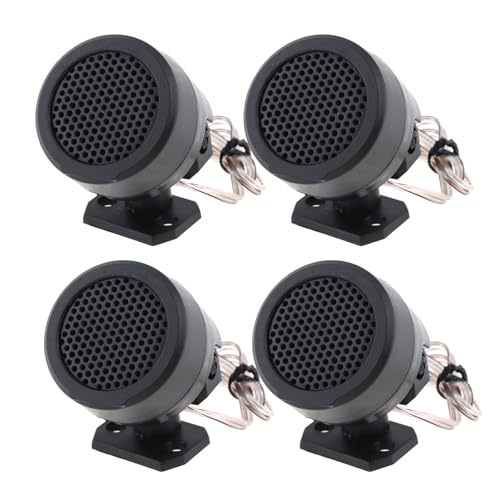
The CCeCCe 2-Pack Square Piezo Horn Tweeter set is built for audio builders, mobile DJs, and car audio tinkerers who want to bring dead high-end frequencies back to life. Designed as a direct drop-in replacement for standard 3.25-inch tweeter cutouts, this speaker element slots neatly into multi-way cabinets, stage monitors, and customized vehicle setups. If your current speakers sound muffled or lack the crisp snap of percussion and brass, this pair offers an accessible, functional upgrade.
Installation is simple thanks to the pre-drilled four-hole corner pattern and the included set of eight M4 screws. Because piezo elements act as capacitive loads, they do not require complicated protective crossover circuits to prevent blowout, making them significantly easier to wire into existing setups than standard dynamic compression drivers. They connect directly across the audio feed, letting you finish your cabinet repair in minutes.
In real-world use, these horn tweeters immediately brighten up the soundstage. With a high sensitivity rating of 91dB, they push clear acoustic cues, cymbals, and vocal harmonics directly to the front of the mix. They are especially effective in open garage workshops, outdoor tailgates, and lively backyard parties where directional treble projection helps sound travel through noisy environments.
Overall, the CCeCCe piezo replacement speaker set serves as a durable, budget-friendly fix for blown horn elements. While it does not deliver delicate audiophile warmth, it provides dependable volume, bright projection, and high power tolerance that get your favorite sound box back into action quickly.
Performance on this speaker element centers entirely on the upper register. Covering a dedicated frequency range from 5kHz to 20kHz, it focuses strictly on airy treble, snare cracks, and top-end vocal overtones. There is no lower midrange warmth or bass output here, making it essential to pair these horns with capable midrange drivers and subwoofers for a complete listening experience.
With a maximum power handling of 150W and 91dB sensitivity, the horn produces substantial output even when driven by moderate amplifier wattage. It cuts through heavy bass lines easily, ensuring high notes stay legible at outdoor volume levels. Listeners looking for relaxed sound may find the horn signature quite forward, but quick adjustments to your head unit or mixer equalizer readily smooth out any excess brightness.
Engineered for functional utility, each speaker features a rigid square plastic housing measuring 3.25 by 3.25 inches with a low-profile depth. Weighing under a quarter of a pound, it adds negligible weight to mobile DJ boxes or trunk enclosures. The matte black finish blends seamlessly into standard speaker carpeting, grilles, and road-ready gear cases.
As a passive wired speaker component, there are no internal batteries to charge, no runtime limitations, and no battery degradation over time. Power is drawn directly from your amplifier or receiver, providing continuous, uninterrupted performance through all-day events, long tailgates, and extended road trips.
Understanding Piezoelectric Speaker Polarity and Phase Behavior
Piezoelectric drivers operate on electrical and mechanical principles that differ completely from magnetic loudspeakers. When considering whether are piezo speakers polar, the short answer is that raw piezo elements are electrically non-polar for alternating current audio signals, but they are acoustically polar within an audio system. Connecting an audio signal to either terminal will make the ceramic crystal vibrate and produce sound without damaging the component. However, matching terminal polarity remains essential whenever the driver works alongside other speakers to prevent acoustic phase cancellation.
The Fundamental Operating Mechanism of Piezo Drivers
Standard dynamic speakers use a wire coil suspended inside a magnetic gap to push and pull a cone diaphragm. In contrast, a piezoelectric speaker uses a specialized ceramic disc, often made of lead zirconate titanate, bonded directly to a thin metal plate. When you introduce an electrical voltage across the crystal material, the crystal experiences mechanical deformation and physically flexes. As an alternating current audio waveform fluctuates between positive and negative voltages, the rapid flexing of the diaphragm creates pressure waves in the surrounding air.
Because the ceramic material acts as a dielectric between two conductive surfaces, a piezo speaker electrically behaves like a capacitor. Conventional electromagnetic speakers present an inductive and resistive load, typically rated at four or eight ohms across nominal audio frequencies. The capacitive nature of a piezo driver means its electrical impedance changes dramatically depending on the frequency of the incoming signal. At low frequencies, the impedance is extremely high, while at very high frequencies, the impedance drops considerably.
Electrical Non-Polarity Versus Acoustic Phase Alignment
From a purely electrical perspective, an alternating audio signal constantly reverses its direction of current flow. A bare piezoelectric disc does not have an inherent electrical polarity that restricts current to one direction like a diode. You can connect positive speaker wire to either terminal, and the crystal will continue to expand and contract smoothly. There is no delicate voice coil that could be forced out of a magnetic gap simply by reversing the wire leads.
While the driver functions safely regardless of electrical orientation, acoustic phase tells a very different story. Sound travels as a series of positive pressure compressions and negative pressure rarefactions. If one driver pushes outward while an adjacent speaker pulls inward, their sound waves can collide and cancel each other out in the listening space. Maintaining consistent phase relationships is vital for achieving balanced and immersive sound across all listening positions.
This phenomenon becomes especially critical near the crossover frequency where a midrange driver and a tweeter share overlapping acoustic output. If a piezo horn is wired out of phase with the main woofer, a severe dip or notch will often appear in the frequency response curve. Listeners frequently perceive this cancellation as a hollow, thin, or distant sound profile with muddy detail. Aligning the relative polarity ensures that both drivers work in harmony rather than neutralizing each other’s output.
Why Manufacturers Mark Positive and Negative Terminals
Many builders wonder why manufacturers bother adding red markings, plus symbols, or different terminal widths to piezo tweeters if the crystal is electrically non-polar. These markings are provided specifically to establish acoustic phase standards across manufacturing runs. When a positive electrical voltage is applied to the marked positive terminal, the diaphragm moves outward in a predictable forward direction. This standardized movement allows installers to wire multiple speakers consistently without guessing driver orientation.
Consistent terminal orientation is especially valuable when configuring stereo pairs or multi-speaker sound reinforcement arrays. If the left channel tweeter moves outward on a positive transient while the right channel moves inward, stereo imaging degrades substantially. The central audio image will wander or feel disconnected, making vocals and high-frequency instruments hard to localize. Following the marked terminals ensures that both stereo channels produce identical wave patterns on synchronized transients.
Component tweeters designed for DJ speakers or car audio enclosures routinely feature these clear markings. For example, the CCeCCe 2 Pack Component Square Tweeter provides an 85mm square frame designed for high-frequency horn replacement in sound boxes. When mounting replacement drivers with the provided mounting screws, observing terminal tags ensures the new horns match the phase of existing woofers. Even small variations in horn placement or wiring can alter treble dispersion in high-output environments.
Crossover Requirements and Electrical Load Considerations
One of the most attractive attributes of piezo tweeters for speaker designers is their natural high-pass filtering behavior. Because a piezo element functions as a capacitor, it naturally presents high impedance to low-frequency signals like bass and lower midrange. As a result, low-frequency electrical currents cannot easily flow through the ceramic element, which prevents low tones from damaging the driver. Many commercial speaker enclosures take advantage of this by wiring piezo horns directly across amplifier outputs without an inductor or capacitor network.
However, driving a purely capacitive load directly from a power amplifier can introduce stability issues in certain audio systems. Some solid-state amplifiers become prone to high-frequency oscillation when connected to purely capacitive loads at ultrasonic frequencies. To stabilize the amplifier, audio designers frequently place a small non-inductive resistor, usually between eight and fifty ohms, in series with the positive lead of the piezo tweeter. This simple addition creates a friendlier load profile while protecting sensitive amplifier output stages.
A series resistor also helps attenuate excessive harshness that can occasionally occur with high-sensitivity horns. The CCeCCe component tweeter features a sensitivity rating of 91dB and power handling up to 150W maximum, making it quite loud relative to standard drivers. Inserting a power resistor of suitable wattage in series allows you to adjust treble balance to match a woofer without introducing complex inductor networks. This straightforward modification keeps the acoustic output clean and shields the amplifier from extreme capacitive swings.
Ultrasonic Transducers and Application Differences
Piezoelectric drivers serve purposes far beyond standard audible treble reproduction in home and DJ audio systems. Ultrasonic transducers take advantage of the high-frequency capabilities of piezo ceramics to generate signals above twenty kilohertz. The MEETOOT 2PCS Ultrasonic Speaker Piezo Loudspeaker demonstrates this application, operating across an extended frequency range from 10 to 50 kHz. These devices are frequently used in pest deterrents, distance sensors, industrial cleaning tanks, and specialized signaling equipment.
In ultrasonic applications, phase alignment and polarity are equally critical for beam shaping and sound pressure concentration. Transducers operating between -20 and 70 Centigrade require durable enclosures to handle extreme environmental shifts. Many of these units feature waterproof construction, making them suitable for outdoor security or repeller systems where moisture could destroy conventional paper cones. For outdoor sound systems that face harsh weather, incorporating waterproof outdoor audio components ensures long-term operational reliability.
Ultrasonic waves suffer from rapid atmospheric attenuation and narrow dispersion compared to audible treble frequencies. If you deploy multiple ultrasonic transducers to blanket an area, wiring them out of phase creates distinct dead zones where frequencies cancel completely. Maintaining strict adherence to polarity markings on ultrasonic horns guarantees maximum sound pressure throughout the intended coverage zone. Paying attention to terminal connections is therefore just as vital for pest management systems as it is for live audio concert rigs.
Practical Step-by-Step Polarity Verification and Testing
Verifying the polarity of an unmarked piezo element requires different techniques than testing traditional dynamic speakers. The common battery test, where an installer connects a 1.5-volt battery to watch cone displacement, does not work well with piezo drivers. The physical excursion of a piezo ceramic disc is microscopic, making visual movement nearly impossible to detect with the naked eye. Furthermore, applying continuous direct current to a crystal can build up an electrical charge without showing sustained physical displacement.
The most reliable practical method to confirm polarity involves a comparative acoustic listening test. Begin by wiring your main woofer and the piezo tweeter in what you believe to be the correct polarity convention. Play a steady audio tone near the anticipated crossover point, such as four kilohertz, or use pink noise played at a moderate volume. Listen carefully from the primary listening axis, paying close attention to clarity and output level at the transition frequency.
Next, disconnect the amplifier power for safety, swap the two wires connected to the piezo tweeter terminals, and restore playback. Whichever connection delivers the fuller, louder, and more seamless sound at the crossover point represents the acoustically correct phase alignment. In some crossover designs, inverting the tweeter leads intentionally provides better summation with the woofer slope. Relying on your ears or a simple measurement microphone provides conclusive proof of correct acoustic integration.
Diagnosing Common Piezo Wiring and Performance Issues
When a piezo speaker sounds quiet, raspy, or disconnected, incorrect wiring is often the underlying contributor. While reversing terminal connections will not silence the driver, improper phase relationships make high frequencies sound diffuse and ungrounded. If your treble seems to originate from behind the cabinet or disappears when you stand midway between two stereo speakers, check terminal wiring immediately. Reversing the leads on one channel often snaps the high-frequency image back into crisp focus.
Another frequent complaint involves harsh, piercing high frequencies that fatigue the listener over extended listening sessions. This issue rarely stems from polarity errors, pointing instead to the lack of damping resistance in the circuit. Because piezo tweeters have low internal damping, they can ring at resonant frequencies if fed high-voltage transients without series resistance. Adding a small wirewound resistor in series with the positive terminal calms ringing and produces a smoother acoustic output.
Amplifier overheating or unexpected protection shutdowns can also occur when multiple piezo tweeters are wired in parallel. Because each piezo driver acts like a capacitor, wiring several in parallel increases total capacitance, which lowers high-frequency impedance dramatically. An amplifier encountering high capacitance at ultrasonic frequencies may begin to oscillate, generating heat and triggering fault circuits. Wiring an eight-ohm or twenty-ohm resistor in series with each parallel branch resolves this capacitive loading problem safely.
Durability, Voltage Limitations, and Operating Conditions
Piezoelectric drivers are known for mechanical ruggedness because they lack delicate voice coils that can burn open from voice-coil heat. Without an adhesive-bonded wire coil in an airtight gap, they tolerate short-term power spikes very well. For instance, the CCeCCe replacement horn is rated for up to 150W maximum power, providing robust output for DJ cabinets and car sound boxes. However, catastrophic failure can still occur if the ceramic crystal is subjected to excessive physical shock or extreme voltage swings.
Direct current voltage poses a unique threat to the internal structure of piezoelectric ceramics. If an amplifier suffers a catastrophic output stage failure and sends continuous DC voltage to the speaker terminals, the ceramic can suffer polarization stress. High continuous DC voltage can depolarize or physically crack the fragile PZT wafer over time. Ensuring that your audio source remains free of DC offset protects both dynamic woofers and piezoelectric tweeters from premature degradation.
Operating temperatures and mounting conditions also influence driver longevity and acoustic stability. Drivers rated for wide temperature boundaries, such as the MEETOOT horn operating between -20 and 70 Centigrade, handle extreme vehicle cabins or exterior installations easily. When mounting any piezo horn, tighten fastening screws evenly into the pre-drilled holes, such as the 71mm adjacent spacing found on standard square frames. Avoid over-torquing the screws, as uneven pressure can warp the plastic horn housing and stress the internal ceramic element.
Taking time to understand the unique characteristics of piezoelectric elements removes the guesswork from wiring your next speaker project. While the ceramic disc inside is electrically non-polar for alternating current audio, respecting marked terminals preserves crucial acoustic phase alignment. Maintaining correct phase prevents cancellation, keeps stereo imaging sharp, and ensures that your audio system delivers clean high frequencies. With proper wiring, suitable series resistance, and careful mounting, piezo drivers offer reliable and cost-effective treble reproduction for years to come.





Write Your Review
No reviews yet. Be the first to share your experience!