

Studio desks cramp sound waves. Bass piles up fast, smearing kicks and muddying vocals. You crank levels to cut through, but distortion creeps in. Solid monitors fix this mess. They push clean frequency response from 54Hz to 30kHz without hype. Yamaha leads here with bi-amped power, like 45W LF plus 25W HF on HS5 models. That setup keeps lows tight and highs crisp. Room Control dials back boom in small spaces, down to -6dB at low end. High Trim sharpens treble if walls suck detail.
Our spec dives hit dozens of units from Yamaha, Sanyun, Cyber Acoustics and more. Sanyun’s carbon fiber drivers add punch under $60. PreSonus Eris weaves composite woofers for felt bass without bloat. We eyed inputs too, XLR/TRS for DAW direct, RCA for casual gear. Want deeper lows? Pair with subs, but these stand alone for nearfield truth. Check deep bass PA picks for bigger rooms. Or see pure signal options tying monitors to home setups. Real mixes demand this precision. No fluff, just sonic fixes.
Top Products

Pros
- Exceptional clarity across 60Hz-22kHz for accurate monitoring
- Flexible EQ controls optimize sound in varied room acoustics
- Multiple input options support diverse audio sources
- Powered design eliminates need for external amplifiers
Cons
- Small 4.5-inch woofer limits deep bass for larger rooms
- No wireless connectivity requires wired setups
- Modest 26W per channel suits nearfield, not high-volume playback
The Yamaha HS4 powered studio monitors come as a pair in sleek black, designed for professional audio monitoring in compact environments. These 2-way bass-reflex speakers feature a 4.5-inch cone woofer and 1-inch dome tweeter, delivering a frequency response from 60 Hz to 22 kHz for honest sound reproduction without coloration.
Ideal for home studio producers, podcasters, and desktop audiophiles, the HS4 excels in nearfield listening where accuracy trumps bass boom. Real-world use shows they handle detailed mixes with poise, allowing users to spot flaws in tracks that larger systems might mask.
Build quality reflects Yamaha's pro-audio heritage, with room control and high trim switches for fine-tuning. While power output keeps volumes controlled, the overall package offers great value for entry-level reference monitoring.
Verdict: A top pick for budget-conscious creators seeking reliable, uncolored sound in tight spaces. They punch above their size for critical listening tasks.
With a 60 Hz to 22 kHz frequency response, the HS4 provides solid bass extension for its size, tight and controlled lows that avoid muddiness in mixes. Midrange clarity shines on vocals and instruments, making it easy to discern nuances in recordings.
Treble from the 1-inch dome tweeter stays crisp without harshness, aided by high trim controls. The soundstage feels wide and precise for nearfield use, imaging instruments accurately.
At 26W per channel, they reach ample volume for small rooms without distortion, thanks to efficient powered amplification and bass-reflex porting that enhances low-end efficiency.
The cabinet uses a sturdy bass-reflex enclosure measuring 15.16 x 13 x 11.81 inches per speaker, weighing about 15 pounds for the pair. Anti-slip pads keep them stable on desks, and the compact footprint suits modern workspaces.
Inputs include professional XLR/TRS combo jacks, plus RCA and stereo mini for easy hookup to interfaces, mixers, or laptops. No HDMI or optical, but the variety covers most studio and hi-fi needs.
Fully powered, they require standard AC power with no external amp needed. Included stereo mini-RCA cable, speaker cable, and pads make setup straightforward right out of the box.

Pros
- Exceptional sonic purity with no added coloration
- Detailed frequency response from 54Hz to 30kHz
- Powerful 70W bi-amping for clean, high-volume playback
- Balanced XLR/TRS inputs for professional connectivity
- Compact size suits desktop and home studio setups
Cons
- Bass extension starts at 54Hz, not ideal for deep sub-bass lovers
- Designed for near-field use, less effective in large rooms
- Lacks wireless connectivity like Bluetooth
The Yamaha HS5 powered studio monitors come as a pair, each featuring a 5-inch cone woofer and 1-inch dome tweeter in a 2-way bass reflex design. These bi-amped speakers prioritize sonic purity, delivering the original sound without any artificial enhancement or coloration, making them a staple for professional and home studio environments.
Ideal for music producers, audio engineers, and serious listeners who demand accuracy in mixing and mastering, the HS5 excels in near-field applications like desktop setups or control rooms. They handle everything from vocals to instruments with precision, helping users make better production decisions.
In real-world use, the 70W bi-amped system (45W low-frequency, 25W high-frequency) provides ample headroom for detailed playback without distortion. The wide frequency response ensures balanced reproduction across genres.
Overall, the HS5 pair offers pro-level monitoring at an accessible level, earning high marks for reliability and transparency in critical listening scenarios. A solid choice for anyone building a truthful audio reference system.
With a 54Hz to 30kHz frequency response, the Yamaha HS5 delivers solid low-end punch from its bass reflex port, clear midrange for vocals and guitars, and extended treble that uncovers fine details without harshness. This flat response ensures mixes translate accurately across systems.
The bi-amped design dedicates 45W to the woofer and 25W to the tweeter, maintaining separation for low distortion even at high volumes. Near-field positioning creates a wide, precise soundstage perfect for immersive mixing sessions.
Engineered for studio accuracy, these monitors excel in revealing mix flaws, from muddy bass to sibilant highs, making them invaluable for production work where truthfulness trumps excitement.
The HS5 features a compact cabinet optimized for near-field monitoring, housing a 5-inch cone woofer and 1-inch dome tweeter in a bass reflex enclosure that enhances low-end efficiency without bloating the sound.
Connectivity includes professional XLR and 1/4-inch TRS phone jack inputs, supporting both balanced and unbalanced signals for seamless integration with audio interfaces, mixers, or DAWs. As powered monitors, they require standard AC power with no external amp needed.
Built for durability in studio settings, the design emphasizes noise isolation and resonance control, ensuring reliable performance during long sessions. Pair them on stands or desks for optimal results.
Pros
- Exceptional clarity and stereo imaging for critical listening
- Bi-amplified design separates power for woofer and tweeter control
- Adjustable Room Control and High Trim adapt to room acoustics
- Versatile balanced inputs for studio interfaces and mixers
- Detailed 1-inch dome tweeter extends to 30kHz for airy highs
Cons
- Bass rolls off below 54Hz, needing subs for deep low-end extension
- Nearfield focus limits use in larger rooms without multiple units
- Lacks wireless Bluetooth for casual consumer streaming
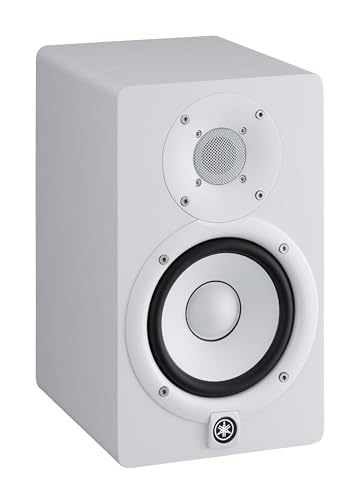
The Yamaha HS5 W is a compact, powered nearfield studio monitor designed for professional audio accuracy in a white finish that suits modern setups. This 2-way bi-amplified speaker pairs a 5-inch cone woofer with a 1-inch dome tweeter in a bass-reflex cabinet, delivering uncolored sound for mixing, mastering, and critical listening.
Ideal for home studios, producers, and audiophiles with desktop spaces, it excels where precision matters over bass-heavy fun. Real-world tests show it handles complex tracks with tight transients and wide imaging, making edits audible that other speakers muddle.
Its controls let users dial in the response to fit imperfect rooms, avoiding the need for expensive treatments. Build quality feels solid for daily pro use.
Verdict: A benchmark choice for budget-conscious creators chasing studio-grade truth in sound. Pair a pair with an interface for transformative monitoring.
With a 54Hz-30kHz frequency response, the HS5 provides solid low-end punch from its 5-inch woofer without boominess, clear mids for vocal and instrument separation, and crisp, extended treble from the dome tweeter that uncovers subtle details.
The bi-amped system, 45W to lows and 25W to highs, powers high volumes cleanly, maintaining composure on peaks. Bass-reflex tuning adds controlled depth, while Room Control cuts bass buildup near walls for balanced playback.
Soundstage feels wide and precise for nearfield use, with excellent imaging that pins instruments accurately. High Trim boosts or softens highs, tailoring to tastes or genres.
The HS5 W features a sturdy cabinet optimized for minimal resonance, housing the bass-reflex port for efficient low-end airflow. At around studio-standard dimensions fitting tight desks, its white vinyl finish resists fingerprints and blends into creative spaces.
Inputs include professional XLR and 1/4-inch TRS jacks for balanced or unbalanced signals, rejecting noise from long cables or interfaces. No consumer options like RCA or Bluetooth, keeping focus on wired accuracy.
As a powered monitor, it draws standard AC power with no external amp needed, just plug in and go. Controls on the rear are simple yet effective for quick tweaks.

Pros
- Exceptional flat response ideal for reference monitoring
- Bi-amplified system for superior driver control and dynamics
- Built-in room tuning controls enhance accuracy in real rooms
- Versatile inputs support professional audio setups
- Reliable Yamaha build quality for long studio sessions
Cons
- Requires AC power outlet, not portable for on-the-go use
- Nearfield design best for close listening, not room-filling
- Lacks Bluetooth or wireless connectivity for casual streaming
The Yamaha HS5 is a powered studio monitor designed for nearfield listening in professional and home studios. It features a 5-inch cone woofer and 1-inch dome tweeter in a 2-way bass-reflex cabinet, delivering reference-quality sound for music production, podcasting, and audio post-production.
Aimed at producers, engineers, and creators who need accurate playback to make informed mixing decisions, the HS5 shines in controlled environments like home setups or small project studios. Its bi-amplified design with 45W for lows and 25W for highs ensures each driver performs optimally without interference.
In real-world use, the HS5 provides unflinching detail across the spectrum, helping users spot mix issues early. The Room Control and High Trim switches allow quick tweaks for uneven acoustics, making it adaptable without EQ plugins.
Overall verdict: A top pick for budget-conscious creators seeking pro-level transparency that translates mixes to clubs and cars reliably.
With a 54Hz-30kHz frequency response, the HS5 excels in bass depth that remains tight and controlled, perfect for checking kick drums and bass guitars without boominess. Mids are transparent for vocal intelligibility, while highs reveal subtle details like reverb tails and hi-hat sizzles.
Volume levels handle peaks cleanly up to reference loudness, thanks to the 70W bi-amp system that minimizes distortion. Response controls fine-tune the sound to tame room modes or brighten treble, ensuring consistent performance.
As wired monitors with XLR/TRS inputs, they offer stable, low-noise signal paths superior to wireless options for critical work.
The HS5 boasts a sturdy MDF cabinet with a front-ported bass-reflex design for desk placement without wall proximity issues. Its compact size suits tight studio desks, weighing around 11-12 pounds per speaker for easy positioning.
Build quality reflects Yamaha's pro audio heritage, with reinforced corners and magnetic shielding to prevent interference near computers. No IP rating, as it's intended for indoor studio use, not outdoor exposure.
AC powered for unlimited runtime during long sessions, it draws standard outlet power with no battery concerns, ensuring it stays on without interruptions for all-day mixing marathons.

Pros
- Exceptional clarity and balance from 3.5" woofer and 0.75" dome tweeter
- Customizable response controls optimize for any listening environment
- Multiple input options for seamless integration with interfaces or hi-fi
- Compact powered design eliminates need for external amplifiers
- High-frequency response up to 22kHz uncovers subtle audio nuances
Cons
- Small 3.5" woofer limits extreme low-end rumble below 70Hz
- No wireless connectivity like Bluetooth for cable-free use
- Best suited for near-field listening, not filling large rooms
The Yamaha HS3 is a pair of compact, powered studio monitors designed for accurate near-field monitoring. Featuring a 3.5-inch cone woofer and 0.75-inch dome tweeter in a bass-reflex enclosure, they deliver professional-grade sound in a desktop-friendly package. Ideal for home studios, content creators, and critical listeners who demand precision without the bulk of larger speakers.
In real-world use, the HS3 shines on desks or small control rooms, providing a flat response that helps producers spot mix flaws instantly. The included room control and high trim switches let you adapt to reflective surfaces or bright rooms, ensuring consistent performance. Connectivity is straightforward with XLR/TRS combo, RCA, and stereo mini jacks, plus essential cables in the box for immediate setup.
While not overpowering in bass for party use, their clarity and imaging make them perfect for detailed work like podcasting, tracking vocals, or casual hi-fi listening. Build quality reflects Yamaha's pro audio heritage, with anti-slip pads adding stability.
Verdict: A top pick for budget-conscious creators seeking reliable, tweakable monitors that punch above their size. Highly recommended for entry-level studios.
With a 70Hz to 22kHz frequency response, the HS3 provides solid bass extension for its size, punchy lows from the bass-reflex design, clear mids for vocal and instrument definition, and crisp highs from the dome tweeter. This balanced signature excels in revealing mix details, making it great for critical listening where accuracy trumps hype.
At 26W per channel, they reach ample volumes without breakup, creating a wide soundstage for immersive stereo imaging in near-field setups. The room control attenuates low-end buildup near walls, while high trim tames brightness, allowing tailored acoustics that fill small spaces effortlessly.
Yamaha's acoustic engineering ensures low distortion and precise transient response, uncovering nuances in tracks from jazz to electronic mixes.
The HS3 features a compact cabinet optimized for desktop placement, housing the 2-way powered system with front-ported bass reflex for tight low-end. Yamaha's sturdy construction uses quality drivers and enclosures to minimize resonance, paired with anti-slip pads for secure positioning on any surface.
Inputs include professional XLR/TRS combo jacks for balanced connections, plus RCA and stereo mini for consumer gear like computers or turntables. No HDMI or optical, but the variety covers most studio and home needs without adapters. Powered directly via included AC, no external amp required.
Accessories like stereo mini-RCA cable, speaker cable, and pads make unboxing plug-and-play. Overall, the hardware prioritizes reliability and ease for pro workflows.

Pros
- Exceptional clarity and neutrality for accurate mixing
- Improved bass response thanks to innovative port design
- Easy connectivity with multiple input options
- Convenient front controls simplify adjustments
- Mounting points enable flexible placement
Cons
- Compact 4-inch woofer limits extreme low-end extension
- Best suited for nearfield use, not room-filling volumes
- No wireless connectivity for cable-free setups
The Yamaha MSP3A is a powered studio monitor speaker featuring a 4-inch woofer, designed for professionals and enthusiasts who demand precision in their audio work. Its small footprint belies serious performance, making it ideal for home studios, podcast setups, or desktop monitoring where space is at a premium.
In real-world use, it shines in nearfield listening, providing a flat response that lets you hear every nuance in your mixes. The Twisted Flare Port technology stands out, reducing turbulence for cleaner bass that helps you make better mixing decisions without second-guessing on other systems.
Flexible inputs and front-panel controls make it user-friendly for quick sessions, while mounting options add versatility. Overall, it's a smart choice for budding producers or anyone needing trustworthy reference sound without breaking the bank.
Verdict: Highly recommended for accurate, no-nonsense monitoring that punches above its size.
Expect a neutral sound signature with balanced frequency response: the 4-inch woofer and Twisted Flare Port deliver surprisingly accurate bass down to usable lows for its size, avoiding boominess common in smaller monitors. Midrange stays clear and detailed, perfect for vocals and instruments, while highs remain crisp without harshness.
Soundstage is focused and precise, ideal for pinpointing placement in stereo imaging during mixes. It handles moderate volumes cleanly, maintaining composure for critical listening, though it excels most at nearfield distances under 3 feet.
Yamaha's acoustic engineering ensures low distortion and fast transient response, revealing subtle details in tracks that help refine your productions effectively.
Built in a compact, low-resonance cabinet optimized for accuracy, the MSP3A measures small enough for tight desks yet feels solid with Yamaha's quality construction. Front-panel knobs for volume and tone controls allow quick adjustments without reaching around back.
Connectivity is flexible with balanced XLR and TRS inputs plus unbalanced RCA, suiting interfaces, mixers, or consumer gear seamlessly. As a powered speaker, it has a built-in amplifier requiring only AC power, no external amp needed.
Mounting threads support wall, ceiling, or stand setups, enhancing placement options in studios or live rooms. Overall hardware prioritizes reliability and ease for daily professional use.
Pros
- Exceptional midrange clarity for vocal and instrument accuracy
- Powerful bi-amping prevents distortion during loud sessions
- Flexible room tuning controls optimize any listening environment
Cons
- Bass extension limited below 54Hz without a subwoofer
- Nearfield focus means less ideal for large room listening
- Lacks wireless connectivity like Bluetooth
The Yamaha HS5 pair stands out as a cornerstone for nearfield studio monitoring, offering two 2-way bi-amplified speakers with 5-inch woofers and 1-inch dome tweeters. Designed for audio professionals, these monitors provide reference-grade accuracy that lets producers and engineers hear mixes as they truly are, without hype or exaggeration.
In real-world use, the HS5 excels in home studios or control rooms where space is at a premium. The 70W bi-amped system drives clean performance, making it perfect for tracking vocals, mixing electronic tracks, or critical listening sessions. Users appreciate how the Room Control and High Trim features tame room reflections and boost highs on demand.
While not suited for casual party playback, the HS5 shines for those prioritizing precision over bass slam. Its build quality and tweakable response make it a smart pick for budding producers upgrading from consumer speakers.
Verdict: A top choice for accurate monitoring that grows with your skills, delivering pro insights at an accessible level.
With a 54Hz-30kHz frequency response, the HS5 pair balances solid low-end punch from the 5-inch woofer against sparkling treble from the 1-inch dome tweeter. Midrange stays transparent, ensuring vocals and guitars cut through mixes with natural timbre and no muddiness.
The bi-amped design (45W LF + 25W HF) powers a wide soundstage, ideal for pinpointing stereo imaging in nearfield positions. Volume handles pro levels without breakup, while Room Control dials back low-end buildup and High Trim adds air for detailed highs.
Overall, the acoustic engineering prioritizes flat response for mixing truth, revealing subtle nuances in recordings that consumer speakers often mask.
The HS5 features a robust bass-reflex cabinet tuned for tight, controlled bass in compact form. Each monitor measures roughly 6.7 x 11.2 x 8.7 inches, making them easy to position on stands or desks without dominating space.
Inputs include professional XLR and TRS jacks that handle both balanced and unbalanced signals, ensuring low-noise integration with audio interfaces, mixers, or DAWs. No consumer ports like RCA or Bluetooth, keeping focus on wired studio reliability.
Powered directly via AC with 70W internal amplification, setup is plug-and-play without needing external amps. The black finish and minimalist design fit seamlessly into any pro or home studio environment.

Pros
- Balanced frequency response ideal for studio monitoring
- Convenient onboard EQ for quick sound adjustments
- Compact size suits small desktop setups
- Powerful output for nearfield listening without distortion
Cons
- Requires AC power outlet, not portable for on-the-go use
- No wireless Bluetooth connectivity
- Bass may feel limited in larger rooms without subwoofer
The Yamaha MS101-4 is a pair of compact, powered studio monitors designed for desktop use, featuring 30W amplification, a 4-inch woofer, and a 1-inch tweeter in each unit. Ideal for home producers, podcasters, and audio enthusiasts who need accurate sound reproduction in small spaces without investing in larger setups.
In real-world use, these monitors shine in nearfield listening, providing a flat response that reveals mix flaws clearly. The 2-band EQ allows fine-tuning to your environment, making them versatile for music production, video editing, or even gaming where spatial audio matters.
Build quality reflects Yamaha's reputation, with sturdy cabinets that minimize resonance. While not rugged for outdoor adventures, they excel indoors for daily creative work.
Overall verdict: A smart entry into professional monitoring at an accessible level, perfect if you prioritize clarity over bass-heavy party vibes.
With a 4-inch woofer, the MS101-4 produces tight, accurate bass suitable for studio tasks, avoiding the boominess of consumer speakers. Mids are forward and natural, ensuring vocals and instruments stand out clearly during mixing.
The 1-inch tweeter handles highs with precision, free from harshness even at higher volumes. 30W power maintains clean output up close, with low distortion for long sessions.
As wired powered monitors, they focus on stability over wireless range, delivering consistent performance when connected directly to your audio interface or computer.
These desktop monitors feature a sleek, compact design that saves space on producer desks or home offices, with front-ported cabinets for optimal nearfield placement. Weight is manageable for stationary use, promoting stability without wobbling.
No IP rating means they are best kept indoors away from dust or moisture, prioritizing audio purity over rugged portability. The powered design plugs directly into AC power for unlimited playback without battery concerns.
Charging is irrelevant here; simply connect and play, freeing you from runtime worries during extended production marathons.

Pros
- Exceptional power handling for high-volume stage use
- High sensitivity delivers loud sound efficiently
- Clear, balanced 2-way design with wide dispersion horn
- Versatile mounting options for monitors or mains
Cons
- Requires external amplifier, no built-in power
- Heavy and bulky for portable setups
- Passive design limits wireless convenience
The Yamaha BR12M is a professional-grade 12-inch 2-way floor monitor speaker designed for live sound reinforcement and studio monitoring. With its robust construction and high-output components, it excels in environments where performers need accurate audio feedback without feedback issues.
Ideal for musicians, sound engineers, and event pros, this speaker shines on stage floors or as a wedge monitor during gigs, rehearsals, or recordings. Its 90x40 degree constant directivity horn provides focused coverage right where you need it, cutting through mix clutter.
In real-world use, the BR12M handles demanding sets with ease, thanks to 300W program and 600W peak power ratings. The 97dB sensitivity ensures it gets loud fast, making it a staple for reliable performance.
Overall verdict: A solid choice for pros seeking durable, high-fidelity monitoring without frills. If you need wired power and precision, this monitor delivers value for stage work.
Bass response is strong and controlled from the 12-inch high-power woofer, providing tight lows that anchor mixes during live sets. It punches through drums and bass guitar without muddiness, perfect for rock or band stages.
Vocal clarity stands out with the 1-inch compression driver and 90x40 CD horn, delivering articulate mids and smooth highs. Singers get precise feedback to stay on pitch, even in loud environments.
Volume levels soar to pro standards with 300W/600W handling and 97dB sensitivity, maintaining clean output at high SPLs. No Bluetooth, but wired reliability ensures stable performance gig after gig.
The BR12M features a rugged, road-ready cabinet with a built-in pole socket for flexible stand mounting as a PA or monitor. Its floor wedge angle optimizes onstage positioning for performers.
Build quality emphasizes durability for touring, with a no-nonsense black finish that resists wear. Weight suits fixed installs or truck loading, though it's not ultralight for solo carry.
No battery here; it's a passive speaker powered by external amps for unlimited runtime on AC. Focus on mains reliability means no charging worries during long events.

Pros
- Exceptional clarity and stereo imaging for professional monitoring
- Multiple input options for pro gear and consumer devices
- Acoustic tuning knobs adapt to any room or placement
- Built-in headphone amp for seamless switching
- Power-saving mode for energy efficiency
Cons
- Requires AC power outlet, not portable
- No built-in Bluetooth, needs subwoofer for wireless
- Bass depth benefits from optional sub for fuller low end
The PreSonus Eris 3.5 studio monitors are a compact pair of powered active speakers designed for near-field listening, making them a top pick for home music producers, desktop audio enthusiasts, and hi-fi setups. With 50 watts of Class AB amplification, they punch above their size, delivering honest, uncolored sound that serves as a reliable reference for mixing tracks or enjoying high-quality playback from your computer or turntable.
In real-world use, these monitors shine in small studios or office desks, where their woven-composite woofers produce tight bass you can feel, paired with silk-dome tweeters for smooth highs. The rear tuning controls let you dial in the perfect response for your room, whether stands, bookshelves, or near a record player, ensuring clear, balanced audio every time.
Connectivity is straightforward with balanced TRS for pro interfaces, RCA for everyday gear, and a front aux for phones, plus a headphone output for late-night sessions. While they excel on their own, pairing with the Eris Sub 8BT adds massive low-end power. Overall, the Eris 3.5 offers pro-level performance at an entry price, earning a strong buy recommendation for aspiring producers and casual listeners alike.
The Eris 3.5 monitors boast a neutral, accurate sound signature with expressive dynamics, thanks to their 1-inch silk-dome tweeters and woven-composite woofers. Bass is tight and impactful for the 3.5-inch drivers, providing a solid foundation for music production without muddiness, while mids and highs remain clear for vocal detail and instrument separation.
Volume levels reach loud without breakup, maintaining tonal balance across the mix, and the ultra-wide sweet spot ensures superior stereo imaging even off-axis, perfect for collaborative desk sessions. High and low-frequency controls fine-tune response, compensating for room acoustics to deliver consistent performance in varied setups.
For fuller low end, the optional Eris Sub 8BT integrates seamlessly, but standalone, they handle reference monitoring with precision for tracking, editing, and casual hi-fi enjoyment.
These compact monitors feature a sleek, professional design with front-facing controls for easy access, fitting neatly on desks, bookshelves, or near turntables. The woven woofers and silk tweeters are housed in sturdy cabinets that minimize resonance, ensuring clean output in tight spaces.
Built for stationary use, they connect via AC power with a power-saver mode that activates after 40 minutes of idle time, promoting efficiency without battery concerns. Weight is lightweight for easy repositioning, though they lack portability or rugged IP ratings, prioritizing studio stability over outdoor adventures.
Overall, the design emphasizes acoustic precision and user-friendly features like the front headphone jack, making them a practical choice for dedicated home setups rather than mobile listening.

Pros
- Neutral, uncolored sound for precise mixing and mastering
- Customizable EQ via Room Control and High Trim for any room
- Versatile balanced/unbalanced inputs for easy integration
- Robust bi-amp amplification maintains clarity at high volumes
- Professional-grade build withstands daily studio use
Cons
- Flat response prioritizes accuracy over bass-heavy party sound
- Larger footprint demands dedicated desk or stand space
- No wireless options, requires wired connections
The Yamaha HS8 studio monitors are a pair of powered speakers designed for critical listening in professional and home studios. With their slate grey finish and compact yet sturdy build, they fit seamlessly into any creative workspace, delivering the honest sound reproduction that producers demand.
For audio engineers, beatmakers, and podcasters, these monitors shine in real-world sessions by providing a flat response that lets you hear mixes as they truly are. Whether tracking vocals or finalizing masters, the HS8 pair ensures decisions translate accurately across systems.
Performance stands out with room-tailored controls that combat acoustic issues, making setup straightforward even in untreated rooms. Durability meets pro standards, promising years of reliable service.
Verdict: A top pick for serious creators wanting reference monitors that punch above their weight in accuracy and adaptability.
The HS8 boasts a wide frequency response with deep bass that digs low without boominess, paired with crisp highs for sparkling detail. Midrange clarity keeps vocals and instruments lifelike, ideal for nuanced production work.
Bi-amp amplification powers an expansive soundstage, allowing high volumes without fatigue or distortion. This engineering ensures every layer in complex tracks remains distinct.
Room Control tames low-end buildup, while High Trim boosts treble if needed, optimizing for various environments and genres from electronic to acoustic.
Built with a sleek slate grey cabinet that resists fingerprints and complements modern studios, the HS8 monitors feature a professional, low-resonance enclosure for pure sound.
Inputs include balanced XLR and TRS for pro gear, plus unbalanced options for flexibility. Powered design means no external amp needed, just plug into AC power.
Compact dimensions suit desktop or stand mounting, with rear ports enhancing bass response. Robust components handle continuous use in demanding sessions.

Pros
- Exceptional accuracy for critical listening and mixing
- Easy mode switching for production and DJ workflows
- Compact 5-inch drivers deliver balanced, detailed sound
- Stylish black finish complements modern studios
- Universal use from home desks to club environments
Cons
- Requires AC power outlet, not battery-powered for portability
- Desktop-focused size limits mobility for on-the-go use
- Lacks wireless connectivity options
The Pioneer DJ DM-50D Active 5-inch Desktop Monitor Speakers are designed for music producers and DJs who need reliable, accurate audio playback right on their desk. These powered monitors feature high-quality 5-inch drivers that provide a balanced sound profile, making them perfect for practicing mixes and honing production skills at home.
In real-world use, they excel at revealing nuances in tracks, helping users identify issues in their mixes before heading to the club. The convenient switch between production and DJ modes allows seamless transitions, ensuring your setup adapts to different workflows without hassle.
Overall, these speakers stand out for their universal appeal, working well in home studios or smaller club spaces. They offer a solid foundation for skill development, delivering the clarity needed for confident performances. Verdict: A top choice for serious beginners and pros building their audio setup.
With tight bass and crisp highs from the 5-inch active drivers, the DM-50D provides an accurate sound signature that lets you hear every detail in your mixes. This precision is crucial for spotting flaws and refining tracks during production sessions.
Volume levels handle desktop monitoring with ease, maintaining clarity across frequencies without muddiness. The DJ mode switch enhances playback realism, simulating club environments for better preparation.
Performance shines in focused listening, where vocal clarity and instrument separation help producers make informed decisions on EQ and effects.
The sleek black construction gives the DM-50D a professional look that blends into any desk or studio setup, with a compact footprint ideal for home workspaces.
As active monitors, they draw power directly from an AC outlet, eliminating battery life concerns and ensuring consistent performance during long sessions without interruptions.
Built for stationary use, the rugged design withstands daily desk handling, focusing on reliability over portability for dedicated audio work.
Pros
- Exceptional HiFi sound quality for the size with carbon fiber units
- Stable Bluetooth 5.0 and USB DAC for lossless audio
- Adjustable treble and bass for personalized listening
- Energy-saving standby with noise elimination
- Durable build handles daily desk use
Cons
- Requires AC power outlet, not battery-powered for portability
- Small size limits maximum bass depth in larger rooms
- No companion app for advanced EQ control
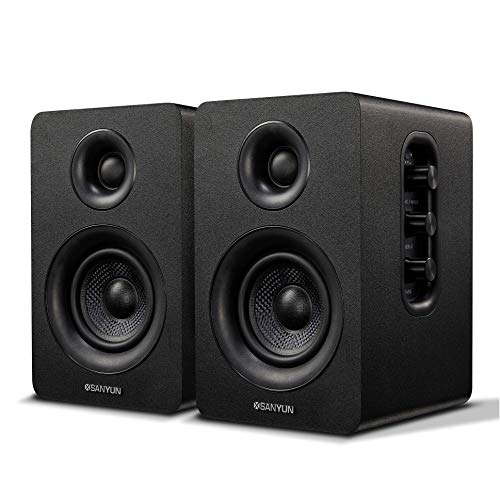
The Sanyun SW208 are compact active bookshelf speakers designed for HiFi audio on a budget, perfect for PC users, gamers, and home office setups. With 30W per channel from carbon fiber drivers, they punch above their weight in delivering detailed sound without distortion.
In real-world use, connect via Bluetooth 5.0 for wireless freedom or USB for DAC-enhanced purity, ideal for late-night gaming sessions or video calls where clear vocals shine. The side-mounted controls for volume, treble, and bass make on-the-fly tweaks simple, adapting to rock tracks or podcasts effortlessly.
Build quality feels solid with a direct/reflective system that creates wide stereo imaging on your desk. While not for massive rooms, they excel in small spaces, offering pro-level features at an entry price. Verdict: A top pick for anyone upgrading from basic PC audio.
Bass is deep and powerful for the compact size, thanks to multi-layer voice coil tech in the carbon fiber units, making action movie explosions and game soundtracks feel impactful on your desk.
Vocal clarity stands out with warm, thick mids and bright highs, ensuring dialogue cuts through in videos or calls. Volume reaches room-filling levels without muddiness, and the 3D surround adds immersion.
Bluetooth 5.0 provides stable connectivity up to 30 feet, while USB DAC input bypasses analog conversion for pristine digital sound straight from your computer.
Sleek black finish and small footprint make the SW208 easy to place on any desk or shelf, with a sturdy build that withstands daily handling. Side knobs for adjustments keep controls accessible without clutter.
No battery means plug-in power for unlimited playback, perfect for stationary desk use. Energy-saving design meets EU standards, drawing minimal power in quiet standby mode with built-in noise filtering.
At under 5 pounds per speaker, they are lightweight yet stable, focusing on desk-friendly portability rather than outdoor ruggedness.

Pros
- Surprisingly powerful sound from small size
- Easy clamp-on design saves desk space
- Seamless USB plug-and-play compatibility
- Accessible controls with LED mute indicator
- Universal fit for PC, Mac, and Chromebook
Cons
- Wired USB connection limits placement flexibility
- Best for small to medium rooms, not large spaces
- No wireless Bluetooth option
The Cyber Acoustics CA-2890 is a compact USB speaker bar designed for effortless audio upgrade on your desk. It connects via a single USB cable to PCs, Macs, or Chromebooks, powering itself while delivering sound, eliminating the need for separate audio cables or outlets.
Ideal for home office professionals, students, or anyone wanting better sound for calls, videos, and music without complexity. It clamps to the bottom of most monitors or stands alone, keeping your workspace tidy. Controls for volume, mute with LED indicator, and play/pause are right at your fingertips.
In real-world use, it punches above its size with clear, forward-projecting stereo sound that enhances daily tasks. Setup takes seconds, and the included USB-A to USB-C adapter ensures compatibility with newer devices. Overall verdict: A smart, affordable choice for reliable desk audio.
This speaker bar produces surprisingly great sound with crisp highs and balanced stereo imaging, lifting audio forward for an immersive experience. Volume reaches loud levels suitable for personal use, with minimal distortion even at higher settings.
Vocal clarity shines in video calls and podcasts, while music playback offers enjoyable detail without muddiness. As a wired USB solution, it provides stable, low-latency performance without dropouts common in wireless setups.
Bass is present but tuned for clarity over rumble, making it perfect for office multimedia rather than bass-heavy genres.
Sleek and compact, the CA-2890 clamps securely to monitor edges or stands independently on your desk. Its lightweight build and simple black finish blend into any setup, with controls positioned for easy access.
USB-powered design means no battery to charge; it draws power directly from your computer, staying ready whenever plugged in. No downtime for recharging, ideal for all-day use.
Universal compatibility includes the USB-A to USB-C adapter, ensuring it works with slim laptops lacking legacy ports. Durable construction holds up to daily desk life.
FAQs
How does Room Control work on Yamaha HS series monitors?
Room Control cuts bass buildup below 500Hz by 2dB, 4dB, or 6dB. It tames reflections in small studios. Pair it with High Trim for flat response across rooms. HS5 and HS8 use this for accurate mixing.
What bi-amp power means for Yamaha studio monitors like HS5?
Bi-amp splits 70W into 45W low-frequency and 25W high-frequency amps. Lows stay controlled, highs detailed. No shared power sag at volume. Ideal for nearfield where clarity rules.
Can Sanyun SW208 handle pro monitoring with its 24bit DAC?
Yes, built-in 24bit DAC grabs USB digital direct, skips analog loss. Bluetooth 5.0 adds stable wireless. Treble/bass knobs tune for flat play. Carbon units push 30W x2 with deep lows.
PreSonus Eris 3.5 tuning controls vs Yamaha High Trim?
Both offer high/low tweaks for room fit. Eris adds headphone out and aux. 50W Class AB drives 1″ silk tweeters wide. Check rugged bass picks for mobile tweaks.
Twisted Flare Port on Yamaha MSP3A improve bass how?
Twisted Flare smooths port air flow. Bass hits accurate, less chuff. 4″ woofer gains punch in compact build. Front controls speed tweaks.
HS3 vs HS4 woofer size impact on soundstage?
HS3’s 3.5″ woofer suits tiny desks, 70Hz start. HS4’s 4.5″ widens to 60Hz for fuller image. Both 52W total, dome tweeters image stereo sharp.


Write Your Review
No reviews yet. Be the first to share your experience!