


Setting up reliable live sound often starts with a fundamental equipment question about power and signal routing. Anyone exploring an are pa speakers active guide quickly discovers that public address systems split into two distinct categories: active and passive designs. Active models feature built-in amplifiers and dedicated signal processing inside the cabinet, whereas passive models rely entirely on external power amplifiers and heavy speaker wire. Selecting the right format depends heavily on your performance venue, travel needs, and how much control you want over individual audio components.
While high-end speaker systems often rely on modular external amplification racks in fixed auditoriums, mobile musicians, public speakers, and venue managers frequently prefer self-contained active cabinets. Active enclosures streamline setup routines by eliminating the guesswork of impedance matching and wattage calculations. This practical guide breaks down the mechanical differences between active and passive PA gear, clarifies input requirements, and examines versatile options ranging from portable powered monitors to specialized outdoor horns.

Pros
- Exceptional clarity from 8-inch woofer and piezo driver
- Lightweight 11-lb design with ergonomic handle for easy carry
- Multiple wired inputs for seamless multi-device connections
- Built-in EQ and gain controls for quick sound adjustments
- Clip protection ensures reliability during long performances
Cons
- No Bluetooth or wireless options for cable-free setups
- 30W power best for small spaces, not large outdoor events
- Requires AC power outlet, limiting fully untethered use
The Gemini AS-2108P is a compact 30W powered PA speaker designed for musicians, DJs, and performers who need reliable sound on the move. At just 11 pounds, its molded ABS cabinet makes it perfect for loading into cars and setting up quickly at practices, small gigs, church services, or casual events. With dual-channel inputs and onboard controls, it functions as a floor monitor, main PA, or instrument amp without extra gear.
In real-world use, it shines in rehearsal spaces and intimate venues where precise audio matters most. Connect microphones, guitars, or phones via XLR, 1/4-inch, RCA, or AUX inputs, and the mix output lets you daisy-chain multiples. The high-temp voice coil and piezo driver provide balanced sound that stays clear even during extended sets, thanks to clip LED protection against overloads.
For gigging pros and hobbyists alike, this speaker offers pro-level features in a budget-friendly, portable form. It eliminates the hassle of unreliable wireless connections, delivering rock-solid performance every time. Verdict: A top pick for anyone prioritizing wired reliability and portability over bells and whistles.
Expect accurate, fatigue-free sound with deep bass from the 8-inch woofer and sparkling highs via the piezo compression driver. Vocals cut through cleanly, making it excellent for lead singers or monitors during band practice. The 30W peak power fills small rooms effortlessly without muddiness.
Onboard bass and treble EQ plus dual-channel gain let you tweak tone on the fly for instruments or DJ mixes. Wired connections ensure zero latency or interference, outperforming Bluetooth in live scenarios. Volume levels handle intimate gigs reliably, with clip protection maintaining clarity at peaks.
Built tough with impact-resistant ABS housing, ergonomic top handle, and standard 35mm pole mount, this speaker withstands the rigors of transport from car to stage. At 11 pounds, it's one of the lightest powered options, perfect for solo setups at practices or events.
As an AC-powered unit, it offers unlimited playback without battery concerns, ideal for plugged-in rehearsals or gigs. No charging downtime means it's always ready, though you'll need a nearby outlet. Road-ready design prioritizes durability and portability over wireless freedom.

Pros
- Exceptional clarity and volume for PA applications
- Adjustable bracket allows flexible aiming
- Compact and lightweight design enhances portability
- Durable ABS construction withstands regular use
- Complete with mounting hardware for immediate use
Cons
- Frequency range limited to 500Hz-5kHz, missing deeper bass
- Peak power rating only, with no specified RMS for continuous use
- May not suffice for very large venues due to 101dB max output
The Pyle 8-inch PA horn speaker is a rugged, portable audio solution designed for amplifying voice or music in indoor and outdoor settings. Ideal for DJs, event organizers, coaches, or anyone needing reliable public address capabilities without complex setups, it excels in gyms, parks, warehouses, or parties.
Standout features include 65 watts peak power and 101dB output at 8 ohms impedance, ensuring loud, intelligible sound across its 500Hz to 5kHz frequency response. In real-world use, it projects clearly over moderate distances, making announcements crisp and music energetic without distortion at normal volumes.
Build quality shines with a durable ABS horn body, weighing just 2.75 lbs and measuring 8 x 4.5 x 9 inches for easy handling. The included 180-degree swiveling bracket and hardware allow secure, adjustable mounting on walls, poles, or stands, promoting versatility.
Potential drawbacks include the narrower frequency range, which skips low bass for fuller music playback, and reliance on peak power specs without RMS details for prolonged high-volume operation. It suits targeted amplification rather than hi-fi audio.
Overall, this Pyle horn speaker offers excellent value for portable PA needs, earning strong recommendation for budget-conscious users prioritizing clarity, ease, and power in practical scenarios.
Key Specs:
- Driver Size: 8 inches
- Impedance: 8 ohms
- Peak Power: 65 watts
- Max SPL: 101 dB
- Frequency Response: 500 Hz - 5 kHz
- Weight: 2.75 lbs
- Dimensions: 8" H x 4.5" W x 9" D
- Material: ABS horn with adjustable bracket
- Includes: Mounting bracket and hardware
Pros
- Instant, hassle-free wireless pairing between the clip-on microphone and speaker.
- Strong vocal projection that easily fills classrooms and auditoriums of over 100 people.
- Generous 2200mAh battery provides up to 12 hours of dependable amplification.
- Versatile Bluetooth 5.3 support for playing background music and presentation media.
Cons
- Susceptible to high-pitched acoustic feedback if the microphone is held too close to the speaker grille.
- Acoustic tuning focuses strictly on vocal frequencies, lacking deep bass response for casual music playback.
- Lightweight plastic enclosure requires careful handling to prevent scuffs in demanding environments.
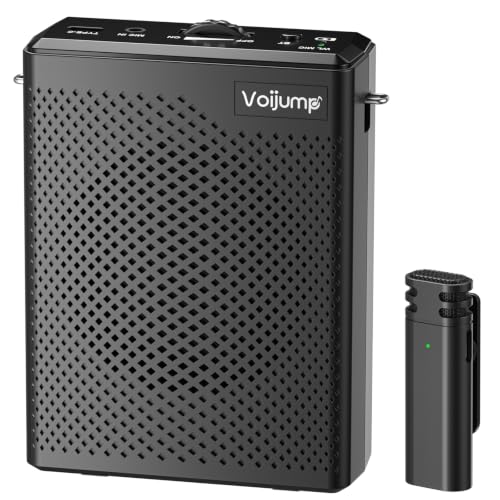
The voijump Wireless Voice Amplifier is an ultra-portable PA speaker system created specifically to eliminate vocal strain for educators, fitness coaches, tour guides, and corporate presenters. Instead of forcing speakers to shout across crowded lecture halls or noisy outdoor spaces, this compact setup projects natural, intelligible speech to crowds of over 100 listeners effortlessly.
What sets this setup apart in daily use is its seamless operation. The included wireless lavalier microphone connects automatically to the speaker unit the moment both devices are powered on. With an accessible wireless reception range of up to 20 meters (approximately 65 feet), teachers and speakers can freely walk around the room, engage with listeners, and write on whiteboards without being anchored to a podium or tangled in mic cords.
Beyond vocal reinforcement, the unit doubles as a practical multimedia speaker thanks to integrated Bluetooth 5.3 technology. Users can pair a smartphone, tablet, or laptop to stream educational audio clips, presentation videos, or background music. While the audio tuning is strictly vocal-centric rather than audiophile-grade for music, it delivers exceptional clarity where spoken dialogue matters most.
Overall, the voijump system provides reliable, everyday voice projection in a lightweight, accessible package. For anyone seeking dependable throat protection and hands-free convenience throughout long lecturing shifts, this wireless package stands out as a highly practical productivity tool.
Acoustically, the voijump voice amplifier is tuned specifically to maximize speech clarity and midrange intelligibility. The internal driver focuses on the critical vocal spectrum, delivering clean upper-bass reinforcement and crisp treble articulation. This targeted response allows spoken words to cut cleanly through ambient room rustle, ventilation noise, and student chatter without sounding boxy or muffled.
The wireless lavalier microphone utilizes an omnidirectional pickup capsule integrated with an intelligent AI active noise reduction chip. This processing hardware isolates original voice dynamics while actively attenuating background interference. Paired with a high-density spray-proof foam cover, the mic effectively tames vocal plosives and breath noise for a smooth, natural sound delivery.
Because the speaker produces high sound pressure levels from a miniature cabinet, acoustic separation is important. Placing the microphone directly in front of the speaker grille at short range can cause acoustic feedback squealing. Wearing the speaker unit on your hip via the included strap and clipping the lavalier to your collar maintains the ideal physical separation for loud, distortion-free output.
Weighing only 0.6 pounds with pocket-friendly dimensions of 1.8 x 0.8 x 2 inches, the voijump voice amplifier is engineered for maximum mobility. The chassis is molded from lightweight, durable plastic built to withstand daily use. It features an integrated heavy-duty back clip along with an adjustable waist strap, allowing you to secure the speaker to a belt, pocket, or wear it comfortably around the waist.
Power performance is driven by an internal 2200mAh rechargeable lithium battery that provides between 10 and 12 hours of continuous voice amplification on a 3 to 4-hour charge. The wireless lavalier mic is equipped with its own rechargeable battery, delivering 6 to 8 hours of continuous operation on a quick 1 to 1.5-hour charge, ensuring reliable power through an entire workday.
Hardware connectivity combines a stable 2.4GHz proprietary wireless link for the microphone with Bluetooth 5.3 for external audio sources. Standard USB charging ports make powering both units straightforward using common wall adapters or computer ports, completing a travel-friendly audio toolkit.
Active Versus Passive PA Speaker Configurations and Performance
Public address sound reinforcement converts low-voltage audio signals into acoustic energy that fills a room or outdoor space. When asking whether PA speakers are active, the practical answer is that both active and passive designs exist across the live sound market. Active speakers integrate power amplifiers and electronic processing directly inside the cabinet enclosure. Passive speakers operate as unpowered driver cabinets that require an external power amplifier or powered mixing board to produce sound. Understanding how these formats diverge allows performers, audio technicians, and venue operators to select the right equipment for their acoustic requirements.
The Core Distinction: Active Versus Passive PA Designs
The fundamental dividing line between active and passive PA speakers comes down to amplifier location. In an active PA speaker, often described as a powered loudspeaker, the manufacturer builds the power amplifier directly into the cabinet chassis. This architecture requires each speaker to connect to an AC electrical outlet or draw current from an internal rechargeable battery. Because amplification electronics reside inside the enclosure, you route line-level or microphone-level signals directly from an audio source into the speaker panel.
Passive PA speakers omit internal power electronics completely, housing only the speaker drivers and a passive crossover network within the cabinet. These enclosures cannot generate sound on their own when connected to standard line-level audio cables. Instead, they must connect to an external power amplifier through heavy-gauge speaker cables rated for high-current loads. While passive systems require extra outboard gear, they centralize amplifier control in a single equipment rack, which remains common in permanent venue installations.
How Active PA Systems Handle Signal Flow and Crossover Networks
Active PA systems deliver notable performance benefits because their internal electronics are matched at the factory. In a powered cabinet, the incoming audio signal passes through an active crossover circuit before reaching the power amplification stage. This active crossover divides the frequency spectrum into distinct bands, sending high frequencies to the tweeter and low frequencies to the woofer. Splitting the signal at line level minimizes power loss and maintains precise frequency division across all listening volumes.
Many powered enclosures utilize dedicated internal amplifier modules for each driver, a design commonly known as bi-amplification. For instance, the Gemini 30W Powered PA Speaker 8” pairs an eight-inch woofer with a one-inch voice coil and a piezo high-frequency compression driver. The internal amplifier delivers thirty watts of peak power matched directly to those drivers, eliminating impedance guesswork. Similar engineering principles appear in modern powered desktop audio speakers, where matched internal amplifiers ensure balanced audio output in compact enclosures.
Integrated active processing also provides built-in tone control right on the speaker cabinet. The Gemini powered unit includes onboard equalization dials for bass and treble, allowing users to modify tone without an external mixing desk. Dual-channel gain controls let performers adjust a vocal microphone and an auxiliary track simultaneously. This self-contained architecture gives solo artists and mobile presenters immediate tone shaping in practice rooms, small venues, and rehearsal halls.
Passive PA Configurations: External Amplifiers and Impedance Loads
Operating passive PA equipment requires close attention to electrical specifications, especially nominal impedance and continuous power ratings. Because passive cabinets lack internal power supplies, an external amplifier must deliver the electrical current that drives the speaker voice coils. Connecting a passive speaker to an incompatible amplifier can cause distorted audio output, excessive thermal buildup, or driver damage. Audio operators must always verify that the amplifier channel output matches the power handling of the connected speaker cabinet.
Impedance, measured in ohms, represents the electrical resistance a passive speaker presents to the connected amplifier channel. The Pyle Indoor / Outdoor PA Horn Speaker illustrates a specialized passive speaker design, featuring an eight-ohm nominal impedance and a sixty-five-watt peak power rating. When driving an eight-ohm horn speaker, the external amplifier must provide clean power within that load range without clipping. Horn-style passive speakers direct acoustic energy into a focused projection pattern, achieving a high output level of 101 decibels across a specialized frequency response of 500 Hz to 5 kHz.
Connecting multiple passive speakers to a single amplifier channel introduces additional electrical calculations. Wiring two eight-ohm speakers in parallel cuts the total circuit impedance down to four ohms, drawing increased current from the amplifier. If an amplifier is not rated for low-impedance operation, it may overheat or trigger protective shutdown circuits. Passive systems therefore require deliberate calculation and appropriate speaker wire to maintain system stability during extended events.
Input Flexibility and Gain Staging on Modern Powered Cabinets
Active PA speakers provide diverse connection options on their rear panels, simplifying integration with a wide variety of sound sources. Typical powered enclosures feature balanced XLR inputs, quarter-inch jacks, unbalanced RCA phono inputs, and 3.5mm stereo auxiliary jacks. Balanced XLR connections offer superior rejection of electromagnetic interference, making them ideal for long cable runs across a stage. Unbalanced RCA and auxiliary ports make it simple to patch in consumer playback hardware, smartphones, or computers.
Switchable input sensitivity is another key asset found on versatile active loudspeakers. On models like the Gemini active cabinet, channels offer switchable mic and line-level modes, allowing the preamplifier circuit to accommodate both low-output dynamic microphones and high-output mixing consoles. Plugging a microphone directly into a standard line input produces very quiet sound, while sending a line signal into an unpadded mic preamplifier creates harsh clipping distortion. Many powered cabinets also feature an XLR mix output to daisy-chain a second powered speaker or subwoofer without requiring splitters.
Compact Personal Voice Amplifiers for Mobile Presentations
Not all sound reinforcement scenarios call for heavy stage monitors or stationary horn arrays. Specialized personal active systems cater to educators, tour guides, and public presenters who need hands-free speech amplification on the move. The voijump Wireless Voice Amplifier with Wireless Lavalier Mic represents an active mini-PA concept engineered specifically for voice clarity in instructional settings. By incorporating an internal 2200mAh rechargeable lithium battery, this ultra-portable active speaker operates for ten to twelve hours without tethering the speaker to an AC wall outlet.
Wireless signal transmission plays a crucial role in modern portable presentation systems. The voijump amplifier pairs automatically with its companion wireless lavalier microphone, which delivers six to eight hours of run time on a short charge. Operating over an accessible transmission distance of twenty meters, the wireless link gives instructors freedom of movement across large lecture spaces. Similar to standard portable wireless speakers, the device also includes Bluetooth 5.3 connectivity, enabling users to stream background music or instructional audio alongside speech.
Intelligent digital signal processing enhances vocal intelligibility when presenting in noisy environments. The lavalier transmitter incorporates active noise reduction circuitry paired with a high-density spray-proof foam windscreen to reduce ambient chatter and air turbulence. Weighing only a fraction of a standard stage monitor, the speaker housing clips securely onto clothing or hangs from an included waist strap. These compact active designs prove that sound reinforcement technology extends far beyond traditional stage cabinets into lightweight everyday tools.
Practical Acoustic Management: Preventing Microphone Feedback
Acoustic feedback represents a persistent challenge when deploying any public address system, active or passive. Feedback occurs when sound emerging from a speaker enters a nearby microphone, gets amplified, and loops continuously until a piercing squeal overwhelms the audio system. Because active speakers often place the microphone preamp, amplifier, and driver in close proximity, managing speaker placement and microphone technique is critical. Understanding acoustic geometry allows operators to maintain high vocal clarity without triggering loud oscillations.
Preventing feedback requires maintaining adequate physical distance and directional isolation between the microphone capsule and the speaker cone. As noted in the operating guidelines for compact systems like the voijump voice amplifier, pointing a lavalier or handheld mic directly at the speaker grille almost guarantees feedback squeal. Presenters should position the speaker slightly ahead of the microphone pickup plane or angle the cabinet away from the performer. Equalization also serves as a valuable defense, as trimming treble or excessive bass frequencies helps tame ringing before feedback escalates.
Setup Workflows, Cable Management, and Portability Differences
Workflow differences between active and passive setups become immediately obvious during system assembly and breakdown. Active PA setups require running two separate cables to every speaker position: an audio signal line and an AC electrical power cable. In outdoor spaces or sprawling event venues, accessing reliable power outlets near each speaker stand can pose logistical hurdles. Users must route heavy-duty extension cords alongside balanced audio lines, taking care to cross cables at right angles to prevent electrical hum.
Conversely, passive PA systems simplify cable runs at the speaker stands because each cabinet requires only a single unshielded speaker cable. All power distribution, thermal management, and circuit protection remain contained within the central amplifier rack near the mixing station. This setup advantage makes passive cabinets particularly attractive for permanent installations on stadium trusses or high venue ceilings. Running lightweight speaker wire through walls and conduit is frequently simpler and safer than running high-voltage AC mains to elevated speaker locations.
Cabinet weight also factors heavily into mobile production workflows. An active unit houses a heavy transformer, amplifier heat sink, and internal chassis circuitry, which adds noticeable heft compared to an equivalent passive box. However, modern materials have significantly reduced this weight penalty over the years. The Gemini eight-inch active monitor weighs just eleven pounds thanks to an impact-resistant molded ABS enclosure and an ergonomic top carry handle, proving that modern powered speakers can be remarkably road-ready.
Enclosure Materials, Projection Horns, and Limiter Protection
Enclosure construction directly influences acoustic dispersion, durability, and environmental resistance across live environments. Molded ABS plastic cabinets, utilized in both active monitors and specialized passive horns, offer outstanding impact resistance against accidental drops during transit. The Pyle outdoor horn features an eight-inch ABS flared design measuring eight inches high by 4.5 inches wide and nine inches deep. This horn flare acts as an acoustic transformer, matching the high acoustic impedance of the vibrating diaphragm to the lower impedance of ambient air for intense projection.
Mounting provisions determine how effectively a speaker can be deployed in diverse installation environments. The Pyle horn speaker weighs a modest 2.75 pounds and includes a 180-degree swiveling adjustable mounting bracket with heavy-duty hardware. This bracket allows installers to aim the horn precisely toward target listening zones, avoiding reflective architectural surfaces. Secure mounting brackets and industry-standard pole sockets ensure that both passive horns and active cabinets can be positioned safely above audience ear level for optimal coverage.
Internal driver protection also separates active and passive architectures during high-output operation. Active PA speakers feature built-in limiting circuits and clip LEDs, such as the visual warning light on the Gemini cabinet, to prevent voice coil damage. Passive cabinets rely entirely on external amplifier headroom and cautious operator monitoring to avoid clipping distortion. The Gemini cabinet intentionally relies on wired-only connections to prevent latency and interference, ensuring reliable signal integrity throughout a performance.
Choosing the Correct PA Format for Your Application
Selecting between active and passive PA gear ultimately depends on your venue layout, technical expertise, and operational style. Mobile DJs, acoustic performers, and traveling presenters benefit immensely from active PA speakers due to their all-in-one convenience and fast setup times. Having internal amplification, dual-channel mixing, and integrated tone shaping in a single eleven-pound box eliminates the need to haul separate mixer cases and heavy amplifier racks. You simply connect your microphone, plug into wall power, and begin performing.
Permanent installations, commercial paging facilities, and large outdoor arenas often achieve greater flexibility with passive speaker architectures. Running passive horn speakers like the Pyle eight-ohm unit allows administrators to mount weatherproof enclosures outdoors while keeping all electrical amplifiers secure inside a climate-controlled equipment closet. Upgrading the system down the road is straightforward because you can replace the central amplifier without removing mounted speakers from high walls. As long as total impedance loads remain safe, adding more passive horns to existing lines remains an economical choice.
Personal voice amplifiers fill another crucial niche where standard PA cabinets are simply too cumbersome to deploy. Educators managing bustling classrooms and docents guiding walking tours achieve effortless vocal projection with miniature active units like the voijump system. By weighing system portability against venue dimensions, audio operators can invest in the exact PA configuration that delivers clean, reliable, and fatigue-free acoustic reinforcement. Verifying power requirements, connection types, and mounting options before purchasing ensures your chosen sound system performs seamlessly from the opening soundcheck to the final encore.


Write Your Review
No reviews yet. Be the first to share your experience!