


Enclosure design dictates how sound waves radiate from the front and rear of an audio driver. Many listeners dealing with boomy bass, muddy low-end definition, or awkward room placement wonder whether can vented speakers be sealed without damaging internal components. Ported speaker boxes rely on an open duct tuned to reinforce specific sub-bass frequencies, whereas sealed designs trap the air entirely to serve as an acoustic spring. Converting an enclosure by plugging its port changes the acoustic damping, transient speed, and overall tonal balance of the audio system.
Vehicle owners and home audio enthusiasts often explore this modification when upgrading their systems with aftermarket component speakers or aftermarket subwoofers. Drivers tuned specifically for vented environments behave differently when restricted to a sealed chamber. Understanding how air displacement, mechanical resistance, and cabinet volume interact helps audio builders decide if blocking a port will produce tighter sound or simply restrict power delivery.

Pros
- Massive 500W RMS power for deep, authoritative bass
- Compact amp with easy multi-section mounting
- Integrated circuit protection with LED status
- Reliable surface mount tech resists vibrations
- Dual 12-inch subs in vented enclosure for efficiency
Cons
- Requires ample trunk space for enclosure
- High power draw needs strong vehicle electrical
- Professional wiring recommended for best results
The MTX TNP212DV is a dual 12-inch loaded vented subwoofer enclosure paired with a 2000-watt capable amplifier, designed as an all-in-one MTX Party Pack to supercharge your vehicle's bass. It packs 1000W max power and 500W RMS into a compact setup, ideal for car audio fans who want to turn drives into concerts without piecemeal installs.
Perfect for bass lovers hitting tailgates, road trips, or daily commutes, this combo installs via multi-sectioned mounting bars, fitting most vehicles. Real-world performance shines in delivering punchy lows that rattle trunks and elevate music, all while the slim amp tucks away easily.
Reliability comes from surface mount technology and vibration resistance, ensuring longevity on rough roads. The LED status indicator flags issues early, protecting your investment. Overall verdict: a top pick for powerful, hassle-free car bass that transforms any ride.
Bass depth is the star here, with dual 12-inch subs at 2 ohms impedance pounding out deep, visceral lows that make every track feel alive in your vehicle. The 500W RMS amp pushes 1000W peaks cleanly, handling high volumes without muddiness for tailgate parties or highway cruises.
Volume levels fill cabins effortlessly, turning stock systems into thunder machines. While focused on subs, it integrates seamlessly with factory audio for balanced thump. Stability is solid in wired car setups, with no dropouts during long drives.
Sleek black enclosure with dual loaded subs keeps a low profile, while the ultra-compact amp uses multi-sectioned bars for flexible mounting in tight vehicle spaces. Vibration-resistant surface mount tech ensures it holds up on potholed roads or off-road adventures.
Rugged build withstands daily abuse without flexing, though it's vehicle-powered rather than battery-operated, drawing from your alternator for unlimited runtime on drives. Weighs in sturdy for stability but needs trunk real estate; no IP rating, but sealed design fights dust and moisture inside cars.

Pros
- Ported chamber design substantially increases volume output compared to sealed alternatives
- Sturdy, well-sealed MDF structure prevents unwanted rattles and acoustic leaks
- High-flow vent assists in woofer thermal dissipation during high-power playback
- Durable charcoal carpet wrap matches factory automotive trunks and cargo spaces
Cons
- 42Hz factory tuning emphasizes punchy mid-bass over ultra-low sub-30Hz frequencies
- Single-chamber setup does not allow multi-sub upgrades without adding extra enclosures
- Sizable height profile requires verifying trunk and cargo depth before installation
The QPower 12-Inch Single Subwoofer Box is a dedicated solution for automotive audio enthusiasts looking to amplify their low-end without the time and expense of building a custom enclosure from scratch. Designed to house a single standard 12-inch driver, this ported cabinet yields 1.65 cubic feet of internal airspace. It caters squarely to drivers who prioritize sheer output, high efficiency, and dynamic punch over muted, low-output configurations.
In real-world applications, this enclosure drops neatly into the trunk of most sedans, hatchbacks, and sport utility vehicles. The exterior is wrapped in a hard-wearing charcoal carpet that blends effortlessly into stock interiors, resisting the abrasions caused by moving luggage or tools. The mounting baffle is cleanly recessed, ensuring an airtight seal when mounting your chosen subwoofer basket.
Acoustically, the box makes the most of available amplifier power. Thanks to its ported bass-reflex design, it allows low-frequency energy to radiate freely into the vehicle cabin with minimal motor resistance. For music genres characterized by energetic bass lines like hip-hop, EDM, and hard rock, this setup delivers an instant sonic upgrade that transforms your daily commute.
Ultimately, the QPower 12-inch enclosure represents a smart, cost-effective foundation for your mobile sound system. It gives you the structural rigidity and thermal management necessary to push your subwoofer hard while keeping installation fast and hassle-free.
The acoustic signature of this enclosure is defined by its factory 42Hz port tuning. Unlike fully sealed enclosures that damp driver movement for subtle musical nuance, this vented configuration is engineered for high sound pressure levels and noticeable cabin impact. Bass drops hit with authority, delivering a palpable vibration throughout the car cabin that cuts cleanly through tire and wind noise at highway speeds.
The internal airflow design works to minimize port chuffing, maintaining clear and distinct bass notes even during demanding tracks. Furthermore, the constant air circulation through the vent draws heat away from the subwoofer voice coil and magnet assembly, reducing thermal compression and safeguarding your driver during extended, high-volume listening sessions.
Built using thick, medium-density fiberboard (MDF), the QPower enclosure provides the internal mass necessary to resist mechanical wall flex. Solid joinery ensures that high internal pressures generated by modern high-excursion subwoofers do not cause air leaks or resonant buzzing. The outer surface is wrapped in heavy-duty automotive-grade charcoal fabric that protects the underlying wood from moisture, bumps, and day-to-day wear.
Measuring approximately 18 inches wide, 16 inches deep, and 13.5 inches tall, this box offers a manageable balance between air space and trunk utility. The 1.65 cubic foot chamber suits a vast array of popular aftermarket 12-inch subwoofers rated from moderate entry-level wattages to heavy-duty power ranges. For optimal results, match your driver with a mono-channel amplifier equipped with an adjustable subsonic filter to safeguard your driver below the box tuning point.
Acoustic Principles, Enclosure Dynamics, and Port Blocking Realities
A vented speaker enclosure can be sealed by plugging the port, which converts the bass reflex design into an acoustic suspension system. Audio enthusiasts often experiment with this modification to eliminate port chuffing or reduce excessive resonance caused by room boundaries. Sealing the port fundamentally changes the mechanical damping of the cone, the frequency cutoff point, and the system impedance curve. Taking this step produces distinct sound differences that depend heavily on internal cabinet volume and the electromechanical properties of the driver.
The Core Differences Between Vented and Sealed Cabinets
Vented enclosures, often called bass reflex cabinets, use a tuned duct or port to harness the rear sound wave produced by the speaker cone. This port directs out-of-phase rear sound energy and delays it so that it exits in phase with the front wave across a narrow frequency band. The moving slug of air inside the port resonates at a specific tuning frequency, which increases output efficiency in the deep bass register. This mechanical design allows the driver cone to remain relatively stationary at the tuning point while the port produces the majority of the sound.
Sealed cabinets operate on a completely isolated acoustic principle known as acoustic suspension or infinite baffle. The volume of trapped air inside the box behaves like a mechanical spring, pushing and pulling against the back of the speaker cone. As the driver moves backward, internal air pressure rises and pushes back; as the driver moves forward, a partial vacuum pulls the cone toward resting position. This trapped air increases cone control, minimizes group delay, and creates a very predictable bass rolloff curve without any port noise.
Acoustic Physics of Sealing a Port: Frequency Rolloff and Transient Response
The primary sonic difference after sealing an open vent is how low frequencies diminish at the bottom of the speaker range. Ported enclosures maintain flat bass response down to their tuning frequency, after which their output drops off at a steep rate of 24 decibels per octave. Sealing the enclosure changes this slope into a gentle 12 decibels per octave rolloff that starts at a higher frequency. Bass notes around 40 to 60 Hertz may sound less prominent, but sub-bass frequencies below 30 Hertz can actually maintain higher relative output in small rooms.
Transient response also changes noticeably when the duct is plugged. Vented boxes exhibit phase shifts and ringing around their port resonance, which listeners sometimes describe as sluggish or loose bass. Sealing the box eliminates this acoustic ringing, allowing the cone to start and stop more rapidly in response to rapid drum strikes or basslines. Listeners who evaluate speakers optimized for clean music reproduction often prefer this tighter response over the raw acoustic gain provided by open vents.
Internal Volume and System Q Factor Changes
Enclosure volume plays a critical role in determining whether a sealed conversion sounds balanced or lifeless. Ported enclosures require significantly larger internal air volumes than dedicated sealed enclosures built for the same driver diameter. A 12-inch subwoofer driver might require roughly one cubic foot of airspace in a factory sealed box, yet the same driver could demand two cubic feet in a vented alignment. Plugging the vent on a large box leaves the driver operating in an enclosure that is acoustically oversized for a sealed design.
Acoustic engineers measure this relationship using system quality factor, designated as Qtc. A Qtc value of 0.707 represents a critically damped Butterworth alignment, balancing transient speed with low-end extension. Oversized sealed boxes produce a Qtc significantly below 0.7, creating an overdamped system characterized by lean, hollow bass and rapid loss of warmth. Conversely, if an enclosure is already undersized, sealing it will drive the Qtc well above 0.9, creating an artificial bass peak that sounds boomy and muddy.
Driver Suitability and Thiele-Small Parameters
Every speaker driver possesses intrinsic electromechanical traits known as Thiele-Small parameters that dictate its ideal cabinet environment. The efficiency bandwidth product, abbreviated as EBP, is calculated by dividing the driver free-air resonance by its electrical damping figure. Drivers with an EBP value below 50 are optimized almost exclusively for sealed enclosures, while drivers with an EBP above 90 perform best in vented designs. Drivers with an EBP falling between 50 and 90 are versatile enough to work reasonably well in either cabinet style.
The total quality factor of the driver, known as Qts, also helps determine whether a driver accepts port modification gracefully. High Qts drivers with values above 0.45 naturally control their own cone motion and thrive in sealed enclosures where the air spring provides gentle support. Low Qts drivers with values below 0.35 rely on strong magnetic motor damping and the acoustic loading of a tuned port to produce audible bass. Sealing a ported cabinet housing a low Qts driver frequently results in an anemic sound profile lacking dynamic impact.
Cone Excursion and Mechanical Power Handling Differences
Mechanical power handling and cone movement behave very differently between vented and sealed systems. In a vented system, the resonant air mass in the port dampens cone movement at the tuning frequency, keeping physical excursion minimal. Below that tuning frequency, however, the air spring unloads completely, causing the driver cone to oscillate wildly without acoustic resistance. Subsonic audio signals below the port tune can easily push a driver beyond its physical limits, risking voice coil damage unless an electronic subsonic filter is engaged.
Sealing the enclosure provides continuous mechanical damping across the entire low-frequency band. The trapped air prevents the driver from unloading on extreme sub-bass notes, shielding the cone from violent over-excursion during movie sound effects or deep synthesizer tracks. But near the original port tuning frequency, the driver must move much farther to generate equivalent sound pressure levels. An amplifier delivering sustained high wattage at those frequencies can generate excess thermal energy in the voice coil because the driver no longer benefits from port air circulation.
Practical Enclosure Designs: Comparing Vented Systems and Factory Sealed Pods
Prefabricated speaker enclosures illustrate how manufacturers tailor cabinet dimensions to their acoustic goals. The QPower 12″ Single Subwoofer Box utilizes a solid MDF wood build with 1.65 cubic feet of internal airspace tuned specifically to 42 Hertz. This ported volume allows high air mobility to maximize bass output and cool the voice coil during operation. Sealing this box would turn that 1.65 cubic feet of space into a relatively loose sealed chamber, shifting the response toward smoother rolloff while trading off absolute acoustic output.
Higher-output packages like the MTX TNP212DV 12-Inch 2000-Watt Dual Loaded Vented enclosure demonstrate specialized engineering for car audio environments. This system pairs dual 12-inch subwoofers with a high-current amplifier configured to leverage port resonance for cabin gain in passenger vehicles. Blocking the ports in a dual loaded system of this size requires completely airtight seals on both vents to avoid creating an unintentional acoustic leak. Modifying such a large dual system alters the system impedance curve, which changes how the amplifier distributes power.
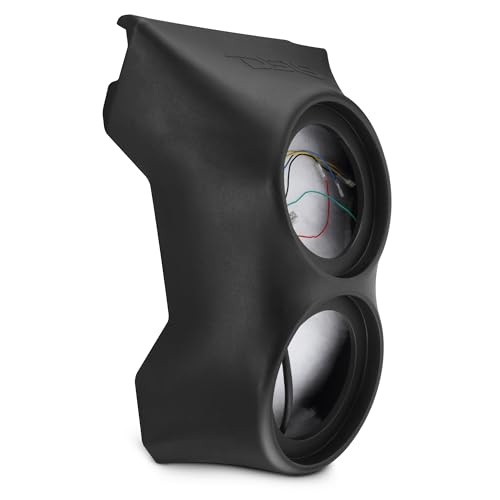
Purpose-built sealed enclosures follow a contrasting engineering philosophy suited for harsh environments. The DS18 Can-Am Maverick X3 Speaker Pod (2017+) uses a sealed polyethylene shell designed for two 6.5-inch drivers mounted in an off-road center console. This sealed construction protects the speakers from water and trail dust while keeping the enclosure compact enough to fit factory vehicle contours. Mid-range speakers installed in sealed pods like this deliver precise vocal clarity without relying on cabinet vents that could allow moisture entry.
Safe Methods for Plugging or Sealing a Port
Temporary modifications offer the safest starting point for listeners curious about converting a ported speaker. Dense open-cell or closed-cell acoustic foam bungs can be rolled tightly and inserted snugly into circular ports. Many high-end bookshelf speakers include these foam plugs in the box to help owners control boundary gain when placing cabinets close to rear walls. Using dense foam allows users to audition the acoustic difference without risking cosmetic damage or altering cabinet value permanently.
Permanent sealing requires rigid materials capable of withstanding internal acoustic pressure. In car audio subwoofer boxes with slot ports or large flared ducts, flexible foam plugs will push out or vibrate noisily under heavy bass transients. A proper seal demands a fitted piece of medium density fiberboard secured across the port mouth using wood glue, silicone sealant, and mechanical fasteners. Any tiny air leak around the perimeter of the plug will generate audible whistling and compromise the acoustic suspension effect.
Acoustic Room Modes and Boundary Loading Effects
Acoustic problems blamed on speaker ports frequently originate from the physical dimensions of the listening room. Low-frequency sound waves reflect off parallel walls, floors, and ceilings, creating standing waves that reinforce or cancel specific frequencies. When a vented speaker sits near a corner or close to a rigid boundary, room gain amplifies port resonance, causing bass to sound droning and muddy. Sealing the port cuts output right around the resonance zone, which can tame boundary coloration without moving the furniture.
Vehicles present an extreme version of this acoustic boundary effect known as transfer function or cabin gain. The enclosed cabin of an automobile acts as a pressure chamber for sound waves whose wavelengths exceed the vehicle interior length. Because cabin gain begins boosting bass below roughly 60 Hertz at a rate of 12 decibels per octave, a sealed box with a 12 decibel rolloff can produce a nearly flat in-car response down to the lowest octaves. Sealing a vented subwoofer in a small trunk often creates tighter, more natural musical punch than a ported box.
Common Mistakes When Modifying Vented Cabinets
Failing to achieve an airtight seal is the most frequent error made during cabinet modifications. If air escapes through tiny gaps around a plug, the enclosure behaves like a leaky box rather than a true acoustic suspension system. This air leakage creates audible chuffing, reduces cone damping, and causes irregular impedance spikes that can strain the amplifier. Testing the seal by gently pressing the driver cone inward should reveal a slow, damped return to resting position without rushing air sounds.
Another widespread mistake involves ignoring amplifier equalization settings after sealing the port. Vented enclosures frequently rely on a high-pass subsonic filter set just below the port tuning frequency to prevent driver damage. When the box is sealed, that subsonic filter may cut off sub-bass signals that the driver is now mechanically capable of playing safely. Adjusting the amplifier crossover, equalizer settings, and gain controls is necessary to balance the altered frequency curve of the modified cabinet.
Practical Verification and Listening Decisions
Evaluating the success of a port modification comes down to personal acoustic preference and source material. Listeners who primarily enjoy electronic music, action movie soundtracks, or hip hop may miss the visceral low-end authority provided by open vents. Those who listen to acoustic jazz, classical arrangements, or rock recordings typically appreciate the improved articulation and transient clarity that a sealed alignment delivers. Experimenting with reversible plugs first gives you the freedom to test both sonic presentations in your actual listening room.
Checking driver operating temperature after extended listening sessions ensures the speaker handles its new environment without distress. Because sealed boxes lack air circulation through an open vent, thermal energy inside the cabinet dissipates more slowly through the wood or plastic walls. If the magnet assembly or driver dust cap feels excessively hot after moderate playback, reducing amplifier gain or returning to the vented configuration will safeguard the voice coil from thermal degradation over time.






Write Your Review
No reviews yet. Be the first to share your experience!