


Splashing liquid over an acoustic grille often leads to an alarming, muffled rattle or a sudden drop in output volume. Many owners immediately wonder whether will water in speakers go away naturally without causing permanent hardware damage to internal voice coils and delicate diaphragms. While light moisture droplets can eventually evaporate under favorable room conditions, waiting for passive drying carries substantial risks of corrosion, driver warping, and electrical shorting. A quick response can protect delicate audio assemblies before moisture leads to lasting internal component failure.
Taking swift, safe action makes a massive difference in whether a driver recovers completely or suffers permanent tonal degradation. Understanding how liquid interacts with internal cones, voice coils, and protective mesh screens helps you decide whether simple air drying is enough or if proactive water-clearing steps are necessary. If you regularly use portable Bluetooth speakers around pools, sinks, or outdoor patios, knowing the limits of liquid resistance can save your audio equipment from irreversible harm. Prompt intervention keeps your gear sounding clear and prevents costly driver replacements down the road.

Pros
- Eye-catching sound-reactive water fountain visual effects with vibrant LED colors
- Flexible connectivity with both wireless Bluetooth and 3.5mm auxiliary inputs
- Compact vertical footprint fits easily on crowded student or home office desks
- Clear vocal clarity for casual YouTube viewing, video calls, and podcasts
Cons
- Lean low-end bass response due to the compact driver dimensions
- Requires tethered USB power and an interconnect cable between both satellite units
- Internal water pump mechanism creates subtle mechanical noise during quiet audio passages
The beFree Sound BFS-Dancing Water speakers bring a captivating audiovisual experience to any desktop or workspace. Designed primarily for casual listeners, gamers, and students who want more personality than standard black-box PC monitors, this 2.0 stereo speaker pair integrates multi-colored LED lights and liquid jets that react dynamically to your audio playback.
In everyday use, setting up the system is refreshingly straightforward. You can quickly tether your smartphone, tablet, or laptop via Bluetooth for cord-free streaming, or utilize the included 3.5mm auxiliary cable for a reliable, latency-free direct link to your desktop PC or gaming console. When sound plays, the internal water pumps push pressurized fluid upward in time with rhythm peaks, creating a hypnotic fountain show right next to your display.
While audiophiles searching for pristine reference playback should look toward dedicated studio monitors, these speakers succeed in their core mission: delivering entertaining, room-brightening sound at an accessible price point. They make an ideal centerpiece for dorm rooms, creative offices, and teen bedrooms where visual ambiance matters just as much as background tunes.
Acoustically, the beFree Sound water speakers focus their energy on the midrange and upper frequencies. Vocals, speech, acoustic guitars, and standard video game effects come through with crisp presence, making YouTube videos, podcasts, and casual background pop tracks easy to enjoy without straining to understand dialogue.
Because these compact desktop towers lack dedicated subwoofers or heavy passive radiators, sub-bass reproduction is relatively modest. Bass-heavy electronic or hip-hop tracks will trigger the visual water jets impressively, but the tactile sub-bass impact will feel lean compared to larger bookshelf speakers. Volume levels are well-tuned for near-field listening, filling a personal workspace or small bedroom nicely before approaching driver breakup.
Each tower stands approximately 10 inches tall with a narrow 3.25-inch footprint, ensuring they flank widescreen computer monitors comfortably without hogging valuable mouse real estate. The bottom enclosure houses the audio drivers and electronic controls in a sleek black finish, while the upper half consists of sealed, transparent acrylic chambers that house the dancing water fountains and four-color LED emitters.
Connectivity includes a standard 3.5mm stereo input alongside Bluetooth wireless pairing, giving you broad compatibility across PCs, Macs, tablets, and smartphones. Power is drawn via an included USB cable, meaning you can power the unit directly from an open PC port, monitor hub, or standard 5V USB wall adapter, while an interconnect cable ties the left and right speakers together for synchronized audio and fountain action.

Pros
- True Wireless Stereo configuration delivers genuine spatial sound separation outdoors
- Rugged IPX7 waterproof housing withstands harsh weather and pool splashes
- Integrated solar panel significantly prolongs battery uptime on sunny days
- Full-featured handheld remote allows convenient control without accessing your phone
Cons
- Solar charging works as a trickle top-off and requires direct sunlight to be effective
- No companion smartphone app for custom multi-band EQ tuning
- Sub-bass frequencies roll off in expansive, open-field yard settings
The Daworot Outdoor Rock Bluetooth 6.0 Speaker Pair is built for homeowners seeking to blend quality audio with natural yard landscaping. Disguised as realistic garden stones, these rugged enclosures nestle neatly into flowerbeds, rockeries, and pool decks. Utilizing modern Bluetooth 6.0 protocol, the speakers pair together wirelessly via True Wireless Stereo (TWS) to deliver left-and-right channel separation, spreading a rich acoustic layer across your backyard without running a single speaker wire.
In practical day-to-day use, these speakers eliminate common outdoor entertainment pain points. Certified with an IPX7 waterproof rating, they easily survive unexpected summer downpours, lawn sprinklers, and poolside splashes. The internal 5000mAh rechargeable battery offers substantial independent runtime, while the top-mounted solar array trickles power during daylight hours to keep the music playing without constantly lugging the units inside for a recharge.
Everyday convenience is enhanced by the included handheld remote control. Users can easily manage tracks, adjust master volume, choose sleep timers ranging from 30 minutes to 5 hours, or activate the integrated music-synced LED lights for nighttime entertaining. For patio relaxers, garden hosts, and pool owners looking for zero-maintenance landscape sound, Daworot provides a capable and discreet wireless solution.
Acoustically tuned for open-air dispersion, this pair provides up to 60W of peak dynamic power designed to push through backyard wind and conversation. The True Wireless Stereo configuration creates a spacious soundfield, distributing audio evenly across outdoor sitting areas. Vocals and mid-range instrumentation are balanced slightly forward, ensuring spoken podcasts, acoustic guitars, and lead vocals stay crystal clear even at moderate conversational levels.
Low-end reproduction focuses on tight, impactful mid-bass rather than muddy sub-bass, preventing distorted boominess in open spaces. Treble response remains clean and smooth, avoiding harsh sibilance at higher volumes. While high frequencies naturally disperse in wide-open lawns, positioning these speakers near retaining walls, fences, or garden borders creates natural acoustic boundaries that enhance low-end resonance and overall sound fullness.
Constructed from an all-weather, high-density resin composite, each speaker measures 7 x 5 x 8 inches and weighs 3.5 pounds, providing sufficient heft to stay planted during windy days while remaining easy to reposition. The realistic stone finish resists fading from sun exposure and hides garden dirt effectively. The rear input compartment is protected by an oversized, watertight rubber gasket covering the USB Type-C charging port to maintain the IPX7 waterproof standard.
Hardware capabilities are anchored by Bluetooth 6.0, providing stable streaming transmission up to 164 feet in open line-of-sight environments. Under the hood, each speaker houses a 5000mAh rechargeable lithium-ion battery paired with a solar top-plate for auxiliary power collection. Built-in multi-color LED lighting accents illuminate through the front acoustic grille, offering rhythmic light modes that create vibrant nighttime ambience across your patio.
Pros
- Captivating fluid motion and vibrant LED illumination create an engaging visual display
- Compact footprint fits neatly on crowded work and study desks
- Straightforward plug-and-play USB power simplifies everyday cable management
- Strong vocal intelligibility makes them well suited for podcasts and video streaming
Cons
- Narrow 220Hz low-frequency threshold prevents deep bass or sub-bass reproduction
- High treble rolls off at 13,000Hz, limiting micro-detail in complex acoustic recordings
- Lightweight plastic construction is intended for stationary indoor use rather than portable travel
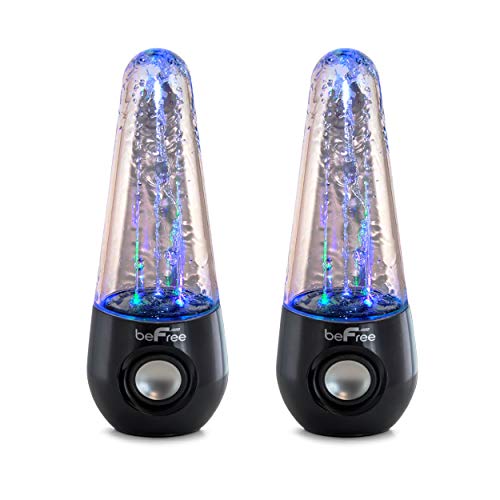
The beFree Sound BFS dancing water speakers blend sensory entertainment with casual audio output. Designed as a dual-tower desktop system, each unit houses clear fluid chambers containing multi-colored LED water jets that react dynamically to the beat of your music. Rather than focusing solely on sterile acoustic engineering, this speaker set is built to provide an engaging, ambient desk centerpiece that enlivens study spaces and gaming setups alike.
In everyday use, the system excels as a visual and auditory desktop companion. Connecting to laptops, smartphones, or tablets via Bluetooth is straightforward, giving users wireless freedom without tethering mobile devices to the desk. When playing tracks with prominent percussion or dynamic peaks, the water jets pulse higher and faster, casting an attractive light pattern on nearby walls in dim or dark rooms.
For casual entertainment, YouTube videos, and vocal-heavy playlists, the audio output is intelligible and forward. The internal amplifier ensures the towers produce enough volume to fill a small bedroom or office cubicle comfortably. While serious audiophiles will notice the absence of chest-thumping bass, casual listeners will appreciate the unique blend of novelty visuals and hassle-free wireless performance.
Ultimately, the beFree Sound water speakers serve as an accessible, gift-worthy upgrade for anyone looking to add flair to their daily workspace. They fulfill a specific niche: delivering sufficient audio quality for background listening while providing an entertaining, music-synchronized light show that never fails to spark conversations.
Acoustically, the beFree Sound speakers feature an operating frequency response of 220Hz to 13,000Hz with a 4-ohm nominal impedance. Because the low-end spectrum begins around 220Hz, deep sub-bass and heavy low-frequency impacts are deliberately rolled off. Instead, the acoustic tuning concentrates firmly on the mid-bass and upper midrange, allowing speaking voices, podcasts, and acoustic instruments to remain intelligible and clean at moderate listening levels.
The high-frequency ceiling reaches up to 13,000Hz, which prevents the speakers from sounding shrill or fatiguing during long work sessions. While tracks rich in high-hats or orchestral overtones will lack the ultra-airy shimmer found on reference monitors, this rounded treble keeps compressed streaming audio sounding smooth. The built-in amplifier provides enough clean gain to reach comfortable room levels without excessive harmonic distortion, provided the volume is kept within reasonable nearfield boundaries.
The BFS towers measure approximately 8.5 inches tall, 6 inches wide, and 3 inches deep, striking a balance between desk presence and footprint economy. Weighing just around 1.5 pounds for the set, the housings consist of durable black plastic pedestals capped with sealed, impact-resistant transparent acrylic fluid reservoirs. Inside each reservoir, five precision water nozzles are paired with multicolor LEDs that illuminate the choreographed water movement.
Power delivery is handled via an included standard USB cable, allowing the speakers to draw energy directly from a PC tower, powered USB hub, or standard USB wall adapter. Audio transmission relies on low-latency wireless Bluetooth for cable-free streaming from modern source devices. The completely sealed fluid chambers require zero refilling or maintenance, ensuring the water jet mechanism remains reliable and mess-free over the lifespan of the system.
How Water Affects Speakers and What to Do About Trapped Moisture
Water trapped inside an acoustic enclosure creates immediate mechanical obstruction and acoustic dampening. While passive evaporation can eventually clear minor residual condensation, leaving standing liquid inside a speaker enclosure is one of the quickest ways to cause permanent hardware failure. Acoustic drivers rely on fine mechanical tolerances, meaning even tiny water droplets on the cone can stifle movement and ruin audio fidelity. Understanding how moisture behaves inside speaker components allows you to intervene before internal oxidation destroys delicate moving assemblies.
The Direct Answer: Does Water Evaporate from Speaker Housings on Its Own?
Evaporation will eventually remove thin layers of surface moisture, but the process is usually far too slow to protect sensitive audio electronics. Enclosed speaker cabinets, front grille meshes, and tight acoustic chambers drastically restrict airflow, trapping humid air directly against the driver. If water sits inside an enclosure for hours or days, minerals and moisture corrode soldered contacts and degrade cone adhesives. Hoping that standing liquid simply vanishes without intervention often turns a temporary inconvenience into a permanent hardware breakdown.
Ambient room temperature and relative humidity also dictate how rapidly trapped liquid transitions into vapor. In cool or humid environments, water droplets linger on acoustic membranes indefinitely, accelerating chemical reactions on conductive metal surfaces. Conversely, exposing the unit to direct heat or hot sunlight to speed up natural drying can warp plastic housings and melt adhesive bonds. Passive drying is therefore an unpredictable recovery method that exposes sensitive audio gear to unnecessary risks.
Why Trapped Moisture Causes Muffled and Distorted Audio
Sound production requires a speaker cone to oscillate rapidly back and forth, displacing air to generate acoustic pressure waves. When liquid penetrates the speaker grille, surface tension causes droplets to adhere directly to the diaphragm or suspend across the fine mesh openings. The added physical weight of the water increases the moving mass of the driver assembly, which drastically dampens high-frequency response. This extra mass prevents the diaphragm from vibrating freely, transforming crisp vocals and detailed instrumentals into a dull, muddy rumble.
Liquid pooled across the acoustic port or front baffle also disrupts the intended airflow and cabinet tuning. Dynamic speakers rely on specific enclosure pressures to produce balanced bass and clear midrange tones. When water forms a physical barrier over acoustic openings, the driver struggles against improper air resistance, leading to audible flapping or rattling sounds. These distracting acoustic artifacts will persist until the physical liquid is displaced from the moving parts.
Internal Speaker Vulnerabilities: Cones, Spiders, and Voice Coils
Every dynamic driver contains delicate internal elements that respond differently to moisture contact. Traditional cones made from treated paper pulp are particularly vulnerable, as liquid absorption weakens structural stiffness and causes permanent cone sagging. Even modern synthetic cones made from polypropylene or aluminum rely on a flexible outer surround made of rubber or foam. Moisture can dissolve or weaken the specialized adhesives bonding the surround to the driver basket, resulting in mechanical separation.
Beneath the cone sits the voice coil, a finely wound cylinder of copper or aluminum wire operating inside a tight magnetic gap. If water reaches this narrow gap, it introduces immediate risks of electrical short circuits when audio signals pass through the coil. Furthermore, trapped moisture combined with electrical currents accelerates galvanic corrosion, pitting the conductive wire and causing coil burnout. The spider, which centers the voice coil, can also lose its calibrated spring tension when saturated, causing the coil to rub against the magnet.
Safe, Immediate Steps to Remove Water from Speaker Drivers
The immediate priority after any liquid spill is cutting electrical power to prevent catastrophic short circuits. Turn off the speaker immediately, disconnect any external power adapters or charging cables, and unplug all auxiliary audio inputs. Avoid pressing buttons repeatedly or cycling power to test if the speaker still functions, as active voltage through damp components accelerates hardware failure. If the unit features a removable battery, take it out immediately to eliminate all residual electrical currents.
Next, orient the speaker so gravity can draw liquid away from internal circuitry and out through the grille. Gently tilt the device forward with the speaker grille facing downward onto a clean, lint-free microfiber towel. Lightly tap the exterior casing with your hand to encourage surface-tension droplets to release from the mesh. Allow the unit to rest in this downward position in a well-ventilated space with steady ambient airflow, such as near an electric room fan.
Desiccants can provide substantial assistance during the drying phase without exposing fragile components to mechanical stress. Placing the damp audio unit inside an airtight container alongside sealed silica gel packets draws moisture out from internal cavities. Silica gel acts far more efficiently and safely than uncooked rice, which introduces fine starch dust that can gum up voice coil assemblies. Leave the speaker in the dry desiccant environment for at least twenty-four to forty-eight hours before attempting to reconnect power.
Sound Waves and Low Frequencies for Water Ejection
Modern portable devices often utilize acoustic vibration to clear water droplets from miniature speaker grilles. Low-frequency sound tones, typically between 130 Hz and 250 Hz, force the speaker cone to make large physical excursions. These rapid forward-and-backward strokes create strong air pulses that shatter the surface tension of water droplets clinging to the mesh. As the diaphragm pumps air through the grille openings, the trapped water is ejected outward as fine spray or beads.
You can employ this mechanical ejection technique on battery-powered speakers once the unit has undergone initial external drying. Set the speaker at a moderate volume while playing continuous sine-wave tones or dedicated water-ejection audio tracks. Keep the speaker grille tilted slightly downward so that expelled droplets fall away from the cabinet rather than draining back inside. Do not crank the amplifier to maximum volume during this process, because the extra mass of standing water can strain an over-driven voice coil.
Crucial Mistakes That Cause Permanent Speaker Damage
Applying direct heat is one of the most common and destructive mistakes made during speaker recovery. Using high-temperature hair dryers, heat guns, or placing speakers on radiators will soften delicate adhesives and warp thin polymer diaphragms. Heat can also permanently damage internal lithium-ion batteries and deform acoustic gasket seals designed to maintain enclosure air-tightness. Steady, room-temperature airflow from a standard electric fan is always safer and more effective than artificial thermal drying.
Inserting sharp objects through the speaker grille is another dangerous error that ruins acoustic assemblies. Poking cotton swabs, toothpicks, or metal pins into the grille to soak up moisture frequently punctures the delicate cone or tears the surround. Once a driver diaphragm suffers a puncture or tear, acoustic pressure leaks out, destroying low-end frequency reproduction. Chemical cleaners and solvents should also be strictly avoided, as alcohol and household detergents dissolve protective coatings on synthetic drivers.
Ingress Protection Ratings and What IPX7 Actually Means
Understanding Ingress Protection ratings helps clarify how well an audio system can tolerate exposure to moisture. A rating of IPX7 indicates that the manufacturer designed the enclosure to withstand immersion in fresh water up to one meter deep for thirty minutes. For outdoor recreation, rugged equipment like the Daworot Upgraded Outdoor Rock Bluetooth 6.0 utilizes an IPX7 waterproof design to protect against rain, pool splashes, and damp garden environments. This level of defense relies on tight silicone port seals, waterproof membrane baffles, and water-repellent grille treatments.
Even on fully waterproof speakers, water can still accumulate temporarily over the outer grille surface and cause muffled sound. While internal electronics remain completely isolated from moisture, water droplets clinging to the driver face still dampen audio output until dislodged. When using gear outdoors or setting up weather-resistant outdoor audio setups, ensuring that charging port rubber flaps are firmly seated remains essential. Waterproof ratings only protect audio hardware when all access ports and protective covers are completely sealed.
Distinguishing Water Damage from Decorative Dancing Water Features
Some multimedia audio systems incorporate visible liquid chambers intentionally as an entertaining decorative effect. For example, the beFree Sound Multimedia Sound Reactive Color and the beFree Sound Bluetooth LED Dancing Water use sealed fluid chambers with LED-lit water jets that react to music rhythms. In these specialized designs, the liquid is completely isolated within a factory-sealed transparent acrylic tube far away from the acoustic transducers. The movement of the fluid inside the clear chamber is entirely normal and does not represent an internal leak into the acoustic driver.
Owners of decorative liquid speakers should never attempt to drain, refill, or vent the sealed fluid reservoir. If you notice bubbling or water jet action in such devices, that activity is part of the integrated visual display rather than unwanted liquid ingress. However, accidental liquid spilled onto the electrical base, USB power connections, or external auxiliary inputs of these units must still be addressed immediately. Maintaining separation between decorative visual fluids and external audio jacks ensures safe and long-lasting operation.
Testing and Verifying Sound Quality After Drying
Once a wet speaker has dried thoroughly for at least forty-eight hours, you can begin careful electrical and acoustic verification. Reconnect the power source and listen closely for any unusual electronic humming, buzzing, or popping when turning on the power switch. If the device powers on normally, initiate audio playback at a very low volume using a well-balanced acoustic track with clean vocal passages. Gradually increase the volume to moderate levels while listening for harsh clipping, scratching, or uneven tonal balance.
A scratching or scraping sound during low-frequency passages often points to voice coil rubbing caused by a warped former or shifted magnet gap. If you appreciate the pristine dynamics of high-fidelity home sound systems, you will immediately recognize any lingering muffledness or loss of high-end clarity. In cases where sound remains severely degraded despite complete drying, internal cone deformation or circuit board corrosion has likely occurred. When audio artifacts persist, having the driver inspected or replaced by an audio technician may be necessary.
Long-Term Maintenance and Protecting Audio Equipment from Moisture
Preventative maintenance remains the best strategy for safeguarding non-waterproof audio equipment against accidental liquid exposure. Position desktop speakers and delicate bookshelf drivers well away from beverage containers, open windows, and humid bathroom environments. If you frequently listen to music in areas with high ambient humidity, running a household dehumidifier helps prevent moisture accumulation on passive paper cones. Storing portable gear in breathable protective cases shields grilles from ambient moisture while allowing lingering humidity to escape.
Regularly inspect rubber gaskets, silicone seal covers, and cable grommets on outdoor speakers to ensure they have not cracked or deteriorated. Environmental exposure to UV sunlight and temperature swings can dry out rubber seals over time, compromising factory water resistance. Keeping silicone port covers clean of dirt, sand, and debris guarantees a snug seal whenever moisture threatens your equipment. With proper environmental awareness and rapid intervention, your speakers can deliver clean, dynamic sound across many years of dependable listening.


Write Your Review
No reviews yet. Be the first to share your experience!