


Hooking up modern or vintage audio components often leads to unexpected cabling puzzles behind a receiver or television. Learning how to connect speakers to rca jacks requires distinguishing between line-level preamplifier signals and amplified speaker-level outputs. Many vintage stereo receivers, compact desktop amplifiers, and all-in-one shelf systems rely on RCA-style phono jacks to drive standard passive speakers. Using the proper adapter or pre-terminated pigtail cable protects sensitive audio components from accidental shorts while preserving clear stereo sound. Listeners configuring dedicated two-channel speaker setups frequently encounter these connectors when integrating vintage hardware with modern media sources.
Matching the positive and negative leads between the amplifier port and the speaker terminal is essential for accurate stereo imaging and punchy bass reproduction. Incorrect polarity causes acoustic phase cancellation, leaving audio sounding hollow and thin. Fortunately, solderless screw terminals, spring-loaded push connectors, and pre-stripped bare wire adapters make this wiring process fast and secure without requiring a soldering iron. Taking a few moments to inspect the wire gauge and ensure tight terminal contacts prevents stray copper strands from creating electrical short circuits. Understanding how these connections function ensures reliable playback across bookshelf speakers, background audio arrays, and multiroom entertainment systems.

Pros
- Effortless press-to-connect mechanism eliminates the need for soldering irons or screwdrivers.
- Convenient bundle featuring an even split of 5 male and 5 female connectors.
- Maintains a solid mechanical grip on standard 14 to 18 gauge audio cables.
- Clear polarity indications make hookups fast and error-free in tight spaces.
Cons
- Plastic push tabs require gentle handling to prevent snapping during heavy setup changes.
- Cannot accommodate thick gauge audiophile speaker cables larger than 14 AWG.
- Non-locking RCA outer barrels may feel loose on non-standard or worn audio ports.
Integrating legacy hardware, powered subwoofers, or custom speaker setups often presents a physical mismatch: bare copper wire on one side and standard RCA jacks on the other. The exgoofit Speaker Wire to RCA Adapter 10-Pack bridges this gap effortlessly. Designed for audiophiles, home theater hobbyists, and custom AV installers, this kit removes the hassle of stripping, soldering, or hunting down specialized crimpers just to route a line-level or low-voltage speaker connection.
The installation workflow is as simple as it gets. Each connector features a spring-loaded push-button mechanism. You merely strip a short segment of your speaker lead, press down on the color-coded terminal, slide the wire into the guide, and release. The internal contact springs clamp down securely on the copper, providing instant mechanical and electrical contact. Having five male and five female adapters in one pack gives you the flexibility to adapt existing cables or build custom gender-matched interconnects on the fly.
In practical listening and testing, the connectors deliver transparent performance without introducing audible artifacts or resistance hum. Wires up to 14 AWG hold firm under moderate tugging, keeping connections stable behind busy entertainment units or inside stereo racks. For hobbyists seeking a reliable, low-cost fix for subwoofer runs, zone amplifiers, or surround sound extensions, this kit is an indispensable tool that belongs in every audio gear bag.
While passive adapters do not inherently shape tone, a poor physical connection can severely degrade audio quality through increased resistance, channel imbalance, and buzzing. The exgoofit connectors feature robust internal conductor pins that clamp tightly onto bare copper strands. This secure point of contact preserves low-frequency response down to the deepest subwoofer octaves, ensuring dynamic bass notes hit with precision rather than muffling or clipping due to high-resistance contact.
Midrange and high-frequency details also pass uncolored when used in full-range audio lines. Because the press terminals lock the strands uniformly without fraying individual copper hairs, the risk of stray wires causing short circuits or RF ground loops is heavily minimized. The result is a clean background noise floor, allowing your amplifier and active monitors to present music and movie soundtracks with original fidelity.
Each exgoofit connector is built with an impact-resistant ABS thermoplastic housing measuring 45mm long, 15mm wide, and 20mm tall. This slim profile is critical for modern multi-channel amplifiers and AV receivers, where RCA input jacks are arranged in close proximity. The lightweight structure places minimal downward torque on your equipment jacks, protecting your hardware from strain over long installations.
The spring-loaded terminals accommodate wires up to 14 AWG, providing optimal compatibility with typical 16 AWG and 18 AWG speaker cables. Clear visual polarity markings allow you to keep positive and negative leads organized across multi-room runs. With 5 standard male RCA plugs and 5 female RCA sockets in the package, you have full versatility for terminating custom speaker cables, repairing cut interconnects, or feeding speaker-level inputs directly into compatible subwoofers.
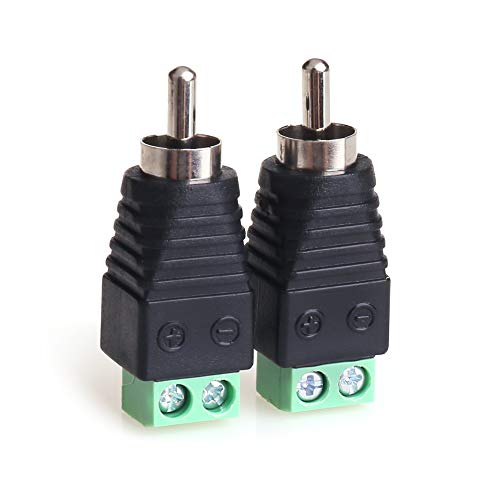
Pros
- Fast, solder-free screw terminal connection eliminates the need for specialized tools
- Clear polarity indicators help avoid out-of-phase speaker wiring mistakes
- Slim and compact profile fits effortlessly into tight back-panel spaces
- Provides a firm mechanical hold that prevents loose wires and signal cutouts
Cons
- Terminal block openings are too compact for heavy 12 AWG or thicker speaker cable
- Lightweight plastic outer shell requires gentle handling compared to full-metal plugs
- Requires a very small precision flathead screwdriver for tightening
The MOBOREST RCA to Speaker Wire Adapter 2-Pack is a practical, high-utility problem solver for home audio setups. Many classic stereo receivers, modern mini desktop amplifiers, and specialized subwoofers utilize RCA terminals where bare speaker wire is otherwise required. Instead of investing in costly pre-made cables or dealing with soldering equipment, this adapter provides an immediate, reliable link for audio enthusiasts and DIY home theater builders.
During installation, the solderless design proves its worth right away. By inserting your stripped speaker leads directly into the screw-down terminal blocks, you achieve a firm mechanical clamp that ensures direct conductor contact. This eliminates loose wire strands that cause short circuits, intermittent audio dropouts, or crackling sounds, giving you a clean and consistent listening experience.
This adapter is particularly valuable for retrofitting existing in-wall audio runs or repairing damaged factory RCA ends without pulling fresh cable through wall studs and tight conduit. Its compact form factor effortlessly clears the crowded rear panels of AV receivers, ensuring you can push media furniture flush against the wall without bending or straining your wire.
Overall, the MOBOREST S-0012 adapter delivers reliable audio performance and unbeatable convenience. For anyone building a custom stereo setup, repairing vintage audio equipment, or managing tight audio-video routing, this two-pack offers an efficient, dependable termination method.
While an adapter does not create sound on its own, its conductivity and contact tension are critical for preserving audio fidelity. The MOBOREST adapter ensures a tight, solid grip on bare speaker wire, reducing contact resistance to negligible levels. This allows your audio amplifier to deliver clean, unhindered power across the entire frequency range, keeping bass response punchy and articulate without dampening dynamics.
Midrange clarity and treble crispness remain natural and uncolored. Because the screw-down terminals cleanly separate positive and negative leads, signal cross-talk and phase cancellation are eliminated. Vocals sound centered and focused, while subtle ambient details in acoustic recordings and film soundtracks come through with precision.
The direct metal-to-metal connection handles both speaker-level and line-level signals effortlessly. Whether you are driving high-efficiency bookshelf speakers or feeding a low-frequency line signal to an active subwoofer, the connection remains silent, stable, and completely free from induced hum or ground buzz.
Built for space-constrained installations, each connector measures an ultra-compact 1.69 inches long by 0.55 inches wide and 0.51 inches high. This slim form factor prevents adjacent-port interference on tightly spaced stereo panels. The outer barrel features an integrated knurled texture that provides positive finger traction, allowing easy installation even in dimly lit media consoles.
The terminal end is clearly marked with positive and negative polarities, guiding accurate speaker phasing during installation. The internal screw clamps comfortably accept wire sizes from 16 AWG down to 22 AWG. Tightening the top-facing screws drives down a solid internal plate that clamps down evenly on copper strands without shearing them off.
The male RCA plug features standard dimensional geometry with a secure ground skirt, ensuring a firm friction fit into standard RCA female jacks. Supplied as a matched pair, this set is fully ready to handle standard left and right stereo channels straight out of the package.

Pros
- Thicker 18AWG wiring offers noticeable transmission improvements over common 20AWG or 24AWG adapters
- Pre-tinned ends make terminal insertion and custom soldering smooth and frustration-free
- Snug-fitting RCA plugs resist accidental disconnects behind crowded audio racks
- Accurate polarity labeling prevents out-of-phase speaker setup errors
Cons
- Fixed 3-foot length limits long-distance speaker runs across larger living rooms
- Not designed for ultra-high-wattage amplification systems exceeding typical consumer audio loads
The Ullnosoo 18AWG RCA to Speaker Wire Adapter provides an essential bridge for audiophiles and home theater enthusiasts trying to marry modern audio components with legacy or proprietary terminal designs. Whether you are hooking up a powered subwoofer with RCA outputs to passive spring terminals, or adapting an older stereo amplifier to modern bookshelf monitors, this two-pack delivers an immediate, plug-and-play solution without the need to cut and splice your own cables.
Crafted specifically for DIY audio systems, multimedia stations, and Hi-Fi setups, this cable removes the headache of custom wire fabrication. The 3-foot footprint makes it especially convenient for compact desktop arrangements, clean entertainment center racks, and close-proximity speaker placement where excess wire slack would otherwise clutter the installation.
In practice, the connection holds fast with satisfying friction at the RCA end, while the pre-tinned open leads effortlessly slip into spring clips, push terminals, or screw-down binding posts. For listeners seeking a reliable adapter that maintains audio fidelity and structural durability, this Ullnosoo harness is a reliable addition to any audio toolkit.
Signal integrity is paramount when adapting line or speaker-level feeds, and the Ullnosoo 18AWG core excels by offering lower electrical resistance than common 20AWG or 22AWG off-the-shelf alternatives. This low-impedance path preserves deep sub-bass frequencies and maintains pristine midrange transients, ensuring your bookshelf speakers and subwoofers reproduce music and movie soundtracks without muffled high frequencies or muddy low-end response.
Additionally, the integrated copper braid shielding keeps common 60Hz ground loop hum and radio frequency interference out of your audio chain. Even when routed alongside standard AC power cords behind an entertainment center, the signal remains clean, allowing for quiet noise floors and crisp soundstage separation across both stereo channels.
The physical construction of these cables highlights user convenience and long-term durability. Coated in a flexible yet resilient PVC jacket, the cables easily bend around sharp corners without damaging internal strands. Each bare cable lead features corrosion-resistant tin plating, which guards against copper oxidation while ensuring strands do not fray during repeated terminal installation or soldering tasks.
Hardware integration is intuitive thanks to visual polarity markers. The color-coded male plugs designate red as the center-pin positive signal and black as the outer-shell negative conductor. Measuring three feet in length, this pair works seamlessly with AV receivers, CD and DVD players, soundbars, projectors, and external tuners across home audio configurations.

Pros
- High-purity oxygen-free copper core maintains clean signal integrity for everyday stereo listening
- Distinct red and black polarity insulation prevents phase reversal mistakes during setup
- Generous 6.6-foot length provides ample routing slack for home entertainment consoles
- Solid alloy RCA plugs seat firmly into audio ports to prevent accidental disconnects
Cons
- 20AWG thickness is optimal for moderate power, but high-wattage subwoofers may require thicker gauge wire
- Bare wire leads are not pre-tinned, requiring careful twisting to avoid stray strands during terminal insertion
- Lacks heavy braided shielding, making it best suited away from high-current power cables
Setting up or restoring an entertainment center often leads to frustrating connection mismatches, especially when pairing modern components with vintage audio gear or proprietary speaker terminals. The caojunzhen RCA to Bare Wire Speaker Cable Adapter is built to solve that exact issue. Delivered in a handy two-pack, this 6.6-foot audio cable lets you interface standard RCA output or input jacks directly with bare-wire spring clips or binding posts on speakers, stereo receivers, subwoofers, and compact desktop amplifiers.
In real-world use, installation is as direct and straightforward as it gets. The alloy RCA male connectors slide snugly into AV receiver outputs without wiggle or loose contact, while the pre-stripped open wire ends insert cleanly into standard speaker push terminals. Whether you are reviving a classic home stereo, hooking up a powered subwoofer, or replacing a damaged factory wire run, this adapter eliminates the need for messy soldering or splicing.
For home theater builders, vintage audio enthusiasts, and everyday DIY listeners, this cable set provides a dependable, budget-friendly audio bridge. It faithfully maintains audio clarity across both channels, making it a reliable hookup solution and a must-have spare for any audio toolkit.
Under the protective jacket, the cable uses a 20AWG high-purity oxygen-free copper (OFC) core. By utilizing OFC instead of cheap copper-clad aluminum alternatives, the wire reduces signal loss and resistance over its 6.6-foot run. This ensures that film soundtracks, vocal tracks, and musical instrumentation arrive at your speakers without dulling high frequencies or muddying low-end punch.
When routing signals to bookshelf speakers or subwoofers, the connection supports a well-balanced acoustic delivery with transparent midrange and crisp highs. Just as importantly, the red and black color-coded wire leads ensure correct phase alignment across stereo pairs, preventing the hollow sound and lost bass response caused by reverse polarity wiring.
Constructed for practical utility, each cable provides 6.6 feet (2 meters) of reach, offering plenty of slack to navigate behind media consoles, TV stands, and desktop speaker stands. The outer PVC insulation strikes a good balance between toughness and flexibility, allowing the wire to bend neatly around tight corners without pinching the internal copper strands.
The hardware termination features an alloy RCA male plug fitted with an integrated strain relief boot that prevents internal wire breakage when adjusting equipment. On the opposite side, the conductors are stripped and ready for universal pairing with push terminals, screw-down binding posts, or aftermarket spade connectors.
Practical Guide to Connecting Speakers to RCA Jacks
Connecting standard speaker wire to RCA connectors is a straightforward task once you recognize the electrical differences between audio connection types. RCA jacks serve multiple audio roles ranging from low-voltage line signals to amplified speaker outputs. A successful installation requires confirming that your audio output delivers the correct signal level for your speakers. Pairing the right adapter with appropriate wire gauge guarantees stable performance and protects your equipment from accidental damage.
Understanding Audio Signal Levels and RCA Port Types
Audio systems communicate through different electrical voltage standards, and plugging cables into the wrong jack can degrade sound quality or harm equipment. Standard RCA jacks on modern receivers usually carry line-level audio signals around one volt. Line-level signals provide audio information between components but lack the current required to drive a passive speaker cone. Passive speakers require high-current speaker-level signals generated by a dedicated power amplifier. Connecting bare speaker wire from a passive speaker directly to a line-level RCA pre-out produces virtually inaudible sound.
Certain audio hardware uses physical RCA jacks to deliver amplified speaker-level power rather than low-voltage line signals. Many vintage stereo consoles, compact shelf systems, mini Hi-Fi units, and budget desktop amplifiers utilize color-coded RCA female sockets as their primary speaker outputs. In these specific systems, internal power amplifiers drive adequate wattage directly through those RCA output jacks. Connecting passive speakers to these units requires an adapter that bridges traditional bare wire conductors to an RCA male plug. Verifying whether your component outputs line-level or speaker-level audio is the vital first step before choosing cables.
Identifying RCA Polarity and Channel Standards
Maintaining correct electrical polarity is fundamental whenever you convert bare speaker wire into an RCA connector. An RCA plug consists of two main conductive elements: the center pin and the outer circular sleeve. Standard audio conventions dictate that the center pin carries the positive signal voltage, while the outer metal barrel acts as the negative ground return. Reversing these connections will invert the phase of the audio signal reaching the speaker driver. While an inverted connection will still produce sound, improper phase matching across stereo pairs degrades overall acoustic performance.
Connecting stereo speakers with mismatched polarity creates an issue known as acoustic phase cancellation. When one speaker cone moves outward on a bass transient while the opposing speaker cone pulls inward, their sound waves cancel each other out in the room. The listener experiences weak, hollow bass reproduction and an unfocused stereo soundstage where vocals lack a solid center image. Aligning polarity across both left and right channels restores impactful low frequencies and sharp stereo separation. Taking the time to double-check wire orientation on both channels guarantees that your speakers perform as intended.
Choosing Between Solderless Adapters and Pre-Made Cables
Connecting bare speaker wire to RCA jacks can be accomplished using several hardware formats depending on your installation requirements. Solderless screw-terminal adapters, such as the compact MOBOREST RCA to speaker wire adapter, feature integrated screw blocks with clearly marked polarity. Green and black markings designate positive and negative terminals for fast assembly with a screwdriver. Their knurled metal housing offers a dependable mechanical grip when plugging and unplugging connectors in tight media cabinets. Solderless push-button alternatives, like the exgoofit speaker phono wire cable connectors, utilize press-style buttons that clamp wire without any hand tools.
Pre-terminated pigtail cables provide a molded, factory-sealed alternative for users who prefer ready-to-use wiring. Cables like the Ullnosoo RCA to speaker wire adapter feature a male RCA plug on one end and three feet of flexible, color-coded bare wire on the other, utilizing an 18AWG copper conductor with braided shielding. Longer options, like the caojunzhen RCA to speaker wire adapter, provide 6.6 feet of 20AWG oxygen-free copper wiring to bridge greater distances across media consoles. Pre-made cables feature factory-tinned wire ends that resist fraying during terminal insertion. Selecting between screw adapters, spring clips, and pre-made pigtails depends on your distance requirements, wire gauge, and available tools.
Preparing Speaker Wire for Clean Connections
Proper wire preparation is vital for ensuring high electrical conductivity and long-term connection reliability. Typical speaker wiring for home audio ranges from heavy 14AWG cables down to lighter 18AWG or 20AWG conductors. Heavier 14AWG wire carries high current over longer distances with minimal resistive loss, making it suitable for high-output passive speaker runs. Thinner 18AWG and 20AWG conductors work well for short desktop runs, vintage mini stereos, or line-level subwoofer connections where power demands are low. Always check the physical aperture of your RCA adapter terminals before selecting your wire gauge to ensure the conductor fits cleanly without trimming.
Stripping the outer insulation requires a dedicated wire stripper sized correctly for your chosen conductor gauge. Remove approximately three-eighths of an inch of plastic insulation from both the positive and negative leads. Once the insulation is stripped away, tightly twist the exposed copper strands clockwise between your thumb and index finger. Twisting bundles the delicate filaments into a unified, rigid conductor that slides easily into terminal openings. Stray, untwisted wire strands represent a serious electrical hazard in audio installations because they can brush against neighboring terminals.
Step-by-Step Installation for Solderless RCA Connectors
Assembling a solderless RCA adapter begins with inspecting the terminal block on the back of the connector housing. Identify the polarity markings, which are usually indicated by plus and minus signs, green and black color coding, or stamped letters. If using a screw-terminal connector, use a small flat-head precision screwdriver to back the terminal screws out halfway. Do not unscrew them completely, as tiny terminal screws are easy to lose on a workbench or carpet. Ensure the wire insertion chamber is wide open and free of manufacturing debris before attempting to insert the conductors.
Insert the prepared positive conductor into the positive terminal cavity, ensuring that no bare copper remains exposed beyond the terminal mouth. The plastic insulation of the speaker wire should sit flush against the terminal entrance, shielding the conductive core from external contact. While holding the wire firmly in position, tighten the clamping screw down onto the copper core until snug. Repeat this exact process for the negative conductor in the adjacent terminal cavity. Gently tug on each wire lead to confirm that the internal clamping plate has gripped the copper conductor firmly.
Connecting Pre-Made RCA to Bare Wire Cables
Pre-made cables simplify installation because the RCA plug is molded and shielded at the factory. The open end of the cable features two exposed wire leads ready for attachment to your speaker enclosure terminals. Most modern bookshelf and satellite speakers feature either spring-clip terminals or five-way binding posts. In wall-mounted audio setups, managing flexible speaker leads neatly behind the speaker cabinet keeps connections tidy and prevents strain on rear terminals. Align the red jacketed wire with the red positive terminal and the black jacketed wire with the black negative terminal on the speaker.
Once the speaker cabinet connections are secured, route the cable toward your audio source without pinching the wire under heavy furniture. Line up the RCA male plug with the corresponding output jack on your amplifier or receiver. Push the plug firmly into the jack until the outer metal collar slides snugly over the exterior barrel of the socket. The knurled grip or molded strain relief on the RCA plug helps you seat the connector completely without bending the center pin. Avoid tugging on the wire to remove the connection in the future; always grasp the connector body directly.
Integrating Powered Subwoofers and Active Systems
Integrating powered subwoofers and active speakers often requires linking line-level RCA pre-outs to powered cabinet inputs. Modern home theater receivers feature dedicated RCA jacks labeled Subwoofer Pre-Out or LFE that output unamplified low-pass audio signals. In these configurations, using a shielded RCA-to-bare-wire cable allows connection to subwoofers that accept high-level or bare-wire inputs. Similarly, multi-room amplifiers can distribute signals to powered desktop speakers or active soundbars that accept analog RCA inputs. Modern listeners frequently combine these analog adapters with Bluetooth speaker connections to bridge legacy audio components with wireless playback systems.
Shielding quality plays an essential role when routing audio signals through RCA cables at line level. Low-voltage signals are susceptible to electromagnetic interference emitted by nearby power cords, television power supplies, and Wi-Fi routers. Cables equipped with oxygen-free copper conductors and braided copper shielding effectively block external radio-frequency and electromagnetic noise. Unshielded parallel speaker wire can act like an antenna when carrying low-voltage audio, causing an annoying low-frequency hum through your subwoofer. When adapting line-level connections, always prioritize shielded cables over basic unshielded lamp cord or two-conductor speaker zip wire.
Preventing Short Circuits and Mechanical Strain
Short circuits are the most dangerous hazard when working with speaker wire and solderless RCA adapters. A single fine copper strand escaping from a positive screw terminal can easily bridge across to touch the negative terminal or the outer metal plug shell. Most modern amplifiers feature protection circuits that shut down the unit instantly to prevent catastrophic failure, but vintage receivers can blow output fuses or burn internal components. Inspecting terminal blocks with a bright flashlight before powering on your equipment prevents this hazard entirely.
Mechanical strain on RCA jacks is another frequent cause of audio failure in home entertainment centers. Heavy speaker wire hanging unsupported behind an audio cabinet exerts continuous downward leverage on the RCA jack soldered to an internal circuit board. Over time, this downward pull can crack solder joints or bend the RCA center pin inside the socket. Supporting your cables with adhesive wire clips or hook-and-loop cable ties relieves strain on rear panel connectors. Leave a generous service loop of slack wire behind your equipment so that moving a component forward for maintenance does not yank on the jacks.
Troubleshooting Weak Audio, Hum, and Dropouts
Diagnosing audio problems after completing your wiring requires a logical, step-by-step approach starting from the source component. If you experience total silence after powering on your system, first verify that the receiver or amplifier input selector matches your active audio source. Next, check that the speaker selector switch on your amplifier is properly engaged and that the volume knob is set to an audible level. Inspect the front panel to confirm the amplifier is not locked in protection mode. If the amplifier displays a protect light or error message, immediately disconnect the speaker wires and inspect all terminal connections.
Extremely faint sound that remains quiet even when the volume knob is turned high points to a signal level mismatch. This symptom almost always occurs when passive speakers are plugged into a standard line-level RCA pre-out rather than an amplified speaker output. Because line-level outputs deliver mere milliwatts of power, passive speaker drivers cannot generate normal acoustic volume without an outboard amplifier. To resolve this, insert a dedicated power amplifier or stereo receiver between the line-level RCA output and your passive speakers. Intermittent audio crackles or dropouts when touching cables usually indicate a loose RCA ground collar, which can be gently tightened with pliers.
System Testing and Final Verification
Before turning on your audio system for the initial sound test, always lower the master volume to zero. Power on your source device first, such as a CD player, TV, or streamer, followed by your amplifier or receiver. Starting with low volume protects your hearing and prevents sudden power spikes from damaging speaker voice coils if a wiring error exists. Slowly advance the volume control while playing a familiar audio track with well-defined stereo separation. Listen closely to both speakers to confirm that sound emerges clearly from both channels without distortion, static, or hum.
Verify stereo channel orientation by adjusting the balance control on your amplifier completely to the left and right, ensuring channels match physical placement. Next, test acoustic phase by sitting in your primary listening sweet spot while playing a bass-heavy track. If low frequencies sound full and centered, your polarity is correct; if bass sounds thin or hollow, swap the positive and negative leads on one speaker channel. Routine maintenance requires checking screw tightness and wiping dust from connectors occasionally. Thoughtful setup and simple preventive care ensure that your speakers and RCA connections deliver clear, dynamic sound for years to come.






Write Your Review
No reviews yet. Be the first to share your experience!