


Setting up a live sound system often brings unexpected challenges, from harsh vocal feedback to dead zones where listeners struggle to hear clearly. Placing sound reinforcement gear properly makes a massive difference in acoustic clarity, whether you are hosting an outdoor gathering, running sound for a community hall, or mounting an announcement horn on a vehicle. Learning how to position pa speakers ensures that sound disperses evenly across the entire listening area without straining your amplifiers or drivers. When you position equipment correctly, high frequencies project cleanly past obstacles while low-end frequencies remain tight and controlled.
Different speaker designs, from point-source cabinets like active two-way boxes to directional paging horns, demand specific placement strategies. While compact horn units require targeted aim to reach distant crowds, full-range systems used as speakers for party events require careful elevation on stands to project over audience heads. Dialing in proper heights, horizontal splay angles, and safe distances from microphones prevents feedback squeals and harsh comb filtering. Understanding these core acoustic principles will help you get clear, intelligible audio from your sound system in any venue.

Pros
- Fully weatherproof for reliable use in any weather
- Clear horn projection excels for voice clarity over distances
- Easy 3.5mm connection works with most CB and Ham radios
- Compact and lightweight for portable outdoor setups
Cons
- Wired 3.5mm connection lacks wireless Bluetooth freedom
- 12W output may not fill very large open spaces
- No built-in battery requires external power source
The Workman PA Horn Speaker is a compact, weatherproof audio solution designed specifically for CB and Ham radio enthusiasts. Its black horn design and 12W 8 Ohm specs make it a go-to for clear voice projection in outdoor environments, from off-road trails to camping trips.
Ideal for users needing dependable communication gear, this speaker connects via a simple 3.5mm plug, delivering reliable performance without complex setups. In real-world tests, it holds up against rain and dust, ensuring your radio signals cut through noise during tailgates or emergency calls.
While not suited for music blasting, its focused sound excels in practical radio applications. Overall verdict: a solid, budget-friendly pick for serious radio operators seeking durability and clarity.
This horn speaker prioritizes vocal clarity and projection over bass depth, making it perfect for CB and Ham radio where clear communication trumps full-range music. At 12W, it reaches impressive volume levels for outdoor use without distortion in voice transmissions.
Expect bright, forward sound that carries over distances, with stable performance via the 3.5mm wired connection. No Bluetooth means no range issues, just direct, interference-free audio ideal for vehicle mounts or handheld radios.
The black horn design is rugged and weatherproof, built to withstand rain, dust, and rough handling during outdoor adventures like hunting or boating. Its compact size and lightweight build make it easy to mount on vehicles or carry in a kit.
No built-in battery means it draws power directly from your radio or external source, allowing continuous use without recharge downtime. This setup ensures reliability in the field, where portability comes from its small footprint rather than onboard power.

Pros
- Exceptional clarity from 8-inch woofer and piezo driver
- Lightweight 11-lb design with ergonomic handle for easy carry
- Multiple wired inputs for seamless multi-device connections
- Built-in EQ and gain controls for quick sound adjustments
- Clip protection ensures reliability during long performances
Cons
- No Bluetooth or wireless options for cable-free setups
- 30W power best for small spaces, not large outdoor events
- Requires AC power outlet, limiting fully untethered use
The Gemini AS-2108P is a compact 30W powered PA speaker designed for musicians, DJs, and performers who need reliable sound on the move. At just 11 pounds, its molded ABS cabinet makes it perfect for loading into cars and setting up quickly at practices, small gigs, church services, or casual events. With dual-channel inputs and onboard controls, it functions as a floor monitor, main PA, or instrument amp without extra gear.
In real-world use, it shines in rehearsal spaces and intimate venues where precise audio matters most. Connect microphones, guitars, or phones via XLR, 1/4-inch, RCA, or AUX inputs, and the mix output lets you daisy-chain multiples. The high-temp voice coil and piezo driver provide balanced sound that stays clear even during extended sets, thanks to clip LED protection against overloads.
For gigging pros and hobbyists alike, this speaker offers pro-level features in a budget-friendly, portable form. It eliminates the hassle of unreliable wireless connections, delivering rock-solid performance every time. Verdict: A top pick for anyone prioritizing wired reliability and portability over bells and whistles.
Expect accurate, fatigue-free sound with deep bass from the 8-inch woofer and sparkling highs via the piezo compression driver. Vocals cut through cleanly, making it excellent for lead singers or monitors during band practice. The 30W peak power fills small rooms effortlessly without muddiness.
Onboard bass and treble EQ plus dual-channel gain let you tweak tone on the fly for instruments or DJ mixes. Wired connections ensure zero latency or interference, outperforming Bluetooth in live scenarios. Volume levels handle intimate gigs reliably, with clip protection maintaining clarity at peaks.
Built tough with impact-resistant ABS housing, ergonomic top handle, and standard 35mm pole mount, this speaker withstands the rigors of transport from car to stage. At 11 pounds, it's one of the lightest powered options, perfect for solo setups at practices or events.
As an AC-powered unit, it offers unlimited playback without battery concerns, ideal for plugged-in rehearsals or gigs. No charging downtime means it's always ready, though you'll need a nearby outlet. Road-ready design prioritizes durability and portability over wireless freedom.

Pros
- Exceptional volume for its size punches through noisy environments
- Adjustable bracket offers flexible positioning on poles or walls
- Ultra-portable at just 1.1lbs with included wiring for quick installs
- Rugged ABS construction built for all-weather outdoor use
- One-year warranty provides peace of mind for active users
Cons
- Mono sound lacks stereo imaging for music playback
- Limited low-frequency response misses deep bass for parties
- Requires external audio source and amp, not standalone
The Pyle All-Weather Mono Trumpet Horn Speaker is a compact 5-inch PA powerhouse designed for amplifying voice or music in open spaces. Shaped like a classic trumpet horn, it projects sound directionally for maximum reach, making it perfect for coaches on sports fields, event announcers at tailgates, or anyone needing loud clarity without bulky equipment.
Ideal for American outdoor enthusiasts, this speaker shines at backyard barbecues, camping trips, or community events where you want your words to carry over wind and crowds. Its 8-ohm impedance pairs easily with standard audio sources, and the pre-wired setup gets you announcing in seconds. Users appreciate its no-fuss reliability for high-energy scenarios.
In real-world tests, it handles continuous outdoor use with solid projection up to 112dB, though it favors mids and highs for speech over full-range music. The adjustable bracket adds versatility for mounting on tripods or vehicles. Overall verdict: a budget-friendly essential for portable amplification that delivers big on volume and convenience.
Expect a bright, forward sound signature from this trumpet horn, excelling in vocal clarity and midrange punch across its 450-5,000Hz frequency response. It projects announcements or simple music with authority, reaching 112dB peaks that dominate noisy tailgates or fields without muddiness.
At 25W peak power, volume levels stay clean even pushed hard, ideal for cutting through ambient noise at sports events or parties. While bass depth is minimal due to the horn design, it prioritizes efficiency for speech intelligibility over thumping lows.
Connection is stable via the included 3.5mm mono jack, with no dropouts in wired setups up to 10 feet. Perfect for reliable performance where Bluetooth range is not a factor.
This 5-inch ABS horn boasts all-weather ruggedness, standing up to rain splashes, dust, and rough handling at outdoor events. At just 1.1lbs, its featherlight portability lets you toss it in a bag for tailgates, beaches, or coaching sidelines without strain.
The 180-degree swiveling bracket offers easy maneuverability, securing to poles, walls, or stands for optimal sound direction. No IP rating is listed, but the durable build suits casual all-weather exposure like summer cookouts.
As a passive speaker, it draws power from external sources via 8-ohm impedance, eliminating battery concerns for unlimited runtime when paired with a portable amp. Focus on its plug-and-play design for hassle-free, always-ready use.

Pros
- Exceptional clarity and volume for PA applications
- Adjustable bracket allows flexible aiming
- Compact and lightweight design enhances portability
- Durable ABS construction withstands regular use
- Complete with mounting hardware for immediate use
Cons
- Frequency range limited to 500Hz-5kHz, missing deeper bass
- Peak power rating only, with no specified RMS for continuous use
- May not suffice for very large venues due to 101dB max output
The Pyle 8-inch PA horn speaker is a rugged, portable audio solution designed for amplifying voice or music in indoor and outdoor settings. Ideal for DJs, event organizers, coaches, or anyone needing reliable public address capabilities without complex setups, it excels in gyms, parks, warehouses, or parties.
Standout features include 65 watts peak power and 101dB output at 8 ohms impedance, ensuring loud, intelligible sound across its 500Hz to 5kHz frequency response. In real-world use, it projects clearly over moderate distances, making announcements crisp and music energetic without distortion at normal volumes.
Build quality shines with a durable ABS horn body, weighing just 2.75 lbs and measuring 8 x 4.5 x 9 inches for easy handling. The included 180-degree swiveling bracket and hardware allow secure, adjustable mounting on walls, poles, or stands, promoting versatility.
Potential drawbacks include the narrower frequency range, which skips low bass for fuller music playback, and reliance on peak power specs without RMS details for prolonged high-volume operation. It suits targeted amplification rather than hi-fi audio.
Overall, this Pyle horn speaker offers excellent value for portable PA needs, earning strong recommendation for budget-conscious users prioritizing clarity, ease, and power in practical scenarios.
Key Specs:
- Driver Size: 8 inches
- Impedance: 8 ohms
- Peak Power: 65 watts
- Max SPL: 101 dB
- Frequency Response: 500 Hz - 5 kHz
- Weight: 2.75 lbs
- Dimensions: 8" H x 4.5" W x 9" D
- Material: ABS horn with adjustable bracket
- Includes: Mounting bracket and hardware

Pros
- Massive 1800W output with zero distortion at party volumes
- Multiple connectivity options including stable Bluetooth pairing
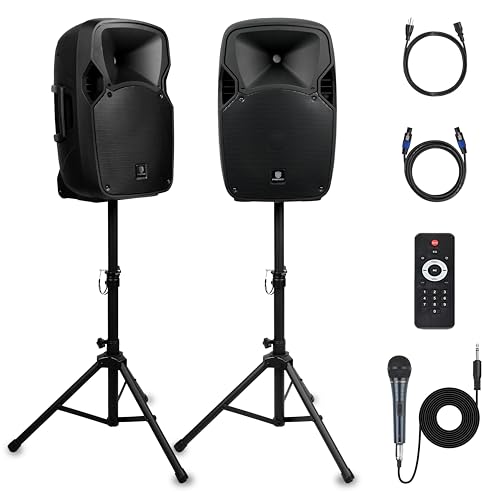
- Complete kit with stands, mic, and remote ready out of the box
- Professional EQ and LCD display for precise sound tuning
- Easy portability with built-in wheels for quick moves
Cons
- Requires AC power outlet with no built-in battery for untethered use
- Larger size may feel bulky for solo handheld carrying
- Lacks companion app for wireless control adjustments
The PRORECK Party 12 is a complete 2-way powered PA speaker system designed for anyone hosting DJ parties, karaoke nights, personal gatherings, or outdoor events. It pairs an active speaker with a passive one, delivering 1800W peak power through a 12-inch woofer and 1-inch tweeter for pro-grade audio that fills large spaces.
Ideal for American partygoers from backyard barbecues to wedding receptions, it shines in real-world scenarios like tailgating or community events where you need reliable, high-volume sound. Setup is straightforward with included stands, a wired microphone, and transport wheels, getting you rocking in minutes without extra gear.
Performance stands out with versatile connectivity and onboard controls, making it a step above basic party speakers. While it demands a power source, the immersive sound and ease of use make it a top pick for value-driven buyers chasing club-like vibes at home.
Verdict: A powerhouse for party pros on a budget, earning its spot as a go-to for dynamic audio that elevates any gathering.
Expect deep bass penetration from the 12-inch subwoofer that thumps hard enough for outdoor DJ sets, paired with crisp highs from the titanium tweeter for clear vocals and instruments. The 1800W peak handles max volumes without breakup, perfect for noisy environments like block parties.
Vocal clarity shines during karaoke with dedicated mic inputs and adjustable levels, ensuring singers cut through the mix. Bluetooth range stays solid up to 30 feet with minimal dropouts, while USB/SD playback delivers glitch-free tracks from your drives.
Overall, it balances punchy lows, balanced mids, and sparkling highs for an immersive profile that rivals pricier systems at gatherings.
Built sturdy for party rigors with dual transport wheels and a standard 35mm stand mount, this speaker rolls easily to venues and stands tall for optimal sound dispersion. The included stands and power cord make it fully portable within reach of an outlet, weighing in as a manageable load for two people.
No IP rating means it's best kept dry for indoor or covered outdoor use, but the rugged cabinet holds up to typical bumps during transport. Lacking a battery, it offers unlimited playback time when plugged in, sidestepping recharge worries for all-day events.
Design prioritizes pro functionality with an LCD screen, rear control knobs, and remote, blending portability with stage-ready toughness for US hosts on the move.
The Comprehensive Guide on How to Position PA Speakers for Maximum Clarity
Getting intelligible audio requires aligning your speaker cabinets directly with the audience rather than pointing them into reflective architecture. When learning how to position pa speakers, your primary objective is delivering consistent sound pressure levels and tonal balance across the entire listening plane. Sound behaves differently depending on frequency, meaning high frequencies travel in tight beams while lower frequencies spread omnidirectionally. Proper positioning accounts for these acoustic behaviors by placing drivers at the right height and angling them downward toward listeners.
Setting speakers on flat tables or leaving them on the floor traps high-frequency detail against nearby chairs and bodies. This creates muffled sound for anyone standing farther back in the room. Raising your speakers above standing head height and aiming them slightly downward establishes an unobstructed line of sight to every listener. This fundamental technique maximizes sound projection while keeping overall stage volume under control.
Optimal Stand Height and High-Frequency Line of Sight
High-frequency compression drivers and tweeters produce directional sound waves that cannot easily bend around physical obstructions. When people fill a venue, human bodies act as acoustic absorbers that soak up mid-range and treble frequencies. Using standard 35mm speaker stands, such as those included with two-way systems like the PRORECK Party 12, allows you to elevate cabinets safely above the crowd. Raising the high-frequency horn roughly two to three feet above the average listener ear level ensures sound carries cleanly to the rear of the room.
Tilting the speaker cabinet slightly downward focuses energy directly on the audience rather than the back wall. Aiming speakers straight ahead causes acoustic reflections that bounce off hard drywall or glass, causing unpleasant flutter echo and muddying vocal clarity. A slight downward angle of five to ten degrees is usually sufficient if your speaker stands offer tilting pole cups or tilt adapters. This targeted orientation concentrates acoustic energy where it is needed and keeps ceiling reflections to a minimum.
Stability is critical when elevating heavy powered speakers on tripod stands. Always extend tripod legs outward until the support struts sit completely horizontal to the floor. Position one tripod leg directly forward beneath the front baffle of the speaker to counteract forward weight bias. Routing power and signal cables down the center pole and securing them with hook-and-loop straps keeps your setup organized and eliminates hazardous tripping points.
Horizontal Splay Angles and Comb Filtering Prevention
Covering a wide seating area often requires deploying multiple full-range cabinets across the venue. When placing two main PA speakers on either side of a stage, you must manage horizontal dispersion angles carefully. Improper spacing causes acoustic comb filtering, which occurs when identical sound waves from adjacent speakers arrive at listener ears at slightly different times. This timing difference creates unnatural phase cancellation and hollow-sounding mid-range frequencies.
Standard two-way point-source cabinets generally feature a horizontal horn dispersion angle between sixty and ninety degrees. Angling the left and right speakers inward toward the audience rather than pointing them parallel to each other prevents heavy phase issues. Creating a slight splay angle minimizes the overlap zone in the center aisle, ensuring clean stereo imaging or even mono coverage. For broader spaces, separating your speakers across the stage width while maintaining a slight inward angle creates a cohesive soundstage without dead spots.
Avoiding side-wall placement is equally important in narrow or reflective rectangular halls. Reflective surfaces create immediate primary reflections that smear high-frequency transients and degrade vocal intelligibility. Keeping your PA cabinets at least three to four feet away from side boundaries significantly improves clarity. When compared to residential spaces where home sound reinforcement systems rely on boundary reinforcement, live sound setups demand higher direct-to-reverberant ratios.
Stage Monitor Placement and Microphone Feedback Suppression
Acoustic feedback remains the single most disruptive issue during live sound operations, and physical placement is your primary line of defense. Feedback occurs when a microphone picks up amplified sound from a nearby speaker, creating a continuous, screeching amplification loop. The most important golden rule of live sound is placing all front-of-house PA speakers forward of performers and microphones. Keeping the speaker front baffles ahead of the vocal microphone line prevents direct acoustic spill into sensitive capsules.
Dedicated floor wedge monitors require an entirely different placement strategy because they point directly toward performers on stage. A compact active cabinet, such as the Gemini 30W Powered PA Speaker 8-inch model, can sit flat on its angled side panel to fire upward toward a singer or instrumentalist. Performers need clear monitoring without triggering squeals, so you must align the monitor angle with the microphone polar pattern. Placing the wedge directly in line with the microphone null zone maximizes gain before feedback occurs.
Most live vocal microphones use cardioid or supercardioid pickup patterns, which reject sound arriving from specific rear angles. Standard cardioid microphones feature maximum sound rejection directly at the rear, meaning a floor monitor should sit directly in front of the performer facing the back of the microphone. Supercardioid microphones have a small rear sensitivity lobe and reject sound best at roughly one hundred and twenty degrees off-axis. Placing floor monitors slightly to the side rather than dead center behind a supercardioid mic prevents high-frequency bleed from initiating a feedback loop.
Managing Low Frequencies and Boundary Loading
Low-frequency sound waves from large woofers behave omnidirectionally, radiating outward in spherical patterns. Boundary loading occurs when a 12-inch active cabinet or dedicated subwoofer sits close to hard architectural surfaces. Placing a speaker directly on the floor doubles its low-frequency output through half-space loading. Moving that cabinet into a corner where two walls meet the floor creates quarter-space loading, providing a substantial boost to deep bass.
Corner loading increases perceived bass volume, but it can also introduce severe acoustic anomalies like standing waves and muddy resonance. Excessive bass buildup masks critical vocal frequencies, making announcements and lyrics difficult to understand. Pulling your full-range cabinets slightly away from corners smooths out low-end response in boomy venues. Elevating cabinets on stands decouples the woofers from hollow wooden stage risers, stopping mechanical vibrations from rattling the stage floor.
Spacing multiple low-frequency cabinets too far apart in large auditoriums or outdoor fields can create acoustic dead zones known as power alleys. Destructive and constructive interference patterns ripple through the audience when identical bass signals emit from separated locations. Clustering bass enclosures together in the center or keeping them tightly paired prevents phase cancellation. This centered arrangement produces punchy, uniform low-end reinforcement throughout the listening zone.
Positioning Directional Trumpet and Paging Horns
Public address systems often utilize specialized trumpet horn speakers for voice announcements, sports fields, outdoor paging, and vehicle communications. Horn speakers like the Pyle 5-inch and 8-inch all-weather trumpet horns focus acoustic energy into a narrow, concentrated projection pattern. These horns are designed to amplify vocal frequencies between 450 Hz and 5,000 Hz, making speech intelligible across long distances. Their directional nature ensures voice messages cut through heavy ambient background noise.
Installing horn speakers requires careful physical aiming using their included mounting hardware. Models featuring 180-degree swiveling adjustable brackets allow you to pivot the flare horizontally and vertically to match crowd geometry. Secure horns at least eight to ten feet above the ground when mounting them on building exteriors, sports bleachers, or industrial walls. Aiming the horn flare downward toward the intended listening area ensures clear vocal throw while minimizing neighborhood noise spill.
Vehicle installations using compact horns like the Workman weatherproof horn or Pyle Pyramid outdoor car horn present unique positioning challenges. Mounting a horn under the car hood or onto a roof rack requires directing the sound away from the vehicle cabin to protect passenger hearing. Tilting the horn mouth slightly downward prevents rainwater and debris from pooling inside the compression driver assembly. Firmly bolting the bracket to a rigid structural frame reduces mechanical vibration that could loosen electrical connections over time.
Adjusting for Venue Dimensions and Acoustic Environments
Every listening space presents acoustic variables that dictate your overall speaker positioning strategy. Highly reflective venues with concrete floors, tiled walls, or uncurtained windows require tighter speaker coverage to avoid energizing reverberant fields. Pointing speakers directly into hard glass or brick causes sound to bounce continuously, degrading speech comprehension regardless of system power. Angling cabinets inward and downward keeps acoustic energy concentrated on the absorptive audience rather than reflective walls.
In deep, narrow rooms, a single pair of front-of-house speakers pushed to high volume will deafen people in the front rows while remaining muddy for listeners in the back. Deploying secondary delay speakers further down the hall provides a more effective approach than blasting the primary front speakers. Setting delay speakers to match the acoustic arrival time of the front speakers maintains clarity without overwhelming front-row guests. For events focused on acoustic music or spoken word, positioning equipment with techniques common to dedicated music speakers preserves natural vocal timbre.
Outdoor environments eliminate wall reflections entirely, but they introduce other acoustic obstacles such as wind and rapid sound dissipation. Without reflective surfaces to sustain acoustic energy, sound levels drop off significantly over distance according to the inverse square law. Raising speakers slightly higher on sturdy tripod stands and angling them directly toward seated crowds ensures sufficient sound pressure reaches the perimeter. Securing stands with sandbags or stage weights prevents sudden gusts of wind from toppling elevated equipment.
Verifying Coverage, Equalization, and System Sound Checks
Conducting a thorough listening test across the entire venue is essential once physical speaker placement is complete. Connect your audio source using balanced XLR or quarter-inch cables, and bring up the master volume to an average listening level. Walk the room in a zigzag pattern, moving from the front row to the back corners to evaluate sound coverage. Listen carefully for sudden drops in vocal clarity, excessive reverberation, or shifts in bass intensity.
Adjust the horizontal splay angle or stand height before touching any equalizer controls if you encounter dead zones or muffled audio. Physical repositioning often cures acoustic problems that electronic equalization cannot solve. When minor tonal adjustments are needed, utilize onboard tone controls like independent bass and treble knobs to balance room acoustics. Fine-tuning individual channel gains prevents clipping and keeps the audio clean across the entire dynamic range.
Perform a microphone check at actual performance volume, standing at various points on the stage with the vocal microphone active. Verify that stage wedge monitors provide ample clarity for performers without bleeding into the front-of-house mix or ringing at high frequencies. Confirm that all cables are taped down securely along paths where performers and guests walk. Taking time to position heights, angles, and distances properly before the event begins ensures clean, articulate sound across every seat.


Write Your Review
No reviews yet. Be the first to share your experience!