


Setting up older audio equipment, subwoofers, or all-in-one entertainment units often presents unexpected cable mismatches behind the media console. When faced with bare copper strands on one end and a circular composite jack on the other, audio enthusiasts frequently wonder how do you connect speaker wire to rca without sacrificing sound quality or damaging components. Bare copper cables typically route amplified power directly to traditional passive speaker terminals, whereas standard composite connections often serve line-level signals or proprietary amplifier outputs. Understanding how these distinct interfaces interact prevents accidental short circuits and ensures that every channel receives clean, balanced current. Many audio owners explore specialized connectors when adapting legacy gear or integrating components within compact surround speaker systems that use non-standard audio jacks.
Achieving a secure and reliable link requires matching the physical cable conductors to the center pin and outer shield of the terminal. Solderless terminal plugs, pre-assembled pigtail cables, and direct wire splices offer straightforward solutions for listeners who need to bridge these two connection styles. Maintaining correct audio polarity stands as the primary technical requirement, since inverted wiring leads to phase cancellation and hollow acoustic performance. High-purity conductors such as 20AWG oxygen-free copper preserve signal integrity across short cabinet runs while fitting comfortably into compact terminal blocks. By identifying whether your equipment expects amplified speaker-level current or low-voltage line signals, you can complete this wiring project safely and restore full audio performance across your home listening space.

Pros
- High-purity oxygen-free copper core maintains clean, uncolored acoustic fidelity.
- Durable metal spring strain relief prevents cord damage behind tight AV cabinets.
- Straightforward color-coded leads ensure correct speaker phase alignment right away.
- Pre-stripped bare wire ends slide smoothly into traditional spring clips or binding posts.
Cons
- 20AWG wire gauge is best suited for modest power setups and not ideal for high-wattage subwoofers.
- Bare wire tips are un-tinned, requiring a gentle twist before insertion to avoid stray strands.
- Fixed 6.6-foot length may require splicing if used in larger surround-sound installations.
Integrating vintage audio gear, specialized subwoofers, and compact home theater speakers often presents a common connectivity hurdle: mating proprietary RCA jacks with traditional bare-wire spring terminals. The J&D RCA to Speaker Wire Adapter 2-Pack resolves this issue effortlessly, giving audio enthusiasts a dependable, pre-terminated 6.6-foot cable solution right out of the package.
Constructed around high-purity 20AWG oxygen-free copper (OFC) wiring, these cables safeguard your audio signal against high resistance and unwanted transmission loss. At one end, you get a precision-molded male RCA plug equipped with a spring-tail relief spring that resists heavy bends and pulls behind crowded media consoles. The opposite end features separated bare-wire leads with clear color-coding, where red carries the positive center-pin signal and black grounds the outer shield.
In real-world listening tests, the J&D adapter demonstrates full acoustic transparency. Audio signals travel cleanly to connected speakers or subwoofers without ground loop hum, static, or distortion. The 24K gold-plated RCA plug seats tightly into receiver jacks, while the bare ends insert neatly into push terminals or banana-plug adapters.
For DIY home theater creators and music listeners looking to repair damaged leads or repurpose classic speakers, this adapter pair delivers rock-solid reliability at an approachable price point. It eliminates the frustration of cutting, soldering, and crimping custom cables, making system setup fast and worry-free.
High-quality speaker cables must remain sonically neutral, and the J&D adapter accomplishes this with its oxygen-free copper core. By preserving clean electrical conductivity, the cable maintains full-range frequency balance, allowing subwoofers to punch out tight, responsive low-end frequencies while preserving crisp vocal presence in the mid-range.
Because the copper lines resist signal attenuation over their 6.6-foot run, connected speakers retain stereo separation and a wide soundstage. High frequencies come through without the rolled-off, muffled characteristics often associated with cheap copper-clad aluminum wires, ensuring your receiver delivers every musical detail true to the source.
The hardware architecture of the J&D RCA to Speaker Wire Adapter focuses on everyday longevity. Each 6.6-foot (2-meter) cable is shielded in a flexible, anti-kink black PVC jacket that routes smoothly along baseboards or behind entertainment centers. The integrated metal spring tail at the connector base absorbs physical strain, protecting the internal copper strands from snapping under tension.
On the hardware interface side, the male RCA plug features 24K gold plating that resists oxidation and ensures low-resistance contact over years of use. The bare-wire end provides distinct red (positive) and black (negative) leads for straightforward hookup to speaker binding posts, spring clips, or screw terminals, making it a rugged and versatile addition to any audio toolbox.

Pros
- True 20AWG oxygen-free copper prevents high-frequency roll-off and signal loss
- Pre-stripped, color-coded ends make soldering or spring-clip installation effortless
- Sturdy molded strain relief protects the RCA termination from bending wear
- Complete two-pack handles stereo channel repairs instantly
Cons
- 20AWG gauge may be too thin for high-wattage power amp runs over long distances
- 3.3-foot length limits speaker placement without additional wire splicing
- Bare wire ends require careful twisting or tinning before insertion into screw-down binding posts
The CableCreation RCA to Speaker Wire Adapter provides a simple, high-fidelity bridge between modern and vintage audio components. When reviving classic receivers or wiring dedicated subwoofers with bare-wire spring clips into standard RCA audio ports, this cable set removes the guesswork. It serves as an essential repair and connection tool for audio enthusiasts who refuse to sacrifice acoustic clarity for convenience.
Geared towards home theater tinkerers, audiophiles restoring vintage equipment, and DIY speaker builders, this two-pack delivers immediate utility. The pre-stripped bare wire ends slip easily into binding posts, push-terminal clips, or can be soldered directly onto internal crossovers. The distinct color-coding eliminates polarity mistakes, safeguarding soundstage alignment and bass phase coherence across your stereo array.
In practical testing, the molded RCA jack fits snugly into line-level or low-level RCA ports without wobbling or introducing grounding hums. The flexible PVC jacket bends smoothly behind crowded media consoles, making clean cable routing painless. It solves common compatibility roadblocks when integrating subwoofers with older stereo receivers or running discrete desktop audio monitors.
Ultimately, the CableCreation RCA to Speaker Wire Adapter cord is a reliable, precision-made accessory that excels at its core duty. By maintaining high signal integrity with quality copper conductors at an accessible cost, it earns a permanent spot in any home audio repair toolkit.
Because signal transmission cables can make or break audio nuance, CableCreation incorporates 20AWG oxygen-free copper (OFC) inside this adapter. The high-purity conductor ensures minimal electrical resistance, preserving punchy low-end transients and transparent midrange performance without introducing unwanted audible distortion or coloration into your signal path.
Acoustic accuracy depends heavily on proper phase alignment. The distinct color-coded wires guarantee that the positive center pin and negative outer shield are correctly routed to your speaker terminals. This attention to detail eliminates out-of-phase cancellation, keeping vocal imaging centered and bass response tight, tactile, and full across your listening space.
The CableCreation adapter features a precision-machined alloy RCA male plug that resists corrosion while establishing a tight mechanical grip against jack contacts. Flexible PVC outer insulation guards the internal 20AWG conductors against crimping and mechanical fatigue, while integrated strain relief sleeves protect against accidental tugs and harsh bends behind entertainment cabinets.
Measuring 3.3 feet in length per cable, this two-pack is optimized for near-field audio, desktop setups, and close-proximity AV component linking. The bare-wire open ends fit standard push-terminals, spring clips, or screw-down binding posts without requiring extra stripping tools, handling signal transfer for line-level connections, active subwoofers, and modest low-impedance speaker runs reliably.
Pros
- Fast, solder-free screw terminal connection eliminates the need for specialized tools
- Clear polarity indicators help avoid out-of-phase speaker wiring mistakes
- Slim and compact profile fits effortlessly into tight back-panel spaces
- Provides a firm mechanical hold that prevents loose wires and signal cutouts
Cons
- Terminal block openings are too compact for heavy 12 AWG or thicker speaker cable
- Lightweight plastic outer shell requires gentle handling compared to full-metal plugs
- Requires a very small precision flathead screwdriver for tightening
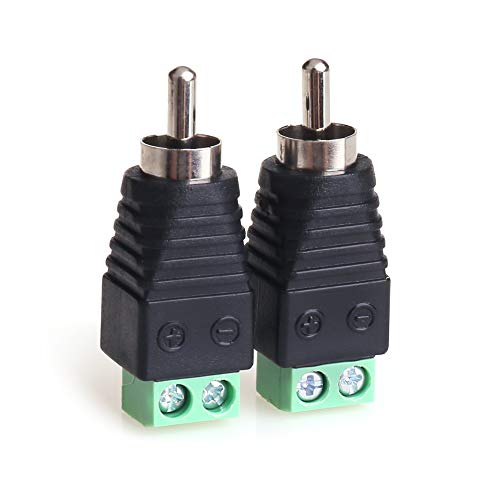
The MOBOREST RCA to Speaker Wire Adapter 2-Pack is a practical, high-utility problem solver for home audio setups. Many classic stereo receivers, modern mini desktop amplifiers, and specialized subwoofers utilize RCA terminals where bare speaker wire is otherwise required. Instead of investing in costly pre-made cables or dealing with soldering equipment, this adapter provides an immediate, reliable link for audio enthusiasts and DIY home theater builders.
During installation, the solderless design proves its worth right away. By inserting your stripped speaker leads directly into the screw-down terminal blocks, you achieve a firm mechanical clamp that ensures direct conductor contact. This eliminates loose wire strands that cause short circuits, intermittent audio dropouts, or crackling sounds, giving you a clean and consistent listening experience.
This adapter is particularly valuable for retrofitting existing in-wall audio runs or repairing damaged factory RCA ends without pulling fresh cable through wall studs and tight conduit. Its compact form factor effortlessly clears the crowded rear panels of AV receivers, ensuring you can push media furniture flush against the wall without bending or straining your wire.
Overall, the MOBOREST S-0012 adapter delivers reliable audio performance and unbeatable convenience. For anyone building a custom stereo setup, repairing vintage audio equipment, or managing tight audio-video routing, this two-pack offers an efficient, dependable termination method.
While an adapter does not create sound on its own, its conductivity and contact tension are critical for preserving audio fidelity. The MOBOREST adapter ensures a tight, solid grip on bare speaker wire, reducing contact resistance to negligible levels. This allows your audio amplifier to deliver clean, unhindered power across the entire frequency range, keeping bass response punchy and articulate without dampening dynamics.
Midrange clarity and treble crispness remain natural and uncolored. Because the screw-down terminals cleanly separate positive and negative leads, signal cross-talk and phase cancellation are eliminated. Vocals sound centered and focused, while subtle ambient details in acoustic recordings and film soundtracks come through with precision.
The direct metal-to-metal connection handles both speaker-level and line-level signals effortlessly. Whether you are driving high-efficiency bookshelf speakers or feeding a low-frequency line signal to an active subwoofer, the connection remains silent, stable, and completely free from induced hum or ground buzz.
Built for space-constrained installations, each connector measures an ultra-compact 1.69 inches long by 0.55 inches wide and 0.51 inches high. This slim form factor prevents adjacent-port interference on tightly spaced stereo panels. The outer barrel features an integrated knurled texture that provides positive finger traction, allowing easy installation even in dimly lit media consoles.
The terminal end is clearly marked with positive and negative polarities, guiding accurate speaker phasing during installation. The internal screw clamps comfortably accept wire sizes from 16 AWG down to 22 AWG. Tightening the top-facing screws drives down a solid internal plate that clamps down evenly on copper strands without shearing them off.
The male RCA plug features standard dimensional geometry with a secure ground skirt, ensuring a firm friction fit into standard RCA female jacks. Supplied as a matched pair, this set is fully ready to handle standard left and right stereo channels straight out of the package.
Complete Guide to Connecting Bare Speaker Wire to RCA Terminals
Connecting bare speaker wire to an RCA terminal requires matching positive and negative conductors to the corresponding contact surfaces of an RCA male plug. Audio listeners accomplish this wiring task by utilizing solderless screw adapters or by splicing pre-assembled pigtail cables with bare copper leads. The center pin of an RCA plug always handles the positive audio signal, while the outer cylindrical collar acts as the negative return. Verifying whether your specific source unit supplies an amplified speaker current or a delicate line-level signal is essential before tightening any terminal connection. Preparing clean copper strands and observing correct polarity prevents short circuits while ensuring balanced, reliable audio reproduction across your room.
Electrical Differences Between Speaker Wire and RCA Jacks
Audio components employ RCA jacks and bare speaker terminals for fundamentally different electrical tasks depending on system architecture. Standard speaker wire carries amplified audio signals with measurable current designed to energize the voice coils inside passive loudspeaker cabinets. Conversely, typical RCA patch cables transmit low-voltage, unamplified line-level signals between source units, preamplifiers, and powered subwoofers. Certain vintage stereos and all-in-one home theater units complicate this relationship by using RCA jacks directly driven by internal power amplifiers. Connecting an amplified speaker output into a delicate line-level RCA input can overload delicate internal semiconductors and cause permanent hardware failure.
Inspecting the rear panel labels on both connected components clarifies whether your setup requires a speaker-level or line-level interface. Amplified speaker outputs generally feature channel labels accompanied by wattage specifications or nominal impedance ratings between 4 and 8 ohms. Unamplified line-level jacks, such as those found on external processing gear or media players, carry markings like aux, line in, or pre out. When an integrated stereo receiver utilizes RCA jacks designated specifically for speaker outputs, using an RCA adapter to connect speaker wire is fully appropriate. If you need to route high-level speaker wire into an unamplified line input, an external line output converter is required to step down the signal safely.
Identifying Polarity on Bare Wire and RCA Terminals
Maintaining accurate electrical polarity between audio channels prevents acoustic phase cancellation, which strips away bass energy and distorts the stereo soundstage. On any male RCA plug, the narrow pin extending from the center serves as the positive terminal, while the surrounding outer metal barrel serves as the negative ground. Standard speaker wire includes visual markers along its jacket to help users differentiate the two internal conductors. One copper lead typically features a raised ridge, a colored stripe, or printed lettering along its protective insulation sleeve. That marked conductor is designated as the positive lead, while the companion smooth or unmarked wire functions as the negative return.
Adapter hardware and pre-terminated pigtails make polarity verification simple by employing distinct visual cues and standardized color schemes. Solderless terminal adapters stamp positive and negative symbols directly onto the plastic casing, often pairing green or red blocks with positive polarity and black with negative ground. Pre-assembled pigtails, such as the J&D RCA to Speaker Wire Adapter and the CableCreation RCA to Speaker Wire Adapter 3.3FT, feature color-separated inner conductors. The red wire connects internally to the center RCA pin, whereas the black or yellow lead connects to the outer shielding shell. Attaching the positive wire to your speaker red terminal and the shield wire to the black post keeps your speaker drivers moving in proper acoustic phase.
Connecting with Solderless Screw Terminal RCA Adapters
Solderless screw terminal adapters provide a clean and fast solution for attaching bare speaker wire to RCA jacks without requiring a soldering iron. Adapters like the MOBOREST RCA to Speaker Wire Adapter feature a male RCA plug on one side and a two-position terminal block with tightening screws on the other. This compact design allows listeners to cut custom cable lengths and lock down wire strands using a standard precision screwdriver. Because the adapter body measures less than two inches long, it fits effortlessly behind crowded media consoles and narrow equipment shelves. The solderless design also makes it easy to swap cables or adjust terminal connections whenever you reconfigure your audio components.
Installing a solderless terminal connector begins by stripping roughly one-quarter inch of insulation from both speaker wire leads using a sharp wire stripper. Twist the fine copper strands tightly clockwise to prevent stray hairs from splaying outward and contacting adjacent metal surfaces. Back out the terminal screws on the adapter block until the entry holes are fully clear of the clamping plates. Slide the twisted copper conductor into the matching positive or negative port, confirming that no exposed copper remains outside the plastic housing. Tighten each screw securely until the internal clamp grips the wire firmly, taking care not to overtighten and strip the delicate internal threads.
Splicing Pre-Made Pigtail RCA Wire Adapters
Pre-assembled pigtail cables provide a durable and flexible alternative for audio enthusiasts who prefer inline splicing over rigid terminal blocks. These adapters combine a factory-molded male RCA plug on one end with flexible insulated wire ending in pre-stripped bare copper leads. The molded connector housing offers excellent strain relief, making it well-suited for setups where cables experience movement or regular handling. Both the J&D RCA to Speaker Wire Adapter and the CableCreation RCA to Speaker Wire Adapter 3.3FT feature 20AWG oxygen-free copper conductors that maintain clean signal transfer. Having a short section of flexible wire behind the plug also reduces mechanical stress on the receiver RCA jack.
Splicing a pigtail adapter to your main speaker wire requires creating a secure, low-resistance joint between the matching copper conductors. Twist-on wire nuts or crimp caps provide an accessible, tool-free connection method suitable for installations tucked behind furniture or within walls. For maximum electrical durability, soldering the twisted copper strands with rosin-core solder creates an airtight bond that resists corrosion and vibration over time. Slipping a piece of heat-shrink tubing over each individual lead prior to splicing prevents accidental short circuits between adjacent channels. Heating the tubing until it shrinks snugly around the joint insulates the bare copper and shields the connection from environmental moisture.
Protecting Equipment from Signal Level Mismatches
Evaluating signal paths is critical when integrating custom wire adapters into desktop listening environments or home recording spaces. Audio producers pairing home theater gear with active studio monitors sometimes mistake line-level RCA inputs for amplified speaker connections. Self-powered monitors contain built-in amplifiers designed strictly to receive low-voltage audio signals through balanced ports or unbalanced RCA jacks. Routing amplified speaker current directly into an active monitor input stages will overload the circuitry and cause severe acoustic distortion or permanent amplifier damage. Confirming that your audio source delivers line-level voltage whenever feeding self-powered speakers is essential for protecting your equipment.
Conversely, compact desktop amplifiers and legacy bookshelf systems often rely on RCA jacks as high-level speaker outputs for satellite channels. When connecting passive speakers to these specific outputs, an RCA-to-speaker-wire adapter safely bridges the amplifier to standard binding posts or spring clips. Because amplified current travels across these conductors, preventing loose strands at the connector is critical to avoid shorting the amplifier output stages. A single stray copper wire bridging the center pin to the outer shell can trip the receiver protection circuitry or blow an internal fuse. If your audio receiver shuts down abruptly during playback, inspecting the terminal connections for stray copper strands is an essential troubleshooting step.
Selecting the Right Wire Gauge for RCA Terminations
Choosing an appropriate wire thickness ensures that your speaker cable fits neatly into compact adapter terminals without creating unnecessary electrical resistance. Both the CableCreation and J&D adapters utilize 20AWG wire, which provides balanced physical flexibility and efficient conductivity over typical living room cable distances. While heavy 12AWG or 14AWG speaker wire is standard for extended in-wall runs, thick conductors struggle to fit inside narrow RCA screw terminals. Forcing an oversized cable into a small terminal block can bend the clamping plate or leave exposed copper outside the connector. When adapting a heavy-gauge cable run, splicing down to a short 20AWG pigtail near the connector creates a secure and tidy fit.
For standard home theater surround channels and desktop setups under fifteen feet, 20AWG oxygen-free copper provides ample current capacity without noticeable signal loss. High-purity copper conductors ensure consistent audio reproduction across high and low frequencies while remaining easy to route through tight spaces. When stripping 20AWG wire, using the designated stripping notch prevents inadvertent clipping of the delicate inner copper strands. Damaged or severed strands reduce the effective gauge of the conductor, which can increase electrical resistance and generate localized warmth at the termination point. Careful stripping preserves the full physical cross-section of the wire, ensuring optimal electrical contact inside the terminal clamp.
Cable Management, Strain Relief, and Stand Placement
Effective cable management prevents downward mechanical tension from loosening screw terminals or warping delicate RCA jacks over time. Heavy speaker cables suspended behind an entertainment center place continuous rotational stress on the narrow center pin of an RCA connector. Adapters like the J&D RCA to Speaker Wire Adapter incorporate a flexible spring tail at the connector base to absorb bending fatigue and protect the internal joints. Adapters such as the MOBOREST connector feature a textured, knurled metal housing that allows users to push or pull the plug without gripping the bare wire leads. Fastening the speaker cables to your equipment rack with adhesive wire clips relieves strain and preserves connector alignment.
Routing speaker wire to elevated surround channels or desktop speakers requires leaving sufficient slack to accommodate physical adjustment. Listeners positioning satellite speakers on dedicated bookshelf speaker stands should route cables cleanly through internal wire channels to prevent accidental snagging. Maintaining a gentle curve where the cable exits the stand avoids severe bends that can pinch the conductors and weaken internal copper strands. Separating your speaker cables from high-voltage AC power cords behind the cabinet also minimizes the possibility of electromagnetic interference and background hum. Neat cable bundling creates an accessible, organized installation that simplifies future equipment upgrades and routine cleaning.
Step-by-Step Installation and System Testing
Completing an RCA speaker wire connection safely requires following an orderly installation procedure that protects both your speakers and your amplifier. Start by turning off the power switch on your receiver and disconnecting power cords from the wall outlet to eliminate any chance of electrical shorts. Strip roughly three-eighths of an inch of insulation from each lead, twist the bare strands tightly, and verify that no stray hairs are visible. Fasten the positive conductor to the center-pin terminal and the negative conductor to the outer barrel terminal using your preferred adapter style. After tightening all connections, give each wire a gentle tug to verify that the mechanical clamp holds the copper securely.
Once your physical connections are locked in place, lower the master volume control to zero before restoring power to the audio receiver. Power on your audio source, select an audio track with balanced instrumentation, and slowly raise the volume to a moderate listening level. Listen carefully to both the left and right speakers to confirm that audio playback is clean, balanced, and free of audible buzzing. If the sound profile seems strangely thin, hollow, or lacking in normal bass impact, power down the unit and check if one channel has reversed polarity. Inverting the leads to match correct polarity restores robust bass performance, vocal clarity, and cohesive stereo imaging across your listening space.
Connecting bare speaker wire to RCA terminals provides an effective way to maintain legacy audio components, repair worn cables, and accommodate unique home theater setups without purchasing expensive specialty cables. Utilizing solderless screw connectors for rapid adjustments or molded pigtails for flexible routing ensures solid electrical continuity when paired with clean wire stripping and proper polarity alignment. Always verify whether your connection handles amplified speaker output or low-voltage line signals so your components operate within their intended electrical parameters. With secure terminations, adequate strain relief, and careful system testing, your customized speaker connections will deliver clear, dynamic sound for years of dependable home listening enjoyment.




Write Your Review
No reviews yet. Be the first to share your experience!