


Setting up a dedicated listening space or home theater often leads to a confusing wall of acoustic specifications. Shoppers trying to balance clear vocals with punchy low-end notes frequently wonder what is a good frequency response for speakers before spending hard-earned money. Manufacturer spec sheets present frequency numbers that seem impressive at first glance, but those ranges rarely tell the entire acoustic story on their own. Comparing balanced studio monitor setups against standard consumer boxes proves that numbers alone cannot guarantee accurate playback without proper acoustic context.
While human ears can detect sound roughly from 20 Hz to 20,000 Hz, room placement and driver architecture drastically alter what listeners actually perceive. Multi-channel layouts like surround sound speaker systems distribute these frequency duties across distinct woofers and tweeters to preserve vocal intelligibility. Grasping how nominal frequency spans interact with decibel tolerance ratings protects buyers from purchasing gear that produces muddy lows or harsh highs. Evaluating the core mechanics of audio bandwidth helps listeners choose the right equipment configuration for their unique listening priorities.

Pros
- Distortion-free response from laser-optimized materials
- Powerful 100W RMS handling for loud, clear output
- IP56 rating proven for marine and off-road use
- Simple plug-and-play install with included hardware
- Wide sound dispersion fills cabins and cockpits evenly
Cons
- Requires vehicle amplifier to reach full power potential
- Wired installation limits placement flexibility
- Larger 5.25-inch size may need custom door panels
The Polk Audio DB522 is a 5-1/4-inch coaxial speaker built for car doors, boats, and powersports vehicles, blending high-fidelity audio with marine-grade toughness. Certified IP56 for splash resistance, it features a polypropylene woofer cone and silk dome tweeter, making it perfect for American boaters, off-roaders, and car audio upgraders who demand reliability on the water or highway.
In real-world use, these speakers shine during long drives or weekend boating trips, pumping out balanced sound with punchy lows and crisp highs via built-in crossovers. The Dynamic Balance technology uses laser imaging to minimize distortion, ensuring every note from country roads to rock anthems comes through cleanly even at high volumes.
Installation is straightforward with provided hardware and grilles that add a sleek look to any interior. While best paired with a solid amp, they transform stock systems into something special for daily commuters and adventure seekers alike.
Verdict: A top pick for durable, high-output audio that survives saltwater sprays and dusty trails, delivering pro-level sound without the premium price tag.
With a 55-22kHz frequency response, the DB522 captures deep bass from the 5-1/4-inch woofer alongside sparkling highs from the 3/4-inch silk dome tweeter. Dynamic Balance ensures smooth, wide dispersion without resonance, ideal for filling car cabins or boat decks with detailed vocals and instrument separation during tailgates or fishing outings.
Handling 100W RMS, these speakers push loud volumes with controlled power, avoiding muddiness in mids or harsh treble. The built-in crossover precisely routes frequencies to each driver, delivering consistent performance whether upgrading factory doors or marine setups.
Users report excellent clarity on highways or waves, with bass that thumps on beats without overpowering lyrics, making it a go-to for bass lovers who want full-spectrum sound.
Rugged coated steel baskets and IP56 certification make the DB522 splash-proof against freshwater, salt-fog, UV rays, and humidity, perfect for boats, ATVs, and motorcycles on rugged American trails. The compact 5-1/4-inch size fits most door panels, with stylish grilles that enhance vehicle interiors.
No onboard battery means it's powered directly by your car's or boat's system, eliminating recharge worries for all-day playback on cross-country drives or lake days. Weighing in at standard coaxial specs, it's easy to handle during installs without added bulk.
Durability shines in harsh conditions, with polypropylene materials resisting wear for years of reliable use, far outlasting basic speakers in wet or dusty environments.
Pros
- Powerful 500W RMS output handles high-volume live performances
- Dual 15-inch woofers with 50oz magnets provide thunderous low-end
- Wide frequency response captures every detail from bass to treble
- Steel grills add durability for road-ready use
Cons
- Unpowered design requires external amplifier
- Large size makes them less ideal for small portable setups
- Heavy build suited for stationary or vehicle transport only
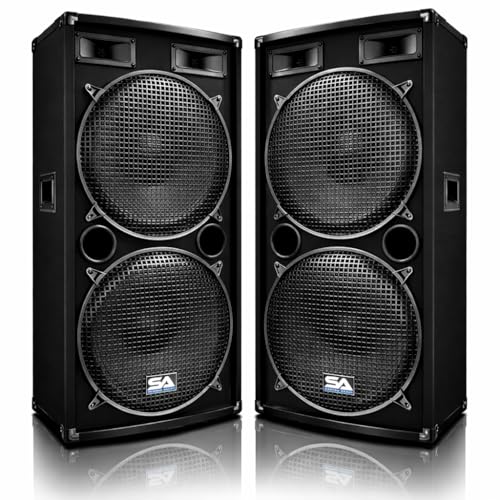
Seismic Audio's pair of dual 15-inch PA DJ speakers are built for professional audio applications, delivering 500 watts RMS per speaker with a 1000-watt peak. Designed for live sound reinforcement, they feature massive woofers with 50-ounce magnets and 2-inch voice coils, paired with dual tweeters for comprehensive coverage.
Ideal for bands, bars, weddings, and churches, these speakers excel in medium to large venues where high volume and clarity are essential. Event organizers and sound engineers appreciate their ability to handle demanding setups without distortion.
In real-world use, they produce full-bodied sound that cuts through crowds, making them a staple for mobile DJs and worship services. The steel grills ensure longevity on the road.
Verdict: A solid choice for pros seeking reliable, high-power PA speakers that punch above their weight in live environments.
With a frequency response of 30Hz to 20kHz, these speakers offer deep bass from the dual 15-inch woofers, ideal for thumping lows in DJ sets or band performances. The 50-ounce magnets and 2-inch voice coils ensure tight, responsive bass without muddiness.
Vocal clarity shines through the two 2x5 tweeters, providing crisp highs that make announcements and lead vocals stand out in noisy venues. At 500W RMS, they reach ear-splitting volumes suitable for bars and weddings.
Performance remains stable under load, thanks to 4-ohm impedance that maximizes amp efficiency for consistent output during long events.
Built tough with steel grills over each driver, these speakers withstand the rigors of gigging life, protecting internals from impacts and dust at events.
The cabinet design prioritizes acoustic performance with a robust enclosure for dual 15-inch woofers, though their size and weight make them best for truck or cart transport rather than handheld carry.
As unpowered cabinets, they draw power from external amplifiers with no onboard battery, allowing flexible scaling for any venue size without recharging concerns.

Pros
- Outstanding vocal clarity that prevents dialogue from getting buried in complex action scenes
- Sound-matched LCR design allows for a perfectly cohesive front soundstage
- Heft and solid build quality with an elegant black ash real wood veneer
- Wide horizontal dispersion ensures off-axis viewers hear identical sound quality
Cons
- Substantial 10.25-inch depth and 24-pound weight require deep, sturdy media furniture
- Dual rear ports can produce boomy bass if placed flush against a wall without using the port plugs
- Requires a high-current AV receiver or dedicated amplifier to reach its full dynamic potential
The Energy Reference Connoisseur RC-LCR serves as an uncompromising acoustic anchor for any high-performance home theater. Engineered to solve the common issue of muffled dialogue, this passive speaker acts as the vocal bridge between explosive soundtrack dynamics and quiet whispered interactions. Its pedigree within the Reference Connoisseur line ensures that it pairs seamlessly with other high-fidelity speakers in multichannel surround sound configurations.
This speaker is built specifically for home theater enthusiasts and audiophiles who refuse to compromise on front-stage cohesion. Thanks to its balanced driver layout, the RC-LCR offers genuine Left, Center, Right versatility. You can mount it horizontally underneath a projector screen or television as a dedicated center speaker, or stand three units vertically across the front to create an identical, unified soundfield that pans effortlessly from side to side.
In real-world testing, the RC-LCR distinguishes itself by keeping complex audio layers neatly organized. Action movies with layered sound effects, heavy musical scores, and simultaneous dialogue remain distinctly separated rather than collapsing into a harsh wall of noise. You can enjoy cinematic volume levels without ear fatigue, eliminating the constant need to raise the volume for speech and lower it for explosions.
Ultimately, the Energy RC-LCR delivers performance well above standard entry-level center channels. For anyone looking to invest in a durable, distortion-free front channel that brings theater-quality presentation into their home, this speaker stands out as a dependable workhorse with audiophile refinement.
Boasting a rated frequency response from 48Hz up to 23,000Hz, the RC-LCR provides a much wider frequency spectrum than typical center channel boxes. High frequencies are crisp, airy, and free of shrillness, rendering nuanced details such as breaking glass or string instruments with lifelike presence. The critical midrange remains smooth and forward, ensuring human speech sounds full, resonant, and natural without a nasal or hollow tone.
The low-end foundation is reinforced by a bass reflex cabinet with dual rear-firing ports. This configuration delivers legitimate punch down to 48Hz, enabling smooth integration with your powered subwoofer. Energy's engineering focuses heavily on wide and constant dispersion, meaning the acoustic output radiates uniformly throughout the room so guests sitting on the outer edges of the couch enjoy the same dynamic experience as anyone sitting directly center.
Constructed with acoustic mass in mind, the RC-LCR features an internally braced cabinet wrapped in an attractive black ash veneer. Measuring 7.5 inches high, 19.5 inches wide, and 10.25 inches deep, its 24.2-pound weight speaks to the dense cabinet construction engineered to eliminate unwanted chassis resonance. The clean front baffle and quality hardware ensure it blends seamlessly with modern media centers.
On the rear panel, the speaker provides heavy-duty five-way binding posts capable of accepting banana plugs, spade lugs, or thick bare wire for maximum signal transfer. Because the speaker is dual rear-vented, Energy includes custom rubber bumpers and dense foam port plugs in the box. These port plugs allow users to dampen lower frequencies and maintain tight, accurate response when placing the speaker close to drywall or within a semi-enclosed cabinet.
Pros
- Exceptional high-frequency volume that cuts through ambient outdoor and engine noise
- Sturdy aluminum bullet horn construction resists marine weather and UV exposure
- Included crossover capacitors protect the voice coil and streamline installation
- Flexible swivel housing allows precise sound staging on wakeboard towers and boats
Cons
- High frequencies can sound overly bright or sharp without proper equalizer tuning
- Large 3.75-inch bullet horn footprint requires ample mounting space
- Produces treble only and must be paired with mid-bass speakers and a subwoofer for balanced sound
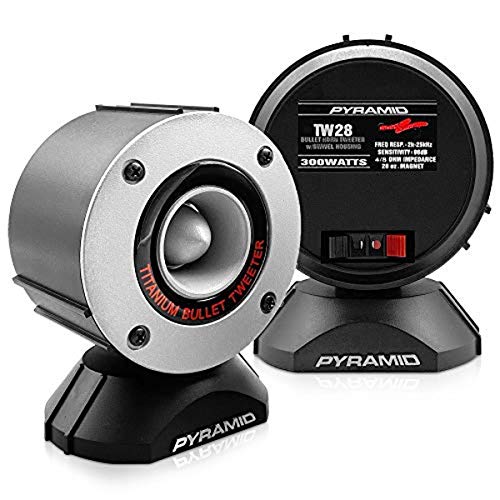
The Pyramid TW28 Marine Tweeter Speaker pair is engineered to resolve a classic open-air audio problem: losing high-end musical details to wind, water, and engine noise. Built with a 3.75-inch aluminum bullet horn and a 1-inch titanium dome, this speaker set is designed specifically to project high-frequency sound across substantial distances. Whether mounted on a center console, a wakeboard tower, or an off-road UTV cage, it provides the focused treble projection that conventional cone speakers simply cannot deliver.
This speaker set is ideal for marine enthusiasts, boat captains, and powersports drivers who already have capable mid-range drivers and subwoofers but need piercing vocal clarity and treble bite. The bullet horn acoustic design acts like a megaphone for high-frequency notes, ensuring that cymbals, guitar picks, and vocal harmonics slice cleanly through the roar of twin outboards or high-speed lake chop.
In real-world marine conditions, the TW28 excels at high volume levels without thermal breakdown, thanks to enhanced ferrofluid cooling and a robust 1-inch high-temperature voice coil. When driven by a clean marine amplifier, these speakers remain crisp and articulate even when pushed near their limits. The included compensation capacitors protect against damaging lower-frequency signals, ensuring the titanium dome reproduces strictly upper-register frequencies.
Ultimately, the Pyramid TW28 delivers an impressive sonic punch for marine sound systems in need of a treble boost. While audiophiles will want to fine-tune their receiver equalizer to smooth out the horn high end, the build quality and output capability make this speaker pair an unbeatable audio solution for open waters.
When it comes to audio performance, the Pyramid TW28 focuses entirely on crisp, high-frequency precision. Spanning a frequency response from 2kHz up to 25kHz, it brings vibrant brightness to tracks that typically sound muffled in outdoor environments. Female vocals, brass sections, and acoustic percussion cut through background marine noise with striking clarity, ensuring that listeners never miss subtle musical nuances even at cruising speeds.
With a 300-watt peak rating and an efficient bullet horn dispersion pattern, volume headroom is the standout feature of this speaker pair. It does not reproduce bass, as it is engineered specifically to complement your existing subwoofers and mid-bass drivers. By delegating upper frequencies to this dedicated horn tweeter, your main speakers run more efficiently, resulting in a cleaner, louder, and more dynamic soundstage across the entire vessel.
Built for demanding marine environments, the Pyramid TW28 features a heavy-duty cast aluminum frame that stands up to sun, salt spray, and splashing water. The swivel housing mechanism adds crucial utility, allowing installers to angle the directional horn toward the main seating area for optimal audio delivery. Weighing over three pounds for the pair, the substantial 20-ounce magnet structure reflects industrial-grade durability rather than cheap plastic alternatives.
As a hardwired marine component speaker, the TW28 connects directly to your vessel 12-volt marine receiver or external power amplifier. This wired setup eliminates the hassle of battery runtimes and recharging, allowing you to blast audio all day out on the lake without interruption. The 4-ohm impedance rating efficiently draws power from standard marine wiring setups, reducing electrical resistance and preserving clean playback from sunrise to sunset.
Decoding Speaker Frequency Response for Real-World Audio Performance
A good frequency response for home speakers typically spans from 50 Hz to 20,000 Hz with a tight variance such as plus or minus 3 dB. This range allows a speaker to reproduce audible music and dialogue without noticeable dropouts or unnatural peaks. Specialty tower cabinets or subwoofers extend lower toward 20 Hz to 30 Hz for deep sub-bass rumble. Ideal frequency specs depend heavily on room size, acoustic boundaries, and whether an auxiliary subwoofer handles low bass.
Understanding the Audible Spectrum from Sub-Bass to Treble
Human hearing covers an approximate range from 20 Hz up to 20,000 Hz. Sub-bass spans from 20 Hz to 60 Hz, delivering tactile vibrations found in modern sound mixes and cinematic effects. Mid-bass extends from 60 Hz to 250 Hz, giving kick drums and bass guitars their rhythmic punch. When a speaker rolls off too early above 80 Hz, playback sounds thin and hollow.
The midrange covers 250 Hz to 4,000 Hz, representing the most sensitive band for human ears. Human speech, acoustic guitars, and lead vocals reside directly inside this acoustic window. Irregular frequency response across the midrange makes dialogue sound muffled, nasal, or strangely recessed. Clean reproduction here remains essential for vocal clarity in movies and stereo imaging in music.
Treble spans 4,000 Hz to 20,000 Hz, adding sparkle, definition, and room ambience to recorded sound. Cymbal crashes and acoustic overtones rely on smooth high-frequency driver output. Even though adult hearing often rolls off near 15,000 Hz, smooth extension toward 20,000 Hz preserves natural harmonic overtones. Speakers that roll off early in the treble range sound dark and lack spacious detail.
Why Decibel Tolerance Matters More Than Raw Frequency Numbers
Many shoppers encounter specification sheets claiming a speaker reaches from 30 Hz to 20,000 Hz. Without a decibel tolerance rating, that stated frequency span tells only half the story. A speaker might emit a 35 Hz tone, but if that tone plays ten decibels below the rest of the music, it remains inaudible. Meaningful acoustic specs always include a tolerance boundary, such as plus or minus 3 dB.
A plus or minus 3 dB rating means output does not stray more than three decibels from the baseline level across that range. Three decibels is roughly the smallest volume change noticeable to human ears during normal listening. Without an explicit tolerance rating, a listed low-end spec could be measured ten decibels below reference volume. Shoppers expecting robust bass from an unrated spec often end up disappointed.
Consider the Energy Reference Connoisseur RC-LCR Center Channel, which lists an explicit frequency response of 48 Hz to 23,000 Hz plus or minus 3 dB. Because Energy includes that three-decibel envelope, listeners know the cabinet reproduces frequencies down to 48 Hz at audibly useful volume. The dual rear vented bass reflex design helps maintain balanced output across dialogue registers without mid-bass boom. Stated tolerance boundaries give buyers clear insight into real-world tonal accuracy.
Bass Extension and Cabinet Architecture
Generating deep low frequencies requires moving substantial volumes of air, which challenges compact speaker enclosures. Small desktop or bookshelf speakers rarely reach below 55 Hz or 60 Hz without running into physical excursion limits. Floorstanding towers and public address systems utilize larger cones and internal air volumes to achieve deep bass output. True low bass demands enclosure volume, cone surface area, or active equalization.
A practical example of high-volume low-frequency capability appears in the Seismic Audio – Pair of Dual 15″ PA DJ SPEAKERS, which lists a frequency response from 30 Hz to 20,000 Hz. Equipped with dual 15-inch woofers featuring 50-ounce magnets, these passive cabinets generate the air displacement required for large event venues. For buyers comparing live sound gear, exploring powered PA speaker options shows how internal amplification shapes low-frequency output during extended playback. High-excursion cones and steel grilles help protect internal drivers when producing heavy bass for live bands and events.
Most residential listeners do not need main speakers that drop down to 20 Hz. Quality bookshelf speakers rolling off near 60 Hz easily handle acoustic instruments, standard bass lines, and rock tracks. When visceral movie rumbles or electronic sub-bass notes are needed, a dedicated subwoofer easily fills the gap. Delegating low frequencies below 80 Hz to a subwoofer lets smaller speakers focus on crisp midrange output.
Midrange Precision in Dialogue and Vocal Performance
Midrange frequencies between 300 Hz and 3,000 Hz determine whether an audio setup sounds lifelike and natural. This zone contains the core fundamentals and primary harmonics of the human voice. When a speaker suffers from a response dip near crossover points, dialogue becomes difficult to distinguish against background audio. Listeners then struggle with constantly adjusting volume levels between conversational dialogue and loud action scenes.
Multi-driver speakers use internal crossover networks to direct low frequencies to woofers and high frequencies to tweeters. If crossover components are poorly tuned, an acoustic dip can occur where drivers transition between frequency bands. Well-designed speakers maintain a smooth response through this crossover zone so voices retain their body and presence. Dedicated center channels prioritize this linear midrange performance over deep bass extension.
Coaxial speaker designs address midrange transition issues by mounting the tweeter directly at the center of the woofer cone. The Polk Audio DB522 DB+ Series 5-1/4″ Coaxial Speaker illustrates this approach with its 55 Hz to 22,000 Hz frequency response profile. Built with a 5-1/4-inch polypropylene cone and a 3/4-inch silk dome tweeter, this coaxial setup creates balanced dispersion across vehicle interiors. Listeners enjoy clear vocals and clean instrumentation even when seated off-axis from door panels.
High-Frequency Treble Response and Specialty Tweeters
Frequencies above 5,000 Hz supply air, harmonic presence, and spatial separation in audio playback. Soft textile dome tweeters offer a smooth response that rolls off gently at the upper limits of hearing. Stiffer metal dome tweeters extend past 20,000 Hz with fast transient response and crisp detail. Clean supersonic extension helps prevent audible distortion artifacts from creeping down into the high-treble band.
Specialized sound setups sometimes integrate dedicated super tweeters to expand high-frequency output in noisy open-air conditions. For example, the Pyramid 300 Watt Marine Tweeter Speaker features a focused frequency response from 2,000 Hz to 25,000 Hz. Using an aluminum bullet horn and a 1-inch titanium dome, this component completes custom marine sound enclosures. Its horn-loaded profile projects crisp high frequencies across open water, cutting through wind and engine noise that often swallow subtle treble notes.
Pushing treble output past 20 kHz does not automatically guarantee superior listening quality. A flat response between 6 kHz and 14 kHz proves far more enjoyable than an uneven treble curve reaching 30 kHz. Sharp high-frequency peaks cause listener fatigue, turning vocal sibilants into grating hiss over extended sessions. Smooth tonal balance across audible treble ranges remains far more valuable than extreme ultrasonic numbers.
Room Placement and Boundary Effects on Perceived Frequency
A speaker’s rated frequency response in an acoustic lab never completely matches real-world performance in an everyday room. Walls, floors, and ceilings reflect sound waves, altering bass energy and treble decay times. Placing a speaker directly against a wall or in a room corner boosts output below 100 Hz through boundary reinforcement. While boundary loading adds perceived bass, it can turn low notes boomy and obscure subtle details.
Desktop setups face unique acoustic reflections as sound bounces off the desk surface into the listener’s ears. Setting compact monitors on sturdy desktop speaker stands decouples the cabinets and aligns tweeters with ear height. This physical elevation minimizes desk vibrations and early sound reflections that color vocal frequencies. Proper positioning restores the smooth, balanced response curve intended by speaker engineers.
Rear-ported bass reflex speakers require breathing room behind the cabinet to maintain clean low-frequency extension. Shoving a rear vent against a wall disrupts airflow, shifts enclosure tuning, and creates audible port chuffing. Pulling cabinets out twelve to eighteen inches smooths out bass transitions and restores clarity. When tight spaces require close placement, inserting dense foam plugs into the ports helps control excessive resonance.
Active vs. Passive Systems and Amplifier Interaction
The interaction between an amplifier and speaker drivers strongly influences how linear the frequency response remains during playback. Passive speakers present a nominal impedance load that actually fluctuates significantly across different frequencies. If an amplifier cannot deliver stable current into low impedance dips, bass response can soften and sag audibly. Pairing passive speakers with a stable, capable amplifier keeps the frequency curve consistent across dynamic musical passages.
Active speakers solve some impedance issues by pairing custom internal amplifiers directly with individual drivers. Built-in active crossovers and digital signal processing allow engineers to correct driver irregularities before amplification occurs. This integrated architecture helps compact active cabinets deliver surprisingly flat frequency curves. Even so, internal processing cannot overcome physical driver size when reproducing extreme sub-bass octaves.
Matching speaker sensitivity with amplifier output ensures dynamic clarity across the entire audible band. A speaker rated at 87 dB sensitivity requires considerably more power to reach volume peaks than a high-efficiency 95 dB design. Driving an underpowered amplifier into clipping to force deep bass out of insensitive speakers can damage delicate tweeters. Clean power delivery preserves natural acoustic dynamics across all frequency ranges without premature distortion.
Determining the Ideal Frequency Range for Your System
Choosing an appropriate frequency response depends on your room layout, audio format, and equipment budget. For a standalone stereo music system without a subwoofer, look for speakers reaching down to 45 Hz or 50 Hz. That range captures the body of upright basses, kick drums, and acoustic guitars effectively. If you listen primarily to vocal tracks or dialogue, a clean response from 60 Hz to 20,000 Hz works wonderfully.
In home theater environments, individual surround speakers do not need to reproduce extreme low-end sound effects. Modern AV receivers route movie sound effects below 80 Hz straight to a dedicated subwoofer. Satellite and center speakers with a low-frequency limit of 80 Hz handle these surround duties with ease. Relieving satellite speakers of deep bass duties reduces distortion and improves vocal clarity during complex action scenes.
A good frequency response ultimately comes down to balance rather than sheer marketing numbers. A speaker offering a flat, uniform response across its working range sounds vastly better than an uneven speaker claiming wider specs. Pay close attention to decibel tolerance ratings, respect room acoustics, and match your speaker types to your actual listening space. A balanced approach ensures clean, fatigue-free sound reproduction that brings your favorite audio to life.






Write Your Review
No reviews yet. Be the first to share your experience!