


Factory audio setups and standard coaxial drivers often leave music sounding flat, congested, and muffled down by your feet. Discerning vehicle owners and audio hobbyists frequently look for ways to lift the soundstage, clarify vocal ranges, and produce punchier mid-bass without introducing harsh distortion. Understanding why are component speakers better than conventional all-in-one drivers reveals how dedicated audio engineering changes everyday listening. By dividing the audio spectrum between specialized drivers, these systems unlock cleaner tonal balance and a lifelike stereo image that single-point drivers struggle to replicate.
Unlike coaxial speakers that mount a miniature tweeter directly over the woofer cone, a component package separates each acoustic element into its own optimized housing. Dedicated external crossovers ensure high frequencies reach the tweeter while lower midrange notes flow to the woofer, much like the engineering found in dedicated studio monitor speakers designed for analytical clarity. Whether you consider systems from brands like JBL, Alpine, RECOIL, or Pyle, physical separation and dedicated frequency filtering deliver significant acoustic advantages. Let us examine the specific architectural differences that make these speaker systems the preferred choice for serious audio upgrades.
Pros
- Superior bass depth from patented Plus One technology
- Detailed highs with high power handling and heat dissipation
- Flexible tweeter mounting and volume adjustments
- Efficient 3-ohm design maximizes stereo output
- Premium build for long-lasting car audio performance
Cons
- Component design requires more installation effort than simple coaxial speakers
- Best results with amplifier, not just factory head unit
- Tweeter adjustments may need trial and error for perfect placement
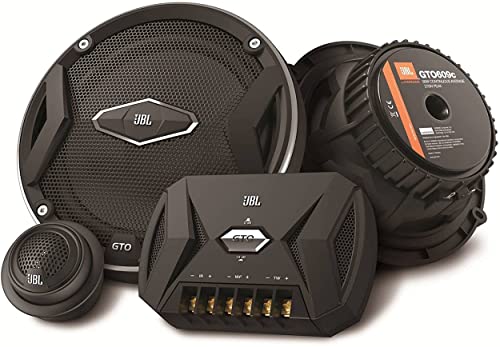
The JBL GTO609C is a premium 6-1/2-inch component speaker system designed to transform your car's audio experience. Featuring patented Plus One woofer-cone technology with carbon-injected cones, these speakers provide larger surface area for moving more air and delivering deeper bass compared to standard sizes.
Ideal for car audio enthusiasts upgrading from factory speakers, they suit daily commuters, road trippers, and anyone craving concert-like sound in their vehicle. The soft-dome tweeters ensure smooth highs, while the low-impedance design makes the most of your existing stereo setup.
In real-world driving, expect punchy lows that handle highways and city streets effortlessly, with adjustable tweeter levels compensating for door placements. The I-Mount system offers installation flexibility, making it a top pick for DIY installers.
Verdict: A high-value upgrade for powerful, clear car audio that elevates every drive.
Bass depth shines with Plus One cones, providing authoritative lows that fill the cabin during fast drives or bass-heavy tracks, outperforming typical 6.5-inch speakers in air movement and impact.
Vocal clarity is exceptional thanks to soft-dome tweeters with oversized voice coils, delivering smooth, detailed highs without fatigue on long trips. Dual volume adjustments let you dial in perfect balance regardless of speaker location.
Volume levels reach high without distortion, supported by 270W handling and 3-ohm impedance that pulls maximum power from car stereos for loud, dynamic performance on open roads.
Rugged carbon-injected cones and robust tweeters withstand car vibrations and temperature swings, built for daily use in American vehicles from sedans to trucks.
The patented I-Mount offers versatile flush or surface mounting, simplifying installs while allowing precise angling for optimal sound staging in tight door panels.
Low-impedance design efficiently uses your car's battery power, delivering full output without straining factory wiring or electrical systems during extended drives.
Pros
- Impressive 45W RMS power for distortion-free volume
- Wide 60Hz-20kHz response captures detailed highs and solid lows
- Component setup allows optimal tweeter placement for better imaging
- High 4.8-star rating signals top-tier quality
- Affordable path to premium car audio performance
Cons
- 60Hz low-end limits deepest bass without a subwoofer
- Requires installation tools and wiring for full setup
- Best with an external amp to unlock maximum potential
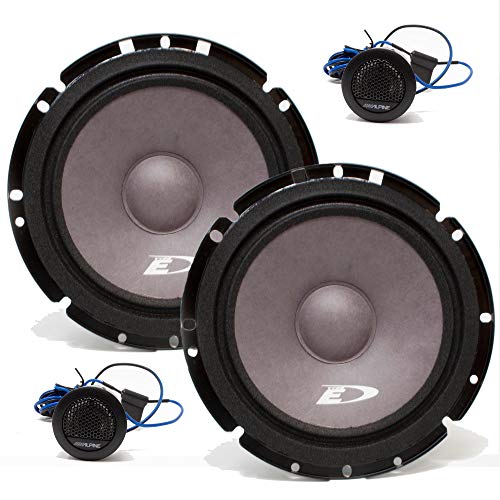
The Alpine SXE-1751S is a 6.5-inch 2-way component speaker system designed for car audio enthusiasts looking to elevate their in-vehicle sound. With 45W RMS and 280W peak power, plus a 60Hz-20kHz frequency response, it replaces lackluster factory speakers with superior clarity and dynamics.
Perfect for daily commuters, weekend road trippers, and entry-level audiophiles, these speakers shine in sedans, trucks, and SUVs. The separate woofers and tweeters allow flexible mounting for optimized sound staging, making your dashboard feel like a stage.
In real-world drives, expect punchy mids for podcasts and vocals, bright highs for rock tracks, and enough low-end punch for highways. Paired with a decent head unit, they handle cruising volumes effortlessly without fatigue.
Verdict: A budget-friendly powerhouse that punches above its weight, delivering pro-level car audio for under $50. Essential upgrade if your stock speakers sound flat.
Bass response kicks in at 60Hz for solid thump on bass-heavy tracks, though it pairs best with a sub for ultimate rumble. Mids are forward and detailed, ensuring vocals cut through traffic noise on commutes.
Highs sparkle up to 20kHz, revealing nuances in guitars and cymbals during spirited drives. 45W RMS power keeps everything clean even at highway speeds, with 280W peaks handling sudden bursts.
Wired component design offers rock-solid connection stability over Bluetooth, with wide dispersion for full cabin fill. Volume scales smoothly for quiet talks or party-level blasts.
Sleek black cones and grilles blend into any dashboard or door panel, with 6.5-inch woofers fitting standard cutouts. Separate tweeters mount flexibly for aimed sound, enhancing stage presence.
Built tough for car vibrations and temperature swings, these speakers endure daily use without rattling. 4-ohm impedance matches most vehicles for plug-and-play power draw.
As a wired car system, no batteries needed; it thrives on your head unit or amp power for unlimited runtime on drives. Lightweight design simplifies DIY installs without added bulk.

Pros
- Superior heat dissipation in oversized tweeter voice coils for reliable highs
- Strong magnetic field ensures efficient power use and loud output
- High-temp adhesive coupling prevents cone separation during intense use
- One-year warranty backs quality for peace of mind
- Versatile adjustments optimize sound for personal listening preferences
Cons
- Requires professional installation for optimal fit and wiring
- Sized specifically for 6.5-inch locations, limiting universal use
- Lacks built-in amplifier, needing external power source
The RECOIL REM65 Echo Series is a 6.5-inch component speaker system designed for car audio upgrades, replacing lackluster factory speakers with pro-level performance. It pairs two woofers and tweeters, handling 200 watts peak power for pairs, making it a smart pick for drivers wanting richer sound without breaking the bank.
Targeted at everyday commuters, weekend road trippers, and entry-level audiophiles, these speakers shine in sedans, trucks, and SUVs. The lightweight polypropylene cones and butyl rubber surrounds deliver responsive mids and impactful bass, while silk dome tweeters ensure smooth highs that stay clear even on highways.
In real-world use, expect enhanced clarity during podcasts, punchier beats in rock tracks, and fatigue-free listening on cross-country drives. The triple-level tweeter adjustment lets you fine-tune for dash placement or personal taste, compensating for imperfect installs.
Verdict: A top budget upgrade that punches above its weight, transforming dull car audio into an immersive experience backed by a one-year warranty.
Bass response hits deep in the mid-bass range thanks to durable butyl surrounds and poly cones, providing thump for hip-hop and rock without muddiness. Midrange is fast and detailed, pulling vocals forward in country tunes or podcasts for natural clarity on the go.
Highs from silk soft-dome tweeters are smooth and extended, avoiding harshness at high volumes. With 100W RMS per pair, it pushes loud without distortion, ideal for open-road cruising or crowded tailgates with windows down.
Triple volume controls on tweeters allow precise balancing, ensuring stable performance regardless of speaker angle. Power handling supports amps up to 200W peak, rewarding upgrades with car-filling energy.
Built rugged for car environments, the thermal-formed cones and high-temp adhesives endure vibrations and power surges. Butyl rubber surrounds add longevity, resisting separation in daily drives or spirited sessions.
Compact ferrite magnets create a potent field while fitting tight spaces in doors or dashes. Tweeter mounts offer flush or surface options with unmatched flexibility for custom installs.
No battery required; draws clean power from your car's system for unlimited runtime. Weighs light for easy handling during swaps, with a one-year warranty ensuring reliability on American roads.

Pros
- Easy integration with Arduino and other microcontrollers
- Clear full-range sound suitable for small-scale audio applications
- Affordable pack of two for experimenting and prototyping
- Standard 4Ohm rating works with common amplifiers
- Compact diameter ideal for tight DIY spaces
Cons
- Limited 3W power restricts use in high-volume scenarios
- Small 2-inch size means modest bass response
- No volume control cable included, requires separate wiring
The Gikfun 2-inch 4Ohm 3W full range audio speakers come as a pack of two, designed specifically for Arduino enthusiasts and DIY hobbyists. These stereo woofers excel in small-scale projects like custom gadgets, robots, or portable audio devices, where space is at a premium.
With a resonance frequency of 190Hz and 77dB sound pressure level, they produce clear, balanced sound without distortion in low-power setups. They are perfect for soldering into home audio-visual equipment, radio replacements, or HiFi experiments, making them a go-to for makers in the US tech scene.
Real-world performance shines in prototyping: pair them with an Arduino for voice alerts or simple music playback. While not for room-filling volume, their reliability and ease of use make them a solid choice for tinkerers.
Verdict: Highly recommended for Arduino DIYers seeking affordable, compact speakers that deliver on specs without fuss.
These full-range speakers offer a neutral sound signature with a 190Hz resonance frequency, providing decent low-end extension for their tiny 2-inch size. Vocals and mids come through clearly, making them suitable for speech synthesis or basic music in Arduino projects.
At 77dB SPL and 3W rated power, volume levels are adequate for personal use, like desktop prototypes or wearable gadgets, but they won't overpower a room. The 4Ohm impedance ensures stable performance when driven by small amplifiers.
No Bluetooth here; these are wired speakers optimized for direct integration, delivering consistent output without wireless dropouts common in portable tech.
The 2-inch diameter design is ultra-compact and lightweight, ideal for embedding in tight spaces like Arduino enclosures or custom PCB projects. Rugged enough for hobby soldering, with 10MΩ insulation resistance for safe handling.
No IP waterproof or dustproof rating, so best kept in controlled environments away from moisture. Their simple, no-frills build prioritizes integration over portability.
As passive speakers, there's no built-in battery; they draw power externally via amplifiers, offering unlimited playback as long as your setup provides juice. Perfect for always-on DIY installations without recharging worries.

Pros
- High-temperature voice coil ensures rich, low-distortion sound at peak volumes
- Multiple mounting options including flush and angle for custom car setups
- Complete kit with grills, wires, hardware, and passive crossovers speeds installation
- Wide 90 Hz to 20 kHz response covers full audio range for immersive listening
- Electroplated basket and heavy-duty build resists daily driving wear
Cons
- Requires basic wiring and installation skills, not ideal for complete novices
- Wired setup lacks wireless convenience of Bluetooth speakers
- Heavy 40 oz magnets add some weight, best for fixed car installs
The Architectural Advantages of Component Speaker Systems
Upgrading an audio system requires understanding how individual drivers interact with vehicle acoustics and listener positioning. Most standard factory setups use coaxial or basic full-range speakers that place every acoustic element into a single physical location. Component systems, by contrast, physically decouple the high-frequency tweeter from the low-frequency woofer and introduce dedicated crossover electronics. This separation provides superior acoustic staging, customizable frequency tuning, and enhanced power handling that single-chassis designs cannot match.
Physical Driver Separation and Soundstage Elevation
High-frequency sound waves are highly directional, meaning listeners perceive their origin with pinpoint accuracy. When a tweeter sits low in a car door panel or footwell, treble frequencies beam directly into passenger floorboards, floor mats, and seat cushions. That downward orientation causes high notes, cymbal crashes, and vocal sibilance to lose their natural sparkle before reaching the listener’s ears. Component systems eliminate this restriction by allowing the installer to mount tweeters higher on the dashboard, A-pillars, or sail panels.
Positioning tweeters near eye or ear level creates a wide, elevated soundstage that mimics the experience of a live musical performance. The lower midrange notes and mid-bass frequencies remain down in the door or kick panel where woofer cones have ample enclosure volume to breathe. Systems such as the JBL GTO609C feature a patented I-Mount system that gives installers the freedom to choose between surface mounting and flush mounting. Similarly, the Pyle PLG6C component system provides three mounting options including flush, surface, or angled hardware to direct high frequencies precisely toward listener seating positions.
This positional flexibility also solves phase cancellation issues that frequently plague coaxial speakers. In a coaxial speaker, high-frequency sound waves radiating from the central tweeter reflect off the surrounding woofer cone, producing uneven frequency peaks and dips. By physically separating the drivers, component setups prevent acoustic reflections between the tweeter housing and the woofer cone. The resulting stereo imaging allows listeners to distinguish individual instruments and vocalists across the dashboard rather than hearing a jumbled, mono-like audio cluster.
Dedicated External Passive Crossovers and Frequency Precision
The crossover network serves as the acoustic brain of any multi-driver speaker system. In basic coaxial speakers, manufacturers usually cut costs by using a tiny inline capacitor soldered directly to the tweeter post. That simple high-pass filter exhibits a shallow slope, which allows excessive lower frequencies to bleed into the delicate voice coil of the tweeter. External passive crossovers included with component systems use dedicated inductors, capacitors, and resistors built onto a separate circuit board.
Dedicated passive networks create steeper filter slopes that strictly direct low frequencies to the woofer and high frequencies to the tweeter. This precise division prevents the woofer from wasting thermal energy trying to produce treble it cannot accurately render. Simultaneously, keeping low-frequency excursion away from the tweeter protects its light voice coil from mechanical distortion and thermal burnout. When exploring complex speaker configurations across multi-room or multi-zone audio, routing signals properly through dedicated hardware such as speaker selector systems provides similar distribution discipline across different audio paths.
Advanced component packages also integrate attenuation adjustments directly into the external crossover enclosure. The JBL GTO609C system provides a dual-level tweeter volume adjustment, allowing owners to attenuate treble output based on personal taste or reflective vehicle surfaces. The RECOIL REM65 Echo Series offers a triple-level adjustment switch to tame brightness when tweeters are mounted close to hard windshield glass. These selectable attenuation pads compensate for harsh reflective cabin acoustics without requiring digital equalization that can degrade audio clarity.
Cone Materials, Voice Coils, and Mid-Bass Dynamics
Component woofers are engineered specifically to handle lower midrange and mid-bass reproduction without the mechanical compromises imposed by coaxial posts. Coaxial drivers must accommodate a central mounting pole through the middle of the cone, which removes valuable radiating cone area and risks dirt entry into the gap. Component woofers feature a solid, unbroken cone surface that moves air more efficiently and provides structural rigidity under heavy dynamic passages. Cone integrity directly dictates how accurately a speaker reproduces bass transients like kick drums and bass guitars.
Manufacturers utilize advanced cone geometries and lightweight composites to improve bass output and speed. JBL implements patented carbon-injected Plus One woofer cones that provide a larger surface area than conventional cones in the 6.5-inch category. The RECOIL REM65 utilizes lightweight thermal-formed polypropylene cones that enable fast midrange response while resisting heat and humidity inside door cavities. Pyle equips its 6.5-inch mid-bass woofer with an eye-catching yellow poly injection cone paired with a heavy 40-ounce magnet structure to maintain steady cone control during high-output playback.
Driver longevity depends heavily on the surround material that joins the moving cone to the rigid speaker basket. High-performance component woofers employ non-fatiguing butyl rubber surrounds rather than inexpensive foam or treated paper edges. RECOIL pairs its butyl rubber surround with high-temperature cone adhesive designed to prevent separation under continuous excursion and heat buildup. Pyle similarly incorporates durable butyl rubber surrounds on its woofers to ensure prolonged mechanical compliance and dependable mid-bass impact over years of operation.
Thermal Management and Continuous Power Handling
Power handling represents an essential specification when building an aftermarket sound system with outboard amplification. Unlike factory speakers that rely on minuscule magnet assemblies and fragile wire, component woofers and tweeters are built to absorb higher electrical loads. Oversized voice coils play a critical role in dissipating heat generated by alternating electrical current. When a voice coil overheats, electrical resistance rises, causing dynamic compression and eventual winding failure.
Both the JBL GTO609C and RECOIL REM65 incorporate silk soft-dome tweeters with oversized voice coils engineered for heat dissipation and smooth, fatigue-free treble. Pyle utilizes a high-temperature ASV voice coil in its 6.5-inch component woofer to maintain linear cone travel while reducing distortion at elevated listening volumes. By pairing these robust thermal components with dedicated crossover filtering, component systems handle sustained power without the harsh clipping and break-up distortion common in budget drivers.
Evaluating continuous power ratings versus peak figures helps buyers match their source unit or amplifier safely. The Alpine SXE-1751S component system is rated for 45 watts RMS with a peak capacity of 280 watts, making it efficient enough for direct head-unit power while accommodating modest outboard amplification. The RECOIL REM65 specifies 100 watts RMS per pair and 200 watts peak, offering greater thermal headroom for external four-channel amplifiers. Pyle lists a peak power handling of 400 watts for its two-way package, though operating closer to clean RMS levels ensures greater longevity and musical accuracy.
Electrical Impedance and Wiring Architecture
Nominal impedance defines the electrical resistance a speaker presents to an amplifier, but this value fluctuates across the audible frequency range. Most car audio speakers operate at a nominal 4-ohm load, as seen in the Alpine SXE-1751S, RECOIL REM65, and Pyle PLG6C systems. Matching 4-ohm component speakers to head units or multi-channel amplifiers guarantees stable operation without overheating the output transistors. This stability mirrors the precise driver and crossover impedance matching found in home audio, including multi-driver floorstanding speaker setups that balance multiple woofers and tweeters across a single cabinet.
Some component designs approach impedance uniquely to extract additional current from factory speaker wiring. The JBL GTO609C employs low-impedance 3-ohm voice coils designed specifically to compensate for the resistance of thin, undersized factory car wiring. When paired with thin vehicle harness wire, the combined impedance reaches a safe 4-ohm load at the amplifier terminals. This lower voice-coil impedance allows the head unit or amplifier to deliver more of its available power output to the speaker cone, yielding greater dynamic range without demanding aftermarket wire runs.
In contrast to multi-driver systems, miniature drivers like the Gikfun 2-inch full-range speaker operate with a 4-ohm nominal impedance but a limited 3-watt continuous rating. While suitable for DIY hobby soldering and small Arduino audio projects, small full-range drivers lack the magnetic force and voice-coil scale required for automotive or high-fidelity listening. Full-range micro-speakers reproduce a narrow band from their listed 190 Hz resonance frequency up to treble limits, but they cannot deliver the dynamic SPL or low distortion of true 2-way component configurations. Recognizing these electrical boundaries prevents buyers from misapplying low-power hobby components to demanding acoustic roles.
Installation Realities and Mounting Requirements
Installing component speakers requires more preparation, physical space, and labor than swapping drop-in coaxial drivers. Because the woofer, tweeter, and crossover are separate parts, installers must plan wire routing and component placement carefully. The mid-bass woofer generally replaces the existing factory speaker in the door frame or rear shelf, utilizing standard 6.5-inch mounting holes. Pyle specifies a mounting depth of 2.65 inches for its PLG6C woofer, which fits many standard OEM door locations but may require spacer rings in shallow door cavities.
Mounting the external crossover demands a clean, dry location protected from moisture that frequently drips down inside vehicle door skins. Placing the crossover inside the vehicle cabin or on the dry side of the door vapor barrier prevents water damage and corrosion over time. Wiring runs must travel from the amplifier or head unit into the crossover input, with discrete pairs exiting to the woofer and tweeter. Included wiring kits and mounting hardware, like those provided in the Pyle PLG6C package, simplify making secure crimp or solder connections to the terminals.
Tweeter installation offers several creative pathways depending on the interior vehicle layout. Surface mounting preserves factory trim by attaching the tweeter pod directly to a door panel or sail panel with small screws. Flush mounting requires cutting a clean circular hole using a hole saw, recessing the tweeter flush with the surrounding plastic for an OEM appearance. JBL’s I-Mount hardware and Pyle’s angled housings allow fine adjustments to driver aiming, letting installers direct high-frequency energy toward ear level to overcome acoustic obstructions.
Architectural Comparison: Component vs Coaxial vs Full-Range
Choosing between component speakers, coaxial drivers, and full-range loudspeakers hinges on sonic priorities, budget constraints, and installation tolerance. Full-range speakers rely on a single cone to reproduce bass, midrange, and treble simultaneously, as demonstrated by basic hobby drivers like the Gikfun EK1725. Because a single diaphragm must move slowly for bass while vibrating rapidly for treble, intermodulation distortion rises rapidly as volume increases. Full-range designs work fine for basic voice announcements, radio replacement, and electronics hobby experiments, but they falter under complex musical passages.
Coaxial speakers combine a woofer and tweeter onto one shared frame, offering a convenient drop-in replacement that fits behind factory grilles in minutes. While coaxial speakers provide a noticeable step up over factory paper cones, their fixed tweeter position keeps high frequencies trapped low in footwells. Furthermore, simple inline capacitors cannot offer the sharp crossover slopes or tweeter attenuation switches found on external component boxes. Listeners who want a quick, budget-conscious replacement often choose coaxial models, but those seeking audiophile staging invariably turn to component packages.
Component speaker systems demand more effort to install, but their acoustic benefits justify the extra work for anyone who values clarity and depth. With dedicated woofers reproducing punchy mid-bass and independent tweeters projecting transparent vocals from the dashboard, the listening experience becomes immersive and open. Fine-tuning features like the dual-level attenuation on the JBL GTO609C and triple-level adjustments on the RECOIL REM65 allow acoustic matching to any vehicle cabin. When properly matched with clean amplification, component speakers deliver dynamic realism that single-point alternatives cannot match.
Upgrading to component speakers transforms dull in-car audio into a detailed, three-dimensional listening environment. The combination of elevated tweeter placement, dedicated crossover networks, and specialized cone materials directly resolves the shortcomings of factory and coaxial speakers. Before purchasing, verify your vehicle’s door mounting depth, check tweeter clearance, and decide whether your current head unit or an aftermarket amplifier will drive the system. Taking the time to properly mount and calibrate a quality component package ensures every drive is accompanied by crisp highs, rich vocals, and impactful mid-bass.


Write Your Review
No reviews yet. Be the first to share your experience!